| Author |
 Replies: 39 / Views: 10,564 Replies: 39 / Views: 10,564 |
Page 3 of 3
|
|
|
|
Pillar of the Community
Canada
1267 Posts |
Quote:
The toning you see is the product of what, in most cases, is called "corrosion." In numismatics, when it has a pleasing appearance, it is called "toning" instead of "corrosion" and fans pay exorbitant prices for it. This statement is not entirely true. Lets start with the definition of corrosion. corrosion Damage that results when reactive chemicals act upon metal. When toning ceases to be a "protective" coating and instead begins to damage a coin, corrosion is the cause. Usually confined to copper, nickel and silver regular issues, although patterns in aluminum, white metal, tin, etc., also are subject to this harmful process. Toning therefore is not corrosion, although over time it will lead to corrosion. That timeframe could be decades or centuries. Now let's consider what toning actually is. The toning that we visualize comes from light refracting through the silver oxide layer that forms on all silver coins. Not all coins exhibit this visual effect, yet that silver oxide layer is there. It's what gives us that thick skinned appearance that many collectors value as a sign of originality. Anybody think that these thick skinned pieces will not eventually succumb to corrosion over time? From the moment a coin is struck, and this applies to every single silver coin struck, the natural process of oxidation begins.....eventually leading to corrosion. Some believe that by dipping a coin and making it all shiny and white again (by removing that silver oxide layer) they are restoring the piece back to how it came from the mint. What they are really doing is stripping a small layer off the surface ( where do you suppose the silver in the silver oxide layer comes from). This exposes a new surface to the environment, and the process begins again (only faster now). Dip and strip. Not long before the luster becomes subdued, and the coin appears dull and lifeless. The bottom line, all silver coins unless kept in a vacuum will eventually succumb to corrosion. Edited by hadleydog
09/05/2018 02:06 am
|
|
Bedrock of the Community
United States
20753 Posts |
All of the previous explanations are why I dislike anything on a coin. I just want them the way they were made.
|
|
Pillar of the Community
5464 Posts |
Quote:
All of the previous explanations are why I dislike anything on a coin. I just want them the way they were made. A totally unacceptable answer! Much it logical for this discussion!  |
|
Pillar of the Community
United States
1901 Posts |
|
|
Moderator
 United States
196560 Posts |
Quote:
Lets start with the definition of corrosion.
corrosion
Damage that results when reactive chemicals act upon metal. And what causes toning? Reactive chemicals acting upon a metal. |
|
Pillar of the Community
United States
2963 Posts |
Quote:
All of the previous explanations are why I dislike anything on a coin. I just want them the way they were made.  To me, arguing over toned coins is an exercise in futility. You'll never find agreement. Very often, one man's trash is another's treasure. Whereas, with untoned coins, it's very black and white (most of the time) in terms of grade and desirability. Discussing toned coins is a lot like men discussing women. One man might find a certain girl extremely attractive, another will not. One guy will prefer the apple shaped woman, another will prefer the pear shaped one. It's all subjective to the particular tastes of the individual. CRH Nickeloholic. 1,600,000 nickels searched in eight years! Have found FOUR complete Jefferson sets!
|
|
Valued Member
United States
441 Posts |
Untoned, red cents? Just the way they were made.
Here's the thing: if anybody here own anything made of copper, brass, or bronze that is not a coin, especially if it is antique, then let me ask you: Is it the same color as the day it was made?
I do not mean to say that a 100-year-old "red" cent cannot stay red; what I do mean to say is that very few that are red are original. Expert dippers are out there, and they have fooled some experts. I would not want a dipped copper in my collection anymore than any damaged coin.
|
|
Rest in Peace
10197 Posts |
Hadleydog has my sentiments from page one much more effectively stated than me. Quote:
From the moment a coin is struck, and this applies to every single silver coin struck, the natural process of oxidation begins.....eventually leading to corrosion.
Some believe that by dipping a coin and making it all shiny and white again (by removing that silver oxide layer) they are restoring the piece back to how it came from the mint.
What they are really doing is stripping a small layer off the surface ( where do you suppose the silver in the silver oxide layer comes from). This exposes a new surface to the environment, and the process begins again (only faster now). Dip and strip. Not long before the luster becomes subdued, and the coin appears dull and lifeless.
The bottom line, all silver coins unless kept in a vacuum will eventually succumb to corrosion. I am a "non-believer" when it comes to toned coins. I personally have seen only one truly rainbow toned example of an ASE, and that was one I bought at a local auction, sold off to Thedollarman in Canada. It was in a snapcase display, where apparently the ink and cardboard insert reacted very well over a few short years. Climate may have been humid Missouri weather, stored in a desk drawer. I can vouch it was a "natural" but I had to restrain everything in me to refrain from some tarnish remover! I have witnessed these "ink-toned" silver coins, mostly having a more encrusted look and turning blacker rapidly. Seems to speed up the process. So, for the OP's benefit, here is a naturally toned 1998 ASE, purchased in 2017, not quite 20 years in the making with all "natural" influences. Here was the result: 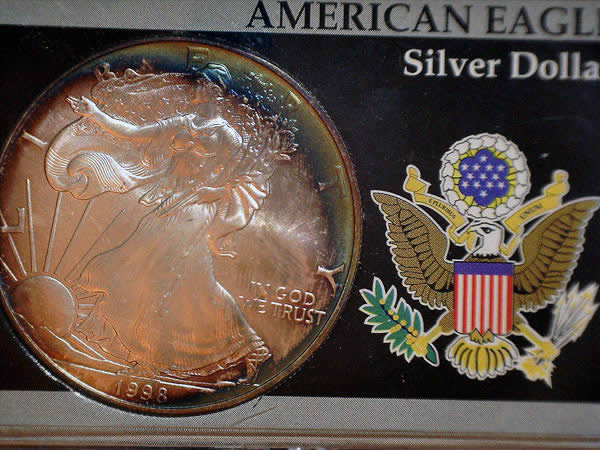 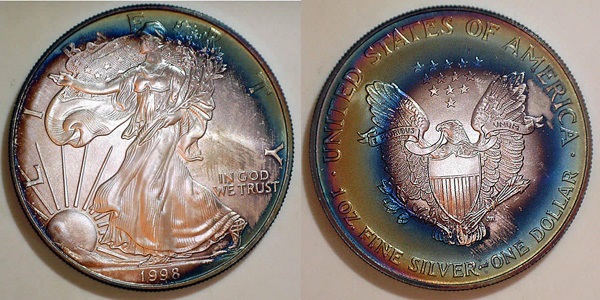 |
|
Bedrock of the Community
United States
12477 Posts |
Quote:
This exposes a new surface to the environment, and the process begins again (only faster now). Why is the process accelerated? In Memory of Crazyb0 12-26-1951 to 7-27-2020
In Memory of Tootallious 3-31-1964 to 4-15-2020
In Memory of T-BOP 10-12-1949 to 1-19-2024
|
|
Pillar of the Community
United States
3479 Posts |
Probably the most educational debate I have ever read on CCF! Kudos to hadlydog for your extensive contribution to this post! I have nothing to add that hasn't already been covered.   |
|
Moderator
United States
196560 Posts |
Quote:
Here's the thing: if anybody here own anything made of copper, brass, or bronze that is not a coin, especially if it is antique, then let me ask you: Is it the same color as the day it was made? Nope. Not even close.  |
|
Valued Member
 United States
84 Posts |
Quote:
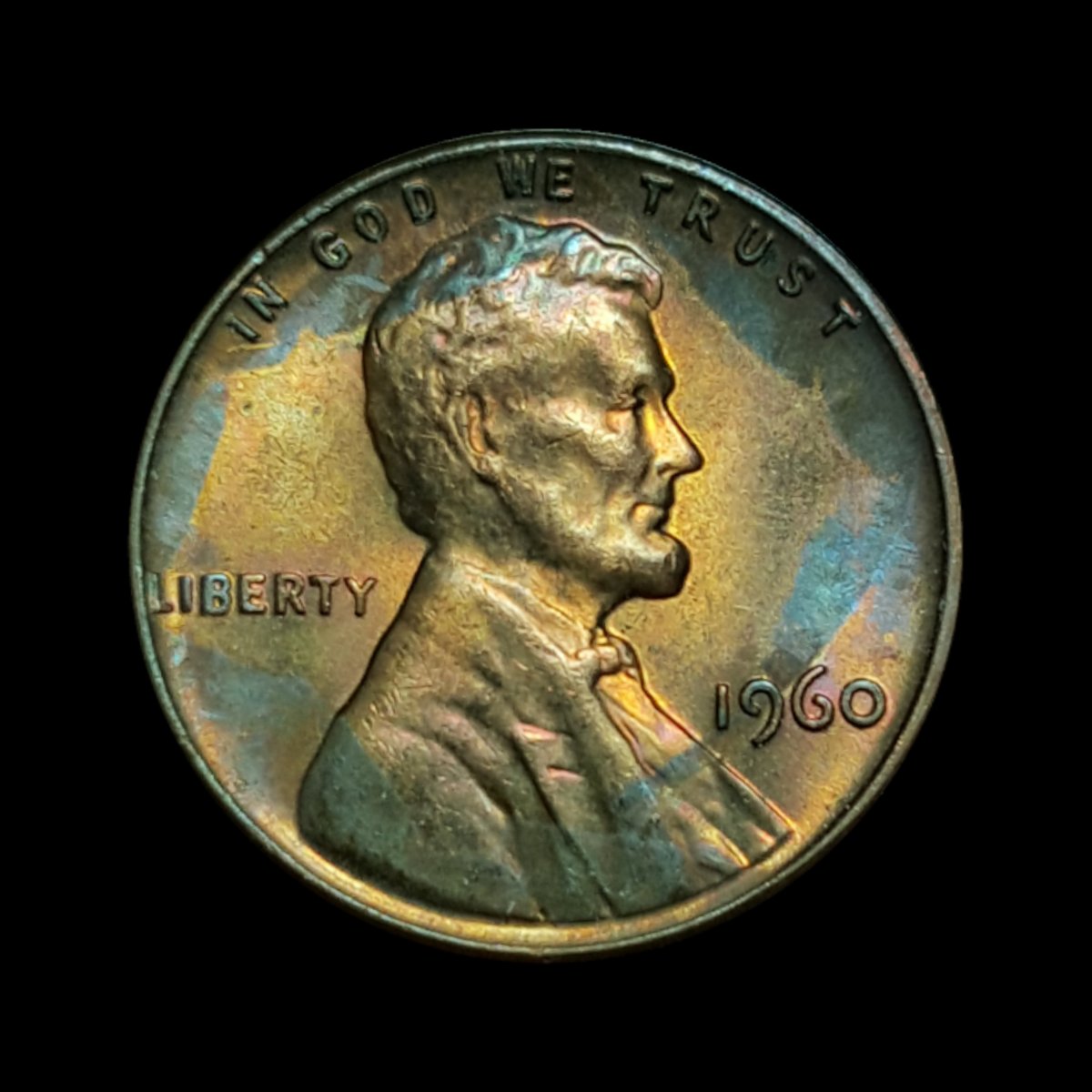
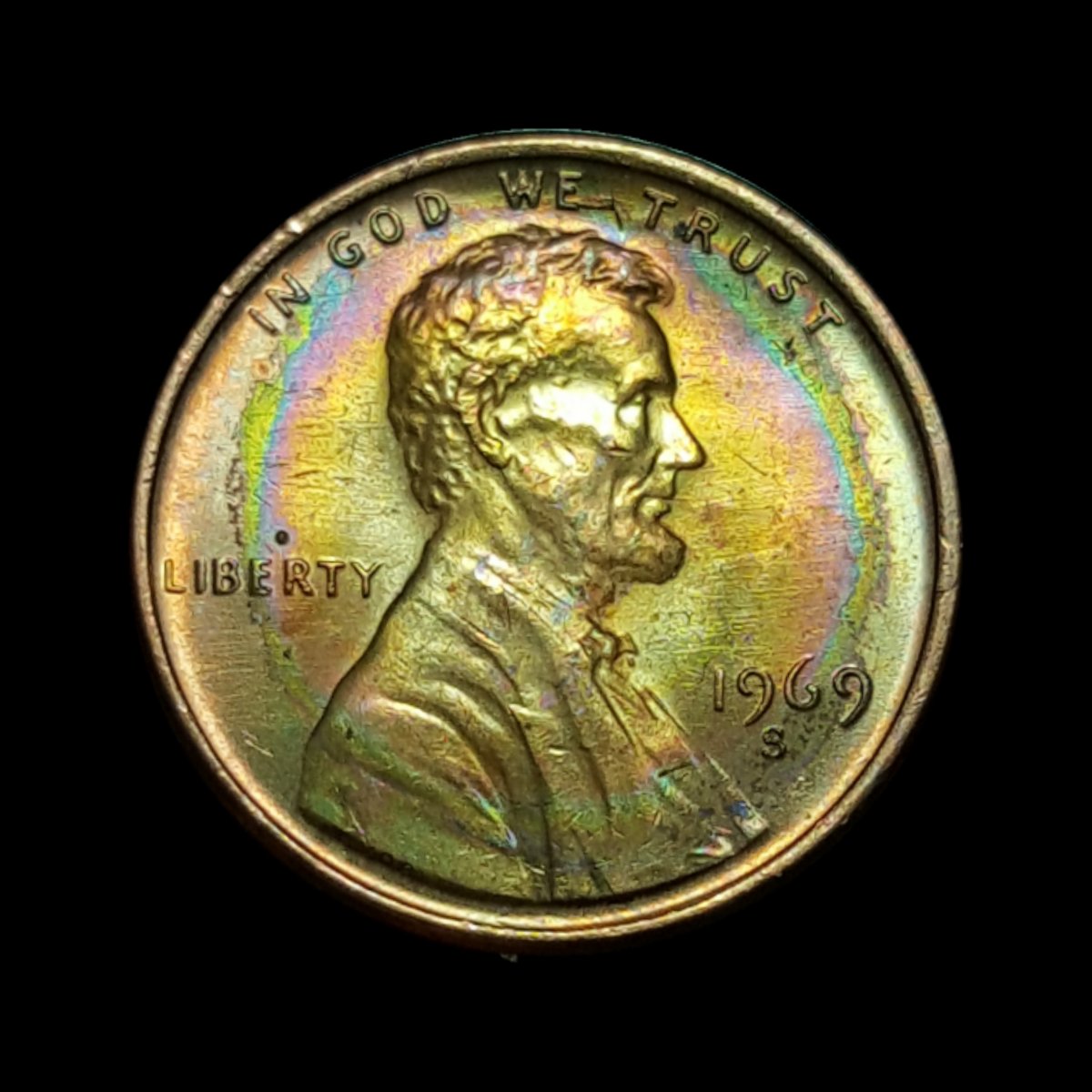
Probably the most educational debate I have ever read on CCF! I completely agree! Toned coins are just a preference of mine. In fact, for the annual ANA YN online auction, I am going to try and get an "Easter egg" toned wartime nickel. The starting bid is $40, but use YN auction dollars, not real money. They also have a toned Wheat penny, but it doesn't look very toned. 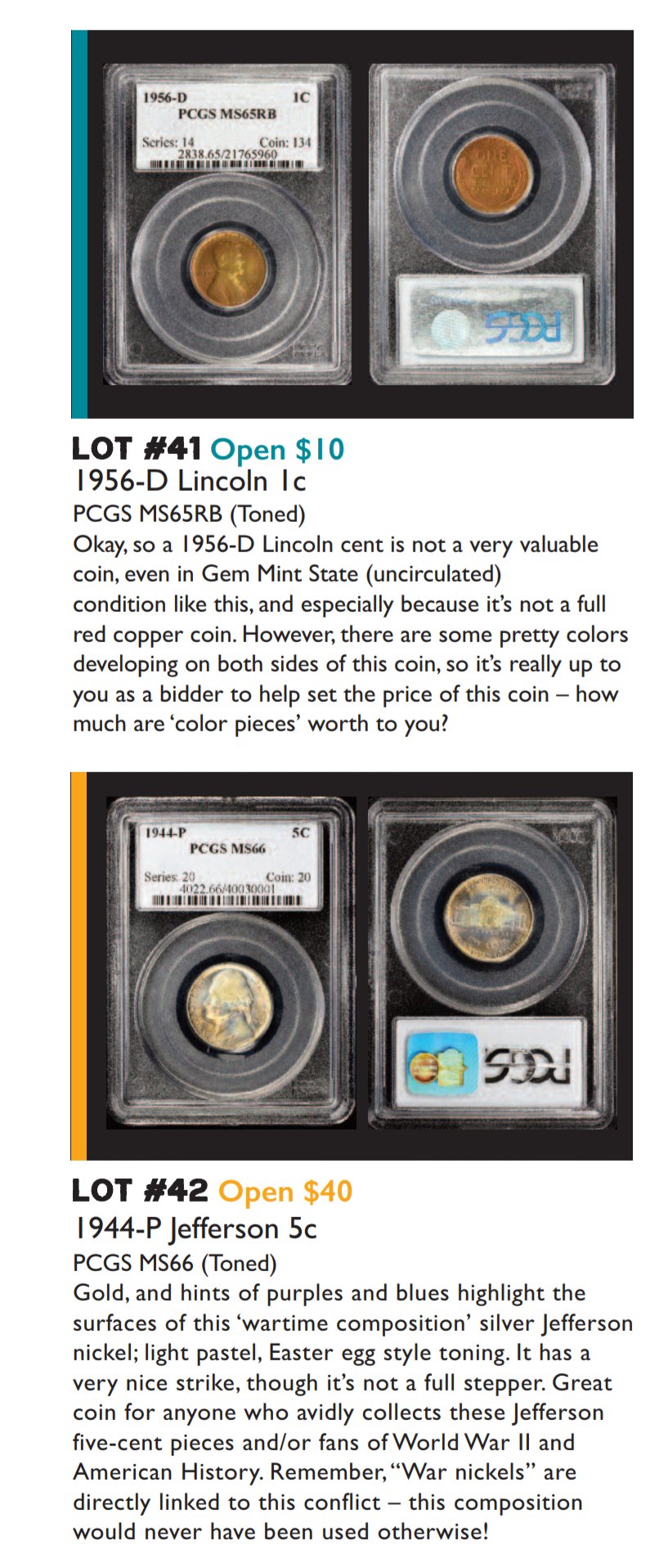 Also, at the 2018 National Money Show, I was finally able to get a proof Wheat penny (1957). And it is has a deep uniform red on the obverse, but it is fairly normal on the reverse. |
|
Valued Member
United States
84 Posts |
I won the toned penny at the annual online YN auction! I won it for 160 YN dollars. I really glad, because this was my first and last year to participate, as I will be 18 next year. It was also one of my top 5 coins I wanted. I sadly didn't win any other coins.
|
|
Valued Member
United States
441 Posts |
Quote:
I won the toned penny at the annual online YN auction! I won it for 160 YN dollars. I really glad, because this was my first and last year to participate, as I will be 18 next year. It was also one of my top 5 coins I wanted. I sadly didn't win any other coins. Congratulations, PennyPride! I bet you'll still have that one three decades from now, too. |
|
Pillar of the Community
United States
1261 Posts |
Collect what you like whether it be white coins vs. toned vs. mint state vs. circulated etc. My complaint is with folks who want to doctor or change the present appearance of coins, especially, those who prefer their coins 'white' and take an otherwise original toned coin and dip it. That isn't right in my opinion. Focus on finding coins that are already white.
It sounds like the OP wants to accelerate the toning process on junk silver. I guess that's ok as long as it doesn't lead to something different in the future.
|
|
Page 3 of 3
|
Replies: 39 / Views: 10,564 |
Page 3 of 3
|





 First Page
 Previous Page

 Posted 09/05/2018 08:44 am