Before coins, there was magic. Or rather, before I started collecting round silver things, I had an interest in folklore, folk magic and particularly lucky charms, amulets and talismans. I have a small collection of religious medallions, apotropaic charms and lucky 'objects'. I am intrigued by the significance these objects, some valuable, some mundane, held for the owners.
It will therefore be of little surprise that I was intrigued when I heard of touch-pieces. What is a touch-piece? Well, if you'll forgive the preamble, it's related to scrofula, a tubercular disease common in the late middle ages and 17th - 18th century. Rarely fatal, but disfiguring and although it could last many years it was also known to occasionally spontaneously heal.
The church was a pervasive force in peoples lives at the time. And with medicine being quite unsophisticated, it's not surprising that people turned to saints to remedy their troubles and ills. Including Royalty. Kings and Queens were quick to claim 'divine right' to justify their rule and claimed they had been chosen by God. So it's perhaps unsurprising that people turned to them for assistance. Early on, this was presumably primarily the gift of alms. However it was not long before people would present themselves or their relatives to the monarch in hope of alleviation of physical ills.
By the 17th century it was a well established practice for the king, during holy day festivals or whilst undergoing Royal 'progresses' about the land, to lay hands upon those suffering from what had become known as the 'king's evil' and present them with alms to support them.
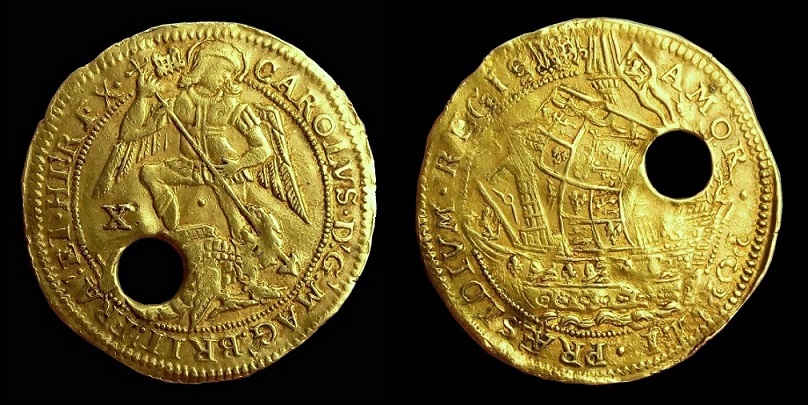
In the case of the king's evil, the choice of alms were obvious. From the days of Edward IV, England has issued a small gold coin called an Angel. On the one side is represented earthly power or the monarchy, in the form of the Ship of State. On the other, heavenly power, by a representation of the Archangel Michael, vanquishing Satan in the form of a dragon.
Not only a reminder of the link between the king and God's authority, but with St Michael considered as a healer and the value of an Angel at 6s 8d a standard doctor's fee, it would be hard to find a more suitable gift for a healing ceremony. The coins were officially pierced and threaded onto a white silk ribbon, then hung around the neck of the recipient by the monarch.
It should perhaps be stated that, officially, touch-pieces are later productions, specifically made to be handed out at touching ceremonies from the reign of Charles II onwards. During Charles I's reign the Angel still circulated as coin, albeit in very small numbers. By this time the majority were made for the Royal Touch and, due to none being struck under Parliament once the King had fled London, it can be assumed that any pierced examples were almost certainly touched by the king himself.
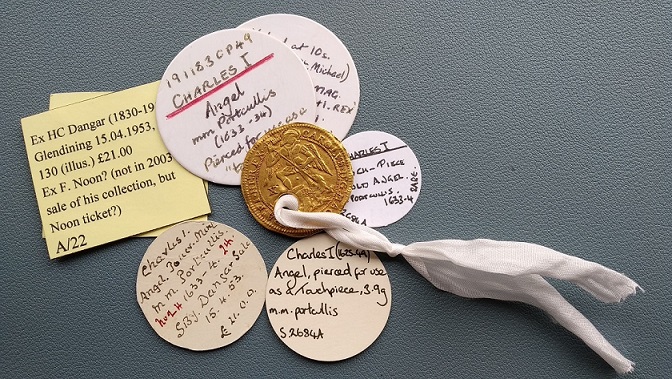
I was therefore very pleased to finally acquire the below. A gold Angel of Charles I. Tower (of London) mint, Spink 2684A, Portcullis privy mark (11 Jul 1633-27 Jun 1634). To the reverse, the (rather ironic) legend
Amor Populi Praesidium Regis (The love of the people is the protection of the king). Official piercing through the dragon's tail. Ex C F Noon collection.





 First Page
 Previous Page


 to the Community, CocktailGod!


 Posted 11/14/2023 08:47 am