| Author |
 Replies: 35 / Views: 4,637 Replies: 35 / Views: 4,637 |
Page 3 of 3
|
|
|
|
Pillar of the Community
 United States
5910 Posts |
I like it as well.
On the new coin, is that a whisper of an R inside the anomaly where the R of LIBERTY would be?
If so, the anomaly must have been there at the time it was struck by the dies.
Words of encouragement are one of the major food groups.
We need to consume them regularly to thrive and grow.
|
|
Bedrock of the Community
United States
10635 Posts |
Looks like a splash of solder to me, but what do I know?  |
|
Pillar of the Community
 United States
9045 Posts |
Very cool to have found another, same year/mint. This is definitely one of the bright spots, of online forums, where you may have not ran across another, otherwise.
-makecents-
|
|
Pillar of the Community
United States
2752 Posts |
It doesn't look like metal to me, even oxidized zinc. Since it is aligned with the "grain" of the coin, it's either a non-metallic intrinsic inclusion or, more likely, some kind of contaminant that was rolled into the strip. It's easiest to diagnose an intrinsic inclusion if the normal metal closes over it to some degree, or if the inclusion dives beneath the normal surface. This material appears to be fully exposed on the surface.
Error coin writer and researcher.
|
|
Pillar of the Community
 United States
2376 Posts |
Mr. Diamond At the rim of my example, the coin metal does appear to close over the foriegn material. 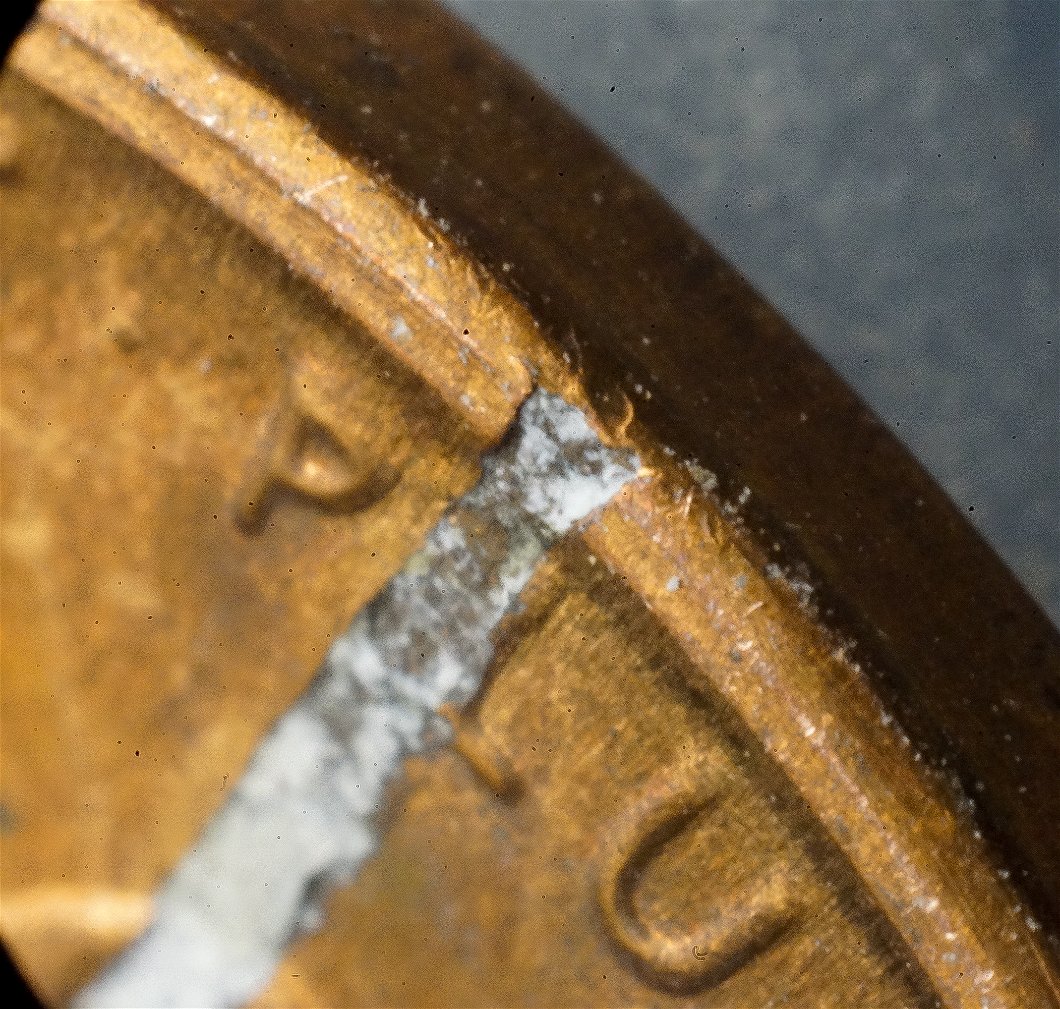 |
|
Pillar of the Community
United States
2376 Posts |
In addition Mr Diamond. Look at the rim over the word GOD on the example that I spotted on Facebook . It appears that the anomaly has extended under the normal surface and appears again at the rim. 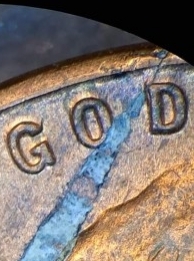 |
|
Pillar of the Community
United States
2752 Posts |
That does appear to be the case. Then this would appear to be an intrinsic inclusion. Identifying the material would require an SEM/X-ray analysis.
Error coin writer and researcher.
|
|
Pillar of the Community
United States
2376 Posts |
Many thanks sir for taking a look!
|
|
Pillar of the Community
United States
2831 Posts |
Way to persevere and nail down an interesting mint error stoneman227!
|
|
Pillar of the Community
United States
2376 Posts |
|
|
Pillar of the Community
United States
1784 Posts |
Mike Diamond sorry for the two-year delayed response. For the last week or so I have been researching Woodies and different descriptions people have been giving these pieces as to their root cause such as metal inclusion error, improper mix alloy, lamination peeling and other descriptions for what I thought would be my first paper in 2025 using my new triple tier SEM/EDS on a U.S. Federal Error - the Woodies. When Shaun Tew did his work with SEM/EDS at Michigan State University with SEM/EDS with the early Woodies of ~1909-1920 Lincoln's based on my recommendation and what was causing the surface streaking on these pieces his result although I did not review his paper was that tin was the culprit and found at higher levels on the surface. The destannification process or the movement of tin to the surface during situations say of improper annealing (i.e., too much heat) or of a corrosive nature (i.e., using acid media to clean U.S. Mint striking equipment as he discovered) did not make sense to me. The reason why is zinc is more oxidative that tin so we would expect more zinc than tin on the surface. So what has happened this last week? Well, these processes of dezincification and destannification has been occurring in Indian cents all the way until they changed the composition of the Lincoln Cent away from 95% Cu and 5% of Zn & Sn. Shaun Tew's acid media in U.S. Mint equipment probably resulting in much more Woodies early in the Lincoln production process until this detrimental process was changed sometime before 1920? SO WHAT CHANGED and why am I writing this post. It seems tin was added in this alloy mix to RETARD the more oxidative zinc from corroding in the alloy or to retard dezincification. Also I found one reference that the content in these Lincolns show that IN GENERAL Sn ~4% and Zn is 1% in the alloy mix. This would explain Shaun Tew's SEM/EDS results with tin was the predominant metal at the surface since it was due to its higher percentage in the alloy mix. So at this point from my perspective this has answered all my questions and there is no need to continue Shaun Tew's great discovery any further with more SEM/EDS analysis in 2025 on this error phenomenon IMO. Mexican copper coins BTW in the early 20thC are notoriously found in corrosive conditions because they were made with just 100% Cu and had no oxidative deterrent metals such as Zn & Sn to slow down the oxidative effects on these 100% Cu alloy pieces. So what about this coin? The composition of a Lincoln Cent depends on the year it was minted: 1909-1942, 1944-1982: 95% copper, 5% zinc or tin. So either excessive heat and/or some form of environmental corrosion has forced the tin (destannification) and zinc (dezincification) to the surface causing a laminate surface peel. The peel broke away leaving this exposed underlying area. Indeed both zinc oxide and tin oxide are WHITE POWDERS. As with Shawn Tew's MSU SEM/EDS results we should? expect more tin oxide than zinc oxide in this cavity if analyzed by XRF or SEM/EDS. So what do we call this error = A destannification/dezincification process causing surface lamination effects. Its not really an improper alloy mix since with normal environmental conditions these Cents of 95% Cu and Sn/Zn do fine. There is no outside metal inclusions in play here or improper alloy mixing our outside metal/foreign matter contaminants during the minting process . Like the Mn in the Jefferson War Nickels. Its long term effects on the Jefferson WWII alloy were not very good causing this short term series to register the largest lamination errors than any other 20thC U.S. Federal coin. John Lorenzo - Numismatist Edited by colonialjohn
11/24/2024 08:42 am
|
|
Bedrock of the Community
United States
80160 Posts |
Great find!   Errers and Varietys.
|
|
Pillar of the Community
United States
986 Posts |
I really enjoy seeing these old chestnuts of knowledge and examples come back to life.
Great explanation for the Sn and Zn oxidation on 95% Cu coins. Especially, as it applies the two 1944 D's in this example.
"We are all flawed, some MD and some PMD." NYI |
|
Pillar of the Community
United States
5910 Posts |
Wow! What a great thread of sharing of information.
Words of encouragement are one of the major food groups.
We need to consume them regularly to thrive and grow.
|
|
Bedrock of the Community
United States
19670 Posts |
Outstanding forensic work!
|
|
Page 3 of 3
|
Replies: 35 / Views: 4,637 |
Page 3 of 3
|




 First Page
 Previous Page


 Posted 01/07/2023 12:33 am





