| Author |
 Replies: 26 / Views: 1,722 Replies: 26 / Views: 1,722 |
Page 2 of 2
|
|
|
|
Bedrock of the Community
 United States
10601 Posts |
Shield nickels just scream "Classis Coin" with that design. I really like them but the prices are pretty high for alot of people (YNs) just getting into the hobby .
|
|
Moderator
Australia
16975 Posts |
A factor to consider in terms of "popularity" is collector sentiment. Buffalo nickels and even Liberty nickels are "popular" because lots of old-timer collectors alive today remember getting them in change as young'uns, an obsolete coin which may even have sparked their collecting desire. The Shield nickels, not so much as they were pretty much already gone from circulation by the 1960s (especially if they tended not to work in vending machines due to their different specifications). Thus, the two more-modern-yet-still-obsolete designs have a broader base of collectors interested in them. Don't say "infinitely" when you mean "very"; otherwise, you'll have no word left when you want to talk about something really infinite. - C. S. Lewis
|
|
Pillar of the Community
United States
6880 Posts |
Untestable prediction: in 250 years—or however long it takes to make nickels obselete—people will still hold Buffalo nickels in higher regard than any other five cent American coin. No kid has ever exclaimed with delight, "Oooo boy! That's a Thomas Jefferson's house nickel!" |
|
Pillar of the Community
United States
3724 Posts |
Quote:A factor to consider in terms of "popularity" is collector sentiment. Buffalo nickels and even Liberty nickels are "popular" because lots of old-timer collectors alive today remember getting them in change as young'uns, an obsolete coin which may even have sparked their collecting desire. This. I very well remember getting them in change, and that's exactly what started my collections. Many people collect Shield nickels as type coins, but for all the reasons already noted don't tackle the complete sets. When the silver Three Cent and Half Dime were replaced with the cupro-nickel coinage, the Philadelphia mint had a huge learning curve. The metal is hard, the coining presses were old, and the required striking pressure destroyed dies. For the Shield nickel, another issue was the cluttered design. The result was a lot of cracked dies, poorly struck coins, and frustration. For Philadelphia, however, it was a learning experience. The Liberty nickel was a much lower relief design, easier to strike, and wore much more evenly in circulation. Philadelphia also made all of the dies, and could replace dies easily. Philadelphia also had the lion's share of funding as the main mint, and upgraded its equipment. Fast forward to 1912. Denver and San Francisco were tasked for the first time with striking cupro-nickel coinage with the Liberty nickel. The relative ease of striking that design was deceptive. The following year, the change to the much higher relief and much more cluttered and poorly-wearing Buffalo nickel overwhelmed the branch mints. They hated the design and experienced all the problems Philadelphia had worked through almost a half century earlier with the Shield nickel, but without the benefit of enough working dies, good striking presses, or adequate funding for upgrades. That's a key reason why the Philadelphia Buffalo nickels are much better struck than the Denver and San Francisco Buffalos. That, in turn, led to the less cluttered and slightly lower relief and much better-wearing Jefferson nickel designs. So treat the Shield nickel as Philadelphia's high school metal shop learning curve project that paved the way for the designs that followed. |
|
Moderator
United States
195024 Posts |
Quote:
No kid has ever exclaimed with delight, "Oooo boy! That's a Thomas Jefferson's house nickel!"  |
|
Moderator
United States
195024 Posts |
Quote:When the silver Three Cent and Half Dime were replaced with the cupro-nickel coinage, the Philadelphia mint had a huge learning curve... Fast forward to 1912. Denver and San Francisco were tasked for the first time with striking cupro-nickel coinage with the Liberty nickel... So treat the Shield nickel as Philadelphia's high school metal shop learning curve project that paved the way for the designs that followed. Very interesting!  |
|
Pillar of the Community
 United States
1195 Posts |
A lot of good view points here. But, hey, I like 'em. That's all that matters to me!  I am going to go right on down the line and continue with the next coin that has an empty spot, the 1870! 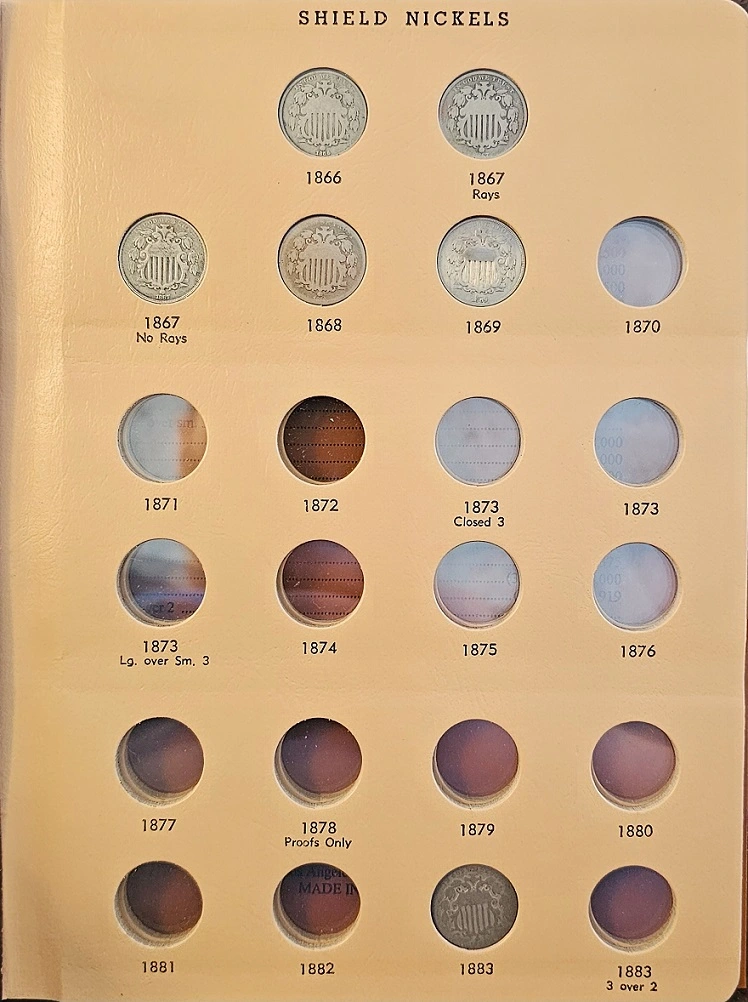 I won't be purchasing any of the key date coins most likely, but I figured I'll fill them with some decent hole filler-type coins. Obviously, no proofs will be going in this set either, let alone purchased. If I ever spent thousands on a coin, my wife would have me committed. Lol. |
|
Moderator
United States
195024 Posts |
Quote:
I am going to go right on down the line and continue with the next coin that has an empty spot, the 1870! Excellent!  |
|
Valued Member
United States
424 Posts |
I think of the 3c and 5c nickels from the 1860s as the beginning of the end for coins being worth their weight in metal, and instead going to 'fiat' value. That's kinda sad in a way, and I suspect has something to do with the unpopularity.
|
|
Bedrock of the Community
United States
10601 Posts |
Quote:
Obviously, no proofs will be going in this set either I don't see why Dansco does that - who's going to crack out a $3000 proof coin and stick it in an album?  |
|
Pillar of the Community
 United States
2385 Posts |
@Brandmeister Quote:
I personally prefer coins with a bust over heraldry. I can hear Lady Liberty saying... Brand...my eye is up here. smat |
|
Valued Member
United States
466 Posts |
Popularity? Maybe it's just Twentieth Century (and Morgan dollar) bias. I focus on Liberty Seated dimes and quarters. The price to rarity comparison between popular Twentieth Century classic coins (no dead heads) is telling. PCGS coin facts estimates as few as 200 total survivors for some early key date Seated dimes. Any Twentieth Century classic coin of similar rarity (if there are any) would cost a relative fortune. In grades up to mid VF the Seated dimes can be had, if found, for under $1,000 to about $2,000. Not chump change, certainly, but imagine what a Mercury dime or Walker with only 200 survivors would be worth. Really, it's a simple matter of supply and demand. There just aren't as many seated coin collectors seeking more than single type coins as there are collectors of the popular, and aesthetically beautiful Twentieth Century classics. I believe ultimately that is the answer to your question about Shield nickels. I have considered doing a set of Shield nickels myself, the series is not long and there are no branch mint rarities. The expensive 1879 and 1880 dates can be filled with more readily available proofs. For what it's worth, I believe the Coin Facts survivor estimates are too low. But they do provide an order of magnitude for comparison to the Twentieth Century coins. If you like them, go get those Shield nickels and have fun doing it. |
|
Pillar of the Community
United States
634 Posts |
Quote:
Dealers are very willing to haggle on slow-movers There hasn't been a coin show in my town in at least 30 years. But worse than that, I absolutely HATE haggling. |
|
Pillar of the Community
United States
634 Posts |
I like Shield nickels. But so far as completing a nice set, it's out of my league, price wise. |
|
Pillar of the Community
United States
1195 Posts |
@ Sharkman To me, it seems like every time you turn around, in the Dansco album, there is an expensive variety coin for the Shield nickels. I do like them, though. There was an 1871 in nice condition awhile back for around 100 dollars on ebay. Vector Ze... Yeah... I agree with that sentiment. This is one of the reasons I haven't really purchased any coins for awhile for this set. |
|
Page 2 of 2
|
Replies: 26 / Views: 1,722 |
Page 2 of 2
|








 First Page


 Posted 02/05/2026 11:40 pm


