| Author |
 Replies: 34 / Views: 7,870 Replies: 34 / Views: 7,870 |
Page 3 of 3
|
|
|
|
New Member
 Malaysia
39 Posts |
Dear Experts of King George III countermark,
I read in a forum that there will be a "Bank of England mark" on the cheek of king George III. So what is the shape of this mark?
Comments are much appreciated.
|
|
Pillar of the Community
United States
2605 Posts |
Quote:
I read in a forum that there will be a "Bank of England mark" on the cheek of king George III. So what is the shape of this mark? No, the Bank of England mark is king George III which was stamped into the image of Carolus. First they used an oval punch, later they switched to an octagonal one. |
|
New Member
Malaysia
39 Posts |
This is quoted from Coin People Forum - comment posted by member IAN
"The Bank of England dollar I posted in the virtual museum is struck over a spanish colonial 8 reales (all BofE dollars were, excepting for the proofs) AND has a bankers mark on George III's cheek. Have a look. ;-)
Ian"
I am curious to know WHAT is the banker's on George's cheek?
|
|
Pillar of the Community
United States
2605 Posts |
Found the post. I wonder what that "virtual museum" is. Tried to look in their gallery but wasn't permitted as a non-member. I think he's talking about a private banker's chop-mark. Something like this 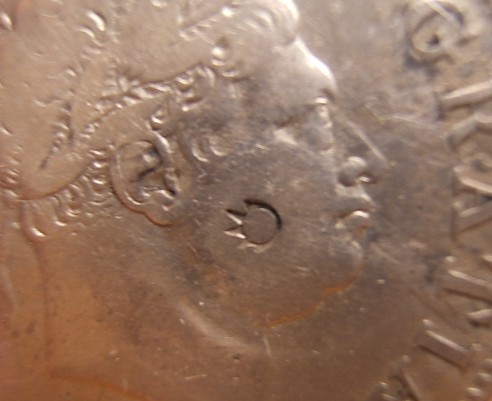 |
|
New Member
Malaysia
39 Posts |
Thank you svslav. If you could kindly examine the cheek of my King George III (posted in page 1), there is clearly a mark visible (on George's cheek). Doesn't look like a scratch mark to me. Looks like the mark was deliberately stamped / punched on his cheek.
(Must be somebody didn't like the foolish king, hahaha...)
|
|
New Member
Malaysia
39 Posts |
King George III's bruised cheek 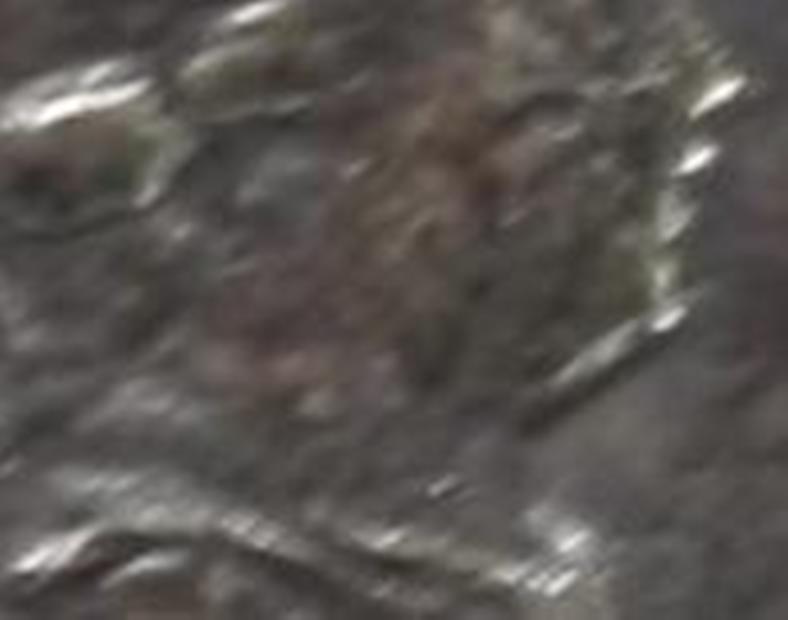 |
|
Pillar of the Community
United States
5362 Posts |
I have never heard of a "mark" on the King's cheek. Most of the fake c/s have poor details on the entire head - some are more like a blob with no features.
But if you notice on the edge pictures there are clear diagonal grip marks on HALF the edge (the lower edge under the date) but these same grip marks do not appear on the upper half over the King's head.
This pattern is usually seen on forgeries made in the period between 1870 and 1930. These are often full weight silver - but this is the first with the GIII punch I have seen.
|
|
New Member
Malaysia
39 Posts |
The mark on the cheek looks like the symbol for pound. 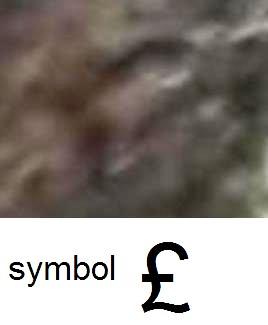 Swamperbob, So you think that this coin is a forgery? Would appreciate further suggestions as to what other features of the coin to examine. I think I will examine King George III's cheek under the microscope then maybe I can tell you all affirmatively what is the symbol / mark on his cheek. |
|
Pillar of the Community
United States
5362 Posts |
Yes, I personally feel this coin belongs in the general class of "Boston" forgeries - the made for trade silver bullion copies of the Charles IV coins that have been well known in certain circles for decades.
But there are no good physical tests to run at this point. XRF is a hopeful theory of mine but still untested and very expensive.
The class of silver forgeries that I would place this coin into is very difficult for many folks to accept. The proof for me has always been the "incorrect" method of edging. Until more definitive edge pattern studies are completed it will be difficult to come up with a "final" decision that the majority of collectors will embrace.
The Boston style counterfeits have been in the market place so long (over 100 years) and their patterns are so familiar that confusion makes them difficult to extricate from the general population. Couple that with the fact that 100's of thousands were made and that the silver content was fine and you can see why they survived. There was no incentive to destroy them or reclaim a fractional silver content. As long as the motivation was the storage of wealth using silver - they were fine sitting in bags alongside real 8Rs. It is only the modern collector like myself who see the need to differentiate between a well made forgery and an original.
|
|
New Member
Malaysia
39 Posts |
So WHO stamped King George III onto the neck of Carolus IIII?
If this coin is a Boston forgery ( late 1800s) , then the oval stamp of King George must also be fake because the stamping of real King George's bust was ordered by Bank Of England nearly 100 years earlier (late 179..).
So who has managed to forge a nice oval counter stamp of King George III?
|
|
Pillar of the Community
United States
5362 Posts |
There have been several well executed copies of the oval c/s used in connection with Numismatic forgeries but even more copies that are not well executed. These forgeries were made at different times and there are new ones that have been recently made in China. Typing the actual punch may be possible but I know of no source that has complied photos of all of them.
There is of course a good possibility that the oval punch was seen as a way to make the coin more acceptable as a forgery. The Birmingham forgeries added a c/s to make their coins pass better. I expect that the forger added the stamp at the time the coin was made.
Now I think we are at a point where Specific Gravity becomes critically important. I have up to this point accepted as fact that the coin is actually silver. We need to actually confirm that fact. I have checked a few of the 8Rs I own and I have located a Birmingham forgery that has a rather similar edge made by using a single die and applying it twice.
The dividing line between Birmingham and "Boston" style fakes is the silver content. Birmingham types contained too little silver. These were made pass into circulation at face value. The Boston style on the other hand were full weight silver and were intended for use in the bullion market. Both types used very good dies to make the fakes, both were struck in screw presses and BOTH made similar edge errors.
So the only actual distinction between the Birmingham coins made between 1792 and 1820 and the "Boston" style made between 1870 and 1930 may in fact be the alloy used.
One other caution when dealing with these classifications of forgeries, "Boston" style is a name I use to identify an entire class of later bullion forgeries. Not all examples were made in Boston nor even in the US. I began my search in 1960 by tracking down a lead from an actual forgery group working in the Boston area. But my research clearly indicates that other locations were involved in the manufacture as well. It is absolutely possible that Europe could have been involved in supplying the Bullion needs of China in the late 19th century and that some of the coins I call "Boston" style may have been made in the UK - even Birmingham itself.
Please confirm the Specific Gravity so we can make an inference as to where this coin should be classified.
|
|
New Member
Malaysia
39 Posts |
Swamperbob, can you suggest an instrument that I can buy to measure density / specific density for metal / alloy / coins.( I want to measure my other collections too).
Otherwise I have to conduct experiment "Archimedes style" to gauge the density of the coin.
And I think it won't be accurate because the volume of water displaced will be small so much so even droplets of water loss ( due to wetting of catchment container/ surface)will significantly altered the result.
|
|
New Member
Malaysia
39 Posts |
Dear All,
This coin is unlikely to be a Modern China forgery because it was kept by previous owner for couple of decades.
I have asked the former owner of my Carolus III coin about the suspicious diagonal marks on the edge of my coin. This is his answer.
It is a practice (bad one) by some to use a FILE tool to scrape the edges & collect some silver dust in order to test for the authenticity of the coin.
|
|
Pillar of the Community
United States
5362 Posts |
The diagonal marks in question are not produced by a file - at least the ones I own. The diagonals are grip marks and can be identified by a lack of scratches running horizontally in each diagonal line.
The explanation given is correct for some forms of silver theft but not in the case I am pointing out. It typically is visible on only HALF the edge.
Specific gravity is tested by weighting the coin in air and then in water. The difference in the 2 weights is the VOLUME of the coin expressed in cubic centimeters (1 gram equals one cubic centimeter). The SG is the result of dividing the weight of the coin by the volume.
|
|
New Member
Malaysia
39 Posts |
I think I know what instrument can be used to perform this test. Newton Spring Scale.
|
|
Page 3 of 3
|
Replies: 34 / Views: 7,870 |
Page 3 of 3
|








 First Page
 Previous Page

 Posted 01/12/2011 11:13 pm


