| Author |
 Replies: 21 / Views: 8,283 Replies: 21 / Views: 8,283 |
Page 2 of 2
|
|
|
|
Valued Member
 United Kingdom
114 Posts |
Another "Portcullis with Chains Royally Crowned", but this time showing three pence on a twelve-sided brass flan. As before, the link with the theme is that it is a symbol of Parliament. In pre-decimal days, £1 = 20 shillings = 240 pence - note that the abbreviation "d" was used for the number of pence, the letter "p" refers to the present decimal penny. This is dated 1970, but this type of coin was demonetised 31 August 1969! The answer is that The Royal Mint produced sets of pre-decimal types dated 1970 as items for collectors (actually produced in 1972). So this item, never legal tender, and therefore never a coin, must be referred to as a Pattern. Here it is then, a Pattern 1970 3d.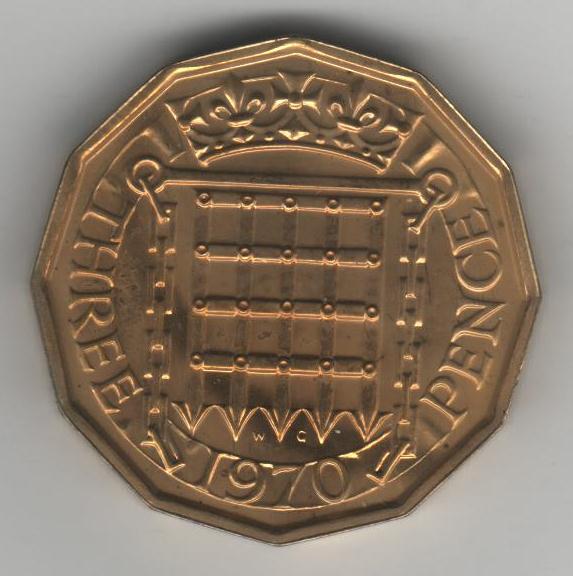 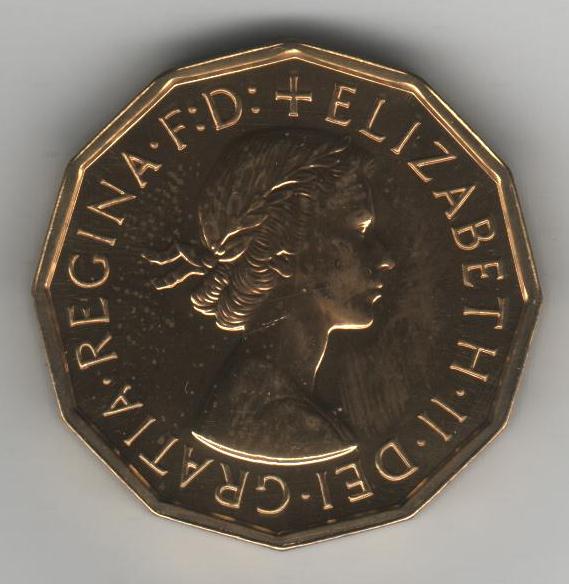 Still more for later. Bill. |
|
Moderator
 Australia
17006 Posts |
Quote:
So this item, never legal tender, and therefore never a coin, must be referred to as a Pattern "Pattern", as the common definition of the word implies, is usually applied to a new or proposed design not yet approved for general issue. The term for a "coin" struck for collectors by an official government mint using old designs or dies is "restrike". While this term isn't technically correct either since there were no "genuine" 1970 predec coins, it is closer to how these coins actually came to be. Anyways, more London pieces. Here is a London-minted penny attributed to the reign of John, Class 5c if my reading of Spink and Coincraft are correct. Reverse legend: ADAM ON LVNDE. 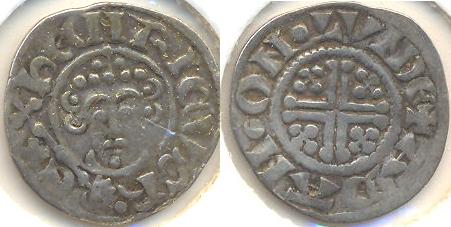 Next up, the only London token I have that's in a scannable condition - the other two I own are corroded wrecks. Francis Shackleton, chandler in Suffolk St, Haymarket. 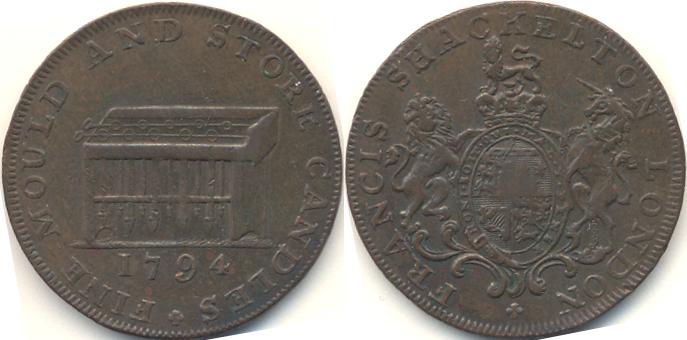 London coins made in modern times almost never have mintmarks - it's the regional and colonial mints that had mintmarks, un-marked coins could be assumed to be London-made. There was one exception, in the Australian series, when London struck coins for us in 1951. The tiny little "PL" mintmark above the date on this sixpence hearkens back to the "pecunia Londinium" or PLON mintmarks seen on many London-made Roman coins, such as bilnic's Constantine II coin posted above. 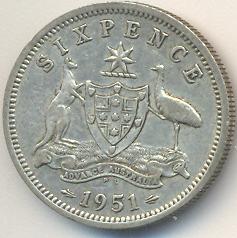 Here's a recent acquisition of mine, a 1 penny token from the "East London Municipality". I spotted it in a dealer's trays and thought, "I don't have any tokens from London in the late 1800s.". Then I remembered that such tokens were illegal in Britain in 1880. I finally figured out that this token wasn't from the East End, it was from East London, the city of that name in South Africa. 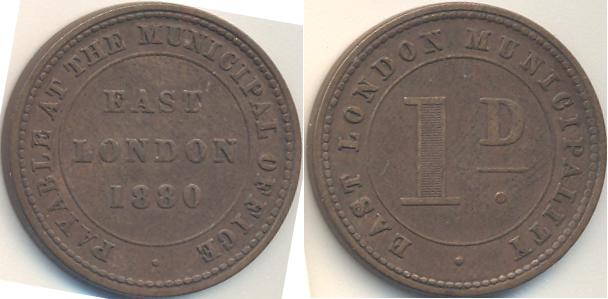 Finally, while we're in the colonies, I have to show a tourist dollar from the city of my birth: London, Ontario, Canada. 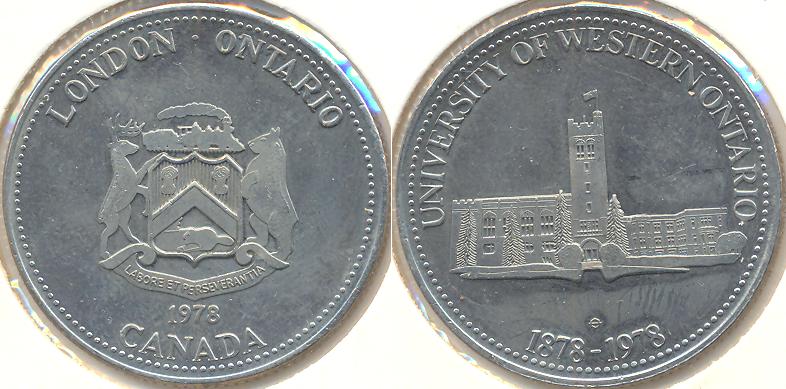 Don't say "infinitely" when you mean "very"; otherwise, you'll have no word left when you want to talk about something really infinite. - C. S. Lewis
|
|
Valued Member
United Kingdom
114 Posts |
A simple Crown coin with much hidden history. 1) The Festival of Britain was held in London in 1951, and some of the Crown (five shillings) coins were struck there by Royal Mint staff using portable equipment. 2) The Centenary of the Great Exhibition of 1851, also held in London. 3) The first Crown coins (other than gold) were produced in the year 1551. 4) The Silver Crown of 1551 was the first British coin to show the year in numerals (other than Roman numerals) Quadruple commemorative! The second event is remembered on the edge (plain edge, incuse lettering) on this coin: " * MDCCCLI CIVIUM INDUSTRIA FLORET CIVITAS MCMLI " A 1951 Crown "Festival of Britain"Bill.   EDIT: "non-gold" added to 3), and 4) added, also Triple amended to Quadruple. Bill. Edited by bilnic
06/14/2011 03:15 am
|
|
Valued Member
United States
321 Posts |
Wow- some nice coin scans here. I need to get my scanner going an join in !
|
|
Valued Member
United Kingdom
114 Posts |
Yes please, as long as it's "London" - any London, anywhere.
I've got a few more to show soon.
Bill.
|
|
Valued Member
United States
343 Posts |
1797 "Conder" penny from the London and Westminster series.  |
|
Valued Member
United Kingdom
114 Posts |
Another London coin, this time from my pocket because they do circulate. 2005 £2 commemorating 60th anniversary of the end of World War 2. St Paul's Cathedral is outlined by searchlights - note that they are angled as a reminder of Winston Churchill's famous "V for Victory" sign.   Bill. |
|
Valued Member
United Kingdom
114 Posts |
Now, this one is a challenge for you, but please, if you know the answer, please don't reply immediately as it would be good to see a few guesses first. It's an everyday sixpence, it happens to be 1936 but the year and design don't matter. What matters is that it's a sixpence (between 1816 and 1967). What is the London connection with this ordinary sixpence?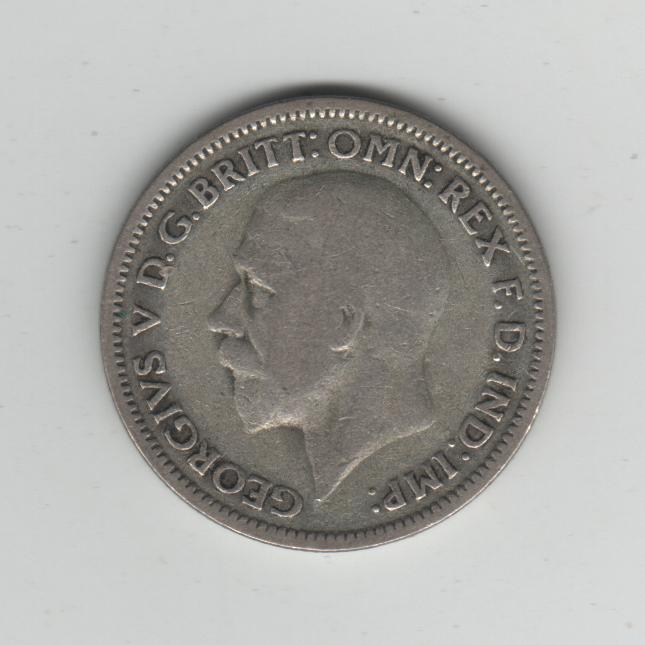 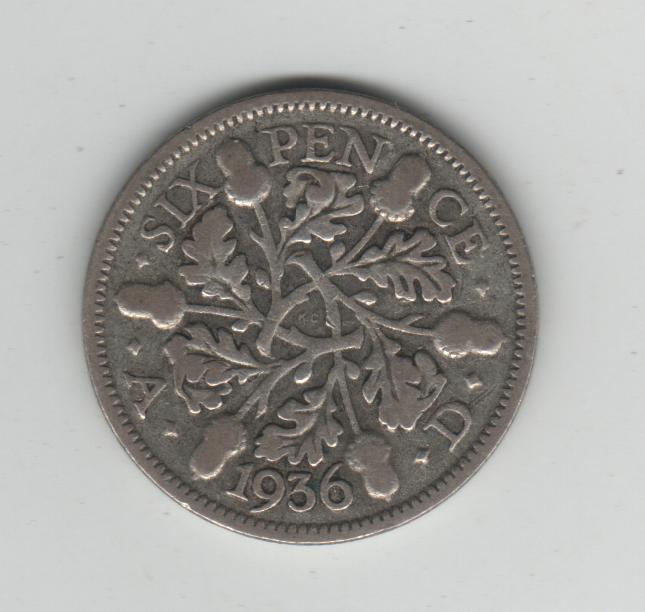 Bill. EDIT: "between 1816 and 1967" added. Bill. Edited by bilnic
08/12/2011 09:48 am
|
|
Valued Member
United States
147 Posts |
1723 George I "South Sea Company" shilling Obverse : Laureate and Armored Bust ( one loose ends and one bow to tie ), facing right; "GEORGIVS·D·G·M·BR·FR·ET·HIB·REX·F·D·". Reverse : Four crowned cruciform shields around central star, SS & C on angles; "BRVN·ET·L·DVX·S·R·I·A·TH·ET·EL·" (date) divided at both sides of crown. Diameter: 26mm Weight: 6g Metal: Silver Mint: London The Coinage of the South Sea's Company were minted in Britain in 1723, after the South Sea Company (SSC) discovered silver in (and shipped it back from) Indonesia in 1722. The coins minted were Crowns, Half Crowns, Shillings and Sixpence's. The Crown is the rarest coin altogether, although the Half-Crown is also excessively difficult to find in higher than VF condition. The shilling is common, with even mint state examples being available. The sixpence is common in most grades, but mint state examples can carry quite hefty prices. All these coins carry "SSC" in the reverse quarters of the cruciform shields. Several die errors and corrections of interest exist on the shilling, including the slightly scarce error SS/C where an engraver accidentally punched the C in the wrong place and then stamped the SS over it. On these pieces you can see a faint C under the SS. There is also a far rarer variety, which catalogues near £100 in F condition, where the whole collection of shields is rotated. 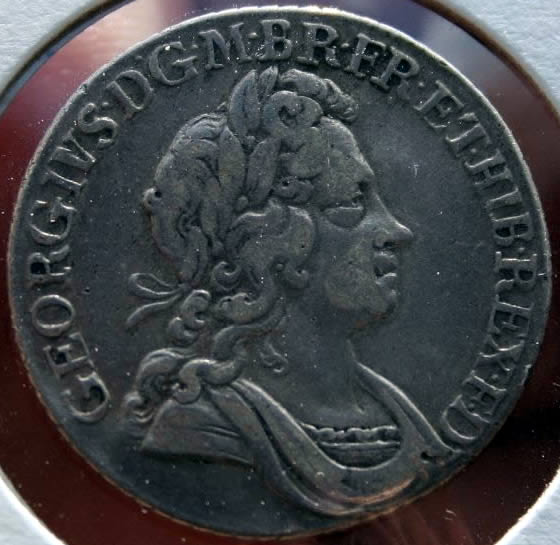 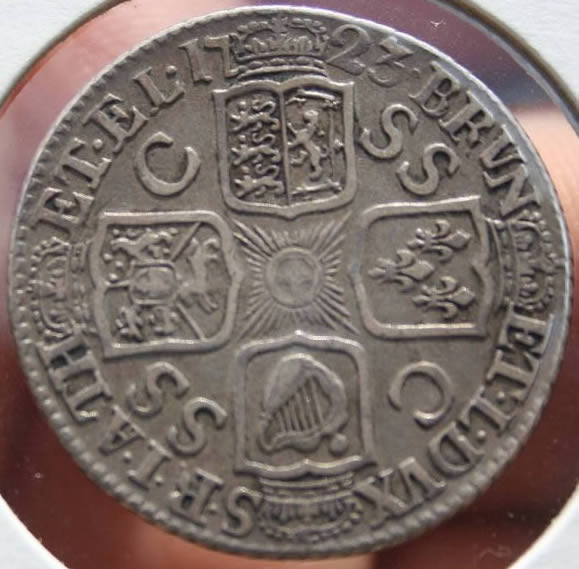 |
|
Valued Member
United Kingdom
114 Posts |
Interesting coin, but I can't see any link with "The Theme is London".
Am I missing something?
Bill.
|
|
Valued Member
United States
147 Posts |
I'm not sure if you're referring to my coin or not but it was minted in London so I though that would have some "connection to London." The South Sea Company was a British joint stock company that traded in South America during the 18th century. Speculation in the company's stock led to a great economic bubble known as the South Sea Bubble in 1720, which caused financial ruin for many, including Sir Issac Newton. In spite of this it was restructured and continued to operate for more than a century after the Bubble. The headquarters was located on Threadneedle Street in London. There is much history associated with this coin. South Sea Company: http://en.wikipedia.org/wiki/South_Sea_CompanyEdited by EarlyMilledCoins
08/12/2011 1:02 pm
|
|
Valued Member
United Kingdom
114 Posts |
Great, now we have the connection. I was rather expecting to see a reply to the question that I asked!
Bill.
|
|
Valued Member
United Kingdom
114 Posts |
Are there no suggestions about the connection between an ordinary sixpence and London?
Bill.
|
|
Valued Member
United Kingdom
114 Posts |
So you give up on the connection between the sixpence and London?
On decimalisation in 1971, the old sixpence was an odd coin with a value of two-and-a-half decimal pence. In itself, it was of little value and was covered by a 2p plus a ½p (and the ½p itself was soon discontinued).
But the old sixpence was used in many machines, mainly for tickets on London Underground, and the old 6d (as 2½p) was retained, following strong representations from London Transport, mainly for this purpose until yet another round of fares increase brought about its demise at the end of June 1980.
Now I've got to find some more 'London' coins - unless you have some that you can post in the meantime.
Remember, THE THEME IS LONDON, but any London, anywhere.
Bill.
|
|
New Member
United States
32 Posts |
more london... aethelred ii, minted by godric of london. 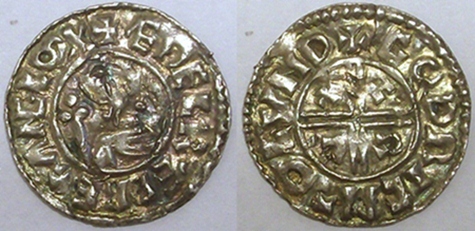 |
|
Page 2 of 2
|
Replies: 21 / Views: 8,283 |
Page 2 of 2
|








 First Page

 Posted 06/11/2011 04:46 am


