| Author |
 Replies: 25 / Views: 14,791 Replies: 25 / Views: 14,791 |
|
Pillar of the Community
United States
1454 Posts |
I asked Hawk about this a while back but he was stumped, as well. Is it just normal oxidation? A specific climate? Luck? I've never had a piece of silver do this. The only secondary characteristics my coins ever take on are ugly white spots, discolorations, or brown tarnish.  |
|
|
|
Pillar of the Community
United States
745 Posts |
 its that little elf guy from Lucky Charms box, he passes by your Silver coins to put on Rainbow Hues...   Edited by Penny4Me
04/12/2012 10:47 pm
|
|
Pillar of the Community
United States
3670 Posts |
This is a great link from here on these coins, esp form the AT side of it, which as one member said should be IT "intentionally toned", instead of "artificially toned", which is technically not correct.... https://goccf.com/t/115231 |
|
Pillar of the Community
 United States
1454 Posts |
Ahhh, so people use certain processes to artificially tone coins. Should have known. That takes a little of the wonder out it for me. Well, most of the wonder, actually. Thanks again, Hawk.
|
|
Pillar of the Community
United States
808 Posts |
I too would like to know more about the chemical processes involved. Pure silver on it's own is apparently very resistant to tarnishing. Silver alloys are more susceptible to oxidation due to the copper component. Additionally, everything from moisture to the trace minerals contained in the pigment used in old colored coin paper rolls and coin holders apparently can contribute to the various effects. I've never heard anything definitive as to what specific circumstances cause a specific effect to appear.
There are some interesting discussions on the jewelry forums that go into great detail on both intentional and accidental tarnishing.
|
|
Pillar of the Community
United States
3670 Posts |
T, keep in mind when the graders get a coin that is "questionable color", they send it back as code 91 via PCGS as not gradable as is the 1961 Ben Franklin in my other thread pics.... All the other coins color formed in a natural way if you will, or by accident over longer periods of time, and the coin graders acknowledge these coins an grade them.... Notice again, the only one I have that is slabbed that DID not get a grade was that 1961 Ben and it says "genuine", as to say they are only acknowledging it is not a fake at least.... Link on it an interesting theory on how it toned.... https://goccf.com/t/113711Edited by Silverhawk74
04/12/2012 11:48 pm
|
|
Pillar of the Community
United States
7842 Posts |
(quote) Penny4Me: its that little elf guy from Lucky Charms box
Edited by oih82w8
04/12/2012 11:49 pm
|
|
Moderator
 Australia
17007 Posts |
"Rainbow hues" on coins are caused by the same thing as "rainbow hues" in soap bubbles, or on oily roads - the thin film effect. In the case of a coin with a naturally-occurring rainbow tone, the thin film is a layer of metal oxides and/or sulfides. The colour is not directly caused by a chemical process, although it is a chemical process that creates the thin film. The colour visible depends on the thickness of the layer. Extremely thin films are reddish-yellow, thickening to green-blue. The next colour after blue is black, where it qualifies as "tarnish". Don't say "infinitely" when you mean "very"; otherwise, you'll have no word left when you want to talk about something really infinite. - C. S. Lewis
|
|
Pillar of the Community
United States
1432 Posts |
Quote:
The next colour after blue is black, where it qualifies as "tarnish". And here's an example of that.  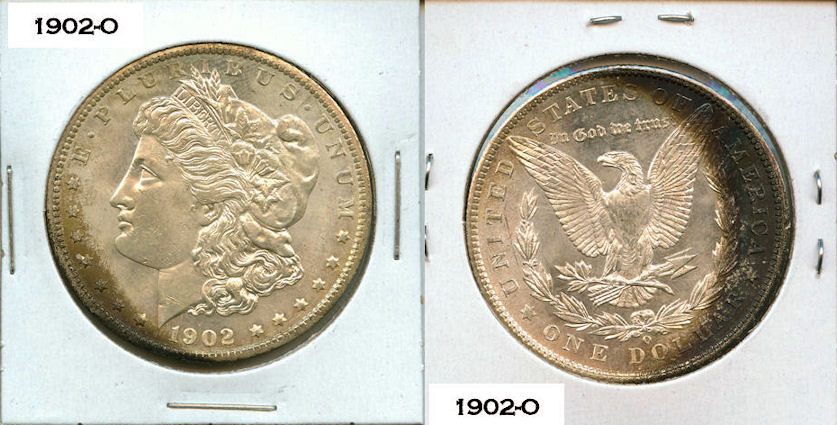 |
|
Pillar of the Community
United States
596 Posts |
 Just Dip it |
|
Pillar of the Community
 United States
2448 Posts |
I've heard of people using a propane torch to artificially tone silver. However, in my mind, I'm still pulling for the Lucky Charms guy.
|
|
Pillar of the Community
United States
1454 Posts |
Quote:
Pure silver on it's own is apparently very resistant to tarnishing. Silver alloys are more susceptible to oxidation due to the copper component If this is indeed true, it makes sense to me. I've noticed that my sterling coins are mostly the ones that are demonstrating unappealing color changes. Very interesting. Here's an example of what I consider tarnish on a .999 silver coin.  |
|
Pillar of the Community
United States
3670 Posts |
Can't see what you are making reference to from those pics, as that piece looks good to me.... It is 1987, as I was in 7th grade in 1987, so it has had time to begin toning. And you are right, .925 will tone out often from the other 7.5% of the copper present.... I have seen some gold eagle 1/10th dimes lately list on ebay at $299 to start, about 100 over typical price. As they have a red huge tone and being .91675 would be because that copper present is responsible for that red toning.... Edited by Silverhawk74
04/13/2012 11:32 am
|
|
Pillar of the Community
United States
7842 Posts |
The brown area on the big bears shoulder?
Edited by oih82w8
04/13/2012 1:53 pm
|
|
Pillar of the Community
United States
1454 Posts |
oih82w8,
That's the area. What's irritating is the stain wasn't there when I bought it two years ago. The coin was unblemished, in near MS70 condition for 23 years until it was sold to me in the rain-soaked Pacific Northwest where I call home. I believe humidity is the culprit; but then again, maybe not, as we have a dehumidifier running in the vicinity of the coins. It's a mystery.
|
|
Pillar of the Community
United States
3670 Posts |
Jeff the 1902 is a tougher date seems like and I kinda like that black crescent moon, that is what I would call it, with a hint of orange....
I would consider a group slab with some other coins to save cost, and if it came back MS-65 or 66 it would still bring good money. There are some dark Gothic Edward Scissor-hand collectors out there that would like to have it, lol. I would take it, as it is a dark unique coin...
|
| |
Replies: 25 / Views: 14,791 |










 Posted 04/12/2012 11:16 pm


