Today we have a look at the second type of the two Arkansas Statehood Centennial coins, the 1936 coin honoring Senator Joseph Robinson. The coin is presented via an example in PCGS MS-65.
Here's a link to my post regarding the first Arkansas type:
http://goccf.com/t/118076The Senator Robinson version of the Arkansas Centennial half-dollar was the result of the Arkansas Centennial Commission seeking to expand their original commemorative coin authorization by three new coins, each with a new reverse design. Arkansas' request came as a competitive counter to the Texas Centennial Commission's request for the authorization of five new/additional coins for its statehood anniversary! Only the Arkansas Commission was successful, albeit for only one of the three coins requested.
Read More: Commems CollectionJoseph Robinson -- born in Lonoke, Arkansas in August 1872 -- was a life-long politician. He began his career with his election to the Arkansas Legislature in 1894. He was elected to serve as a US Representative in 1902 and served five consecutive terms. His next political victory was being elected Governor of Arkansas, taking office on 15 January 1913. He served just 55 days as Governor, however, as the Arkansas legislature voted to return him to Washington, DC as a US Senator to take the seat that opened when recently re-elected Sen. Jefferson Davis died. Robinson served over 24 years in the US Senate, including the last four as Senate Majority Leader. In 1928, he was on the Democratic Presidential ticket as the Vice Presidential nominee. Senator Robinson died in Washington, DC in July 1937; he is buried in Arkansas.
Based on a letter to the US Commission of Fine Arts, it appears that the Arkansas Commission was considering for the new coin a reverse design that depicted "one side of a coin Ferdinand De Soto is supposed to have presented to an Indian woman in Arkansas during his exploration of this State." I've checked several sources, but have not been able to find another reference to such a coin so I don't know what coin it might have been. Considering De Soto was a Spaniard exploring in the name of Spain, it wouldn't surprise me to find that the coin was a Spanish "piece of eight" or eight-real coin. Ultimately, however, it was decided to place a portrait of Senator Robinson on the coin -- from contemporary accounts, it appears Robinson's selection came as a result of political pressure.
The portrait of Robinson is generally considered as the obverse of the coin (just like the conjoined portraits on the previously discussed Arkansas Centennial coin) but per its authorizing legislation, the eagle/flag side of the coin is officially the obverse (on both coins). The initial design sketch for the new reverse of the Robinson half-dollar was prepared by Enid Bell; the models for the coin were done by noted artist/sculptor Henry Kreiss. The two Connecticut-themed commemoratives -- Bridgeport Centennial and Connecticut Tercentenary -- were also designed by Kreiss. The Robinson was a one-year coin, dated ‘1936' but was struck in 1937; the coin's authorizing legislation required the ‘1936' date regardless of when minted.
The coin presented is a nice brilliant white example with very nice luster. The large facial areas of the portrait are prone to nicks and scratches, with the cheek and jaw areas typically being the first to show rub. Nice coins are plentiful, however, so be picky and find a nice one!
I've also included a pair of images of the original holder used by Stack's for distributing the Robinson coins. As you can see, the holder certainly serves a dual purpose: a) provide information on the commemorative coin, and b) advertise Stack's. Such is to be expected when the official distributor of the coin is not the sponsoring organization, but rather a commercial enterprise!
Enjoy!
1936 Arkansas Statehood Centennial, Robinson Type -- Obverse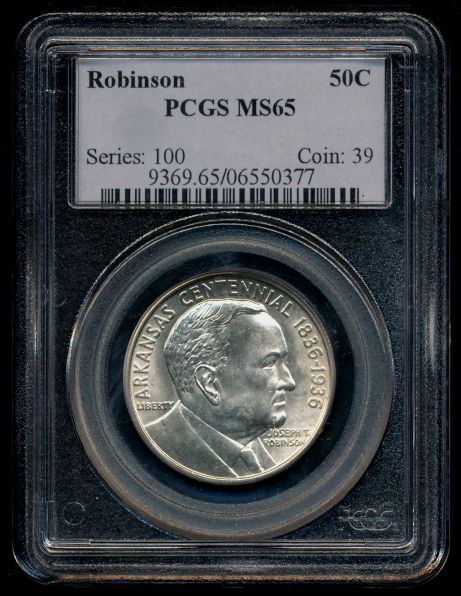 1936 Arkansas Statehood Centennial, Robinson Type -- Reverse
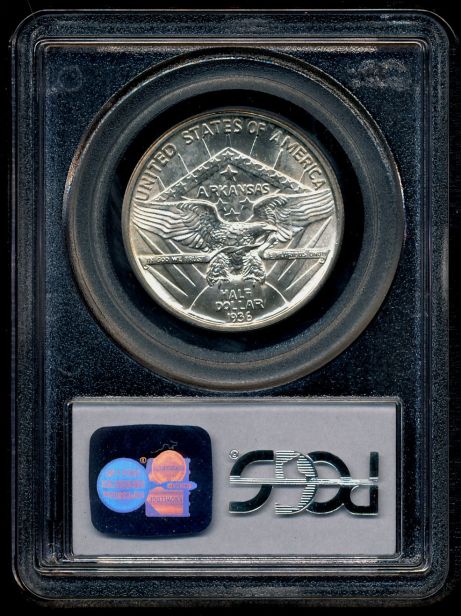 1936 Robinson Original Holder/Mailer -- Front (R) / Back (L)
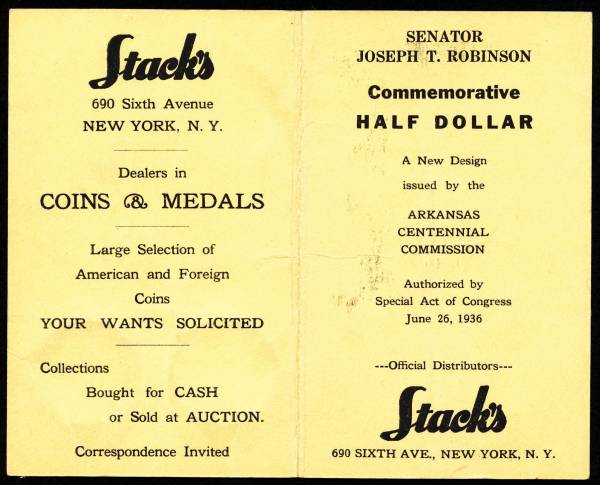 1936 Robinson Original Holder/Mailer -- Interior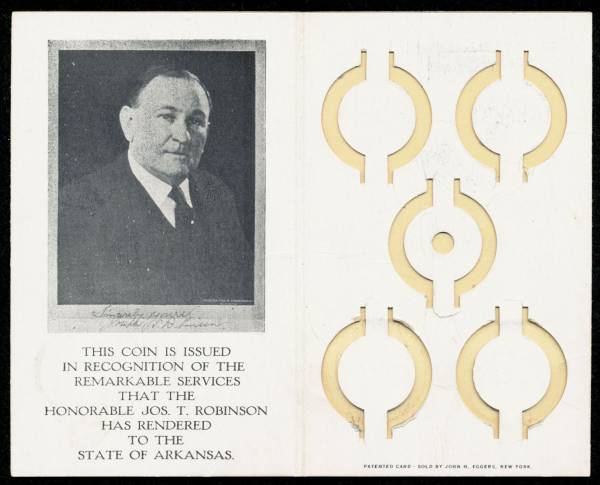







 Posted 05/03/2012 08:38 am





