Tonight we have a look at the commemorative half-dollar struck to mark the tercentenary of the founding of New Netherland by Walloons (French and Belgium Huguenots). The coin is presented via an example in PCGS MS-65.
The New Nertherland Colony was, at its core, a business venture that was founded to protect the fur trading interests of the Dutch West India Company (DWIC). As a follow-up to previous Dutch explorations and their associated construction of temporary forts and trading posts, the DWIC sent a group of settlers (mostly Walloons) to establish permanent settlements in the new claimed territories in 1624 and 1625. Present-day New York City is just one of the areas that was settled by the Dutch at this time as part of New Netherland.
Read More: Commems CollectionThe Huguenot-Walloon half-dollar features conjoined portraits of Admiral Gaspard de Coligny of France and William the Silent of the Netherlands on its obverse, and the sailing ship
Nieu Nederland (or
New Netherland) on its reverse. The coin was modeled by US Mint Chief Engraver George Morgan from designs suggested by Rev. John Baer Stoudt, Director of the Huguenot-Walloon New Netherland Commission. It was Morgan's last coin, as he died just weeks after its completion.
The Huguenot-Walloon half-dollar was criticized on several fronts at the time of its authorization and minting. First, some argued that the US Government should not be striking coins for a religious group (the Federal Council of Churches of Christ in America sponsored the coin via the New Netherland Commission) as it was counter to our Constitutional separation of church and state tenets. Second, the depiction of Coligny and William the Silent on the coin was criticized with the argument that they had nothing to do with the founding of New Netherland and were, in fact, dead for decades before any colonization attempts were made. The execution of the designs by George Morgan was also criticized by
James Earle Fraser on behalf of the US Commission of Fine Arts.
I'll leave the first point for others to debate and move on to the second. The position that neither Admiral Gaspard de Coligny nor William the Silent were involved in the actual founding of New Netherland is born out by the facts, but the Huguenot-Walloon New Netherland Commission didn't select them for the coin based on their direct involvement in the colony. Per their record of the tercentenary celebrations, they noted that "As early as 1562, Admiral Coligny of France made an attempt to gain a foothold in America, and provide thereby a refuge for his fellow ‘heretics' whose long decades of martyrdom he foresaw only too clearly." Regarding William the Silent, the Commission described him as a "protagonist of colonization" and considered him "the champion and protector of the Huguenots" and noted that he "pointed the way which was so successfully followed by his countrymen later on..." So, it appears in the Commission's eyes, Coligny and William were the inspirational catalysts for the later Huguenot involvement in the New Netherland colonization and therefore worthy of being remembered.
Regarding Fraser's criticism's of Morgan's work, let's leave it at Fraser and Morgan had long-standing disagreements over coinage design and how models were reduced to create coinage dies -- the Huguenot-Walloon coin was just another (but the last) example.
To learn more about the Huguenots and the religious persecution they faced in Europe, please see either The Huguenot Society of America
http://huguenotsocietyofamerica.org/) or The National Huguenot Society
http://www.huguenot.netnation.com/general/) for more.
The coin shown is a nice satiny example with strong cartwheel luster on both sides.
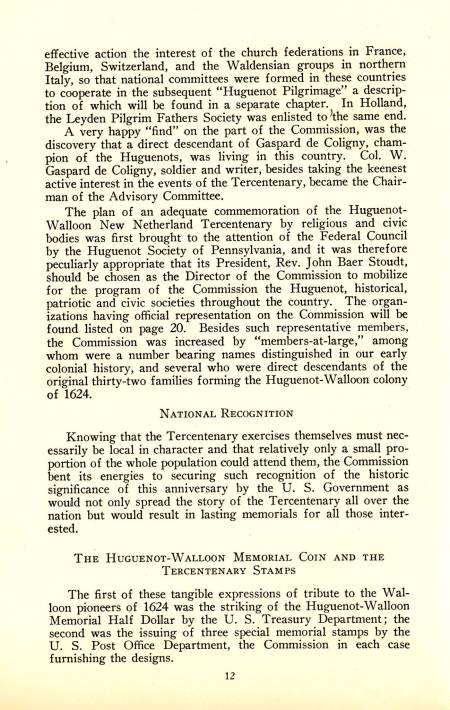
I've also included images of a few pages from the volume created by the New Netherland Commission to record the history of the tercentenary celebrations. Interestingly, the volume discusses the coin but does not include a picture of it, though it does include pictures of all three stamps that were issued for the occasion.
Enjoy!
1924 Huguenot-Walloon Tercentenary -- Obverse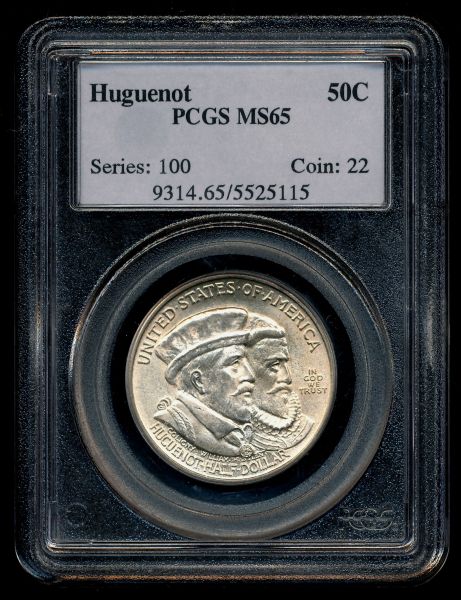 1924 Huguenot-Walloon Tercentenary -- Reverse
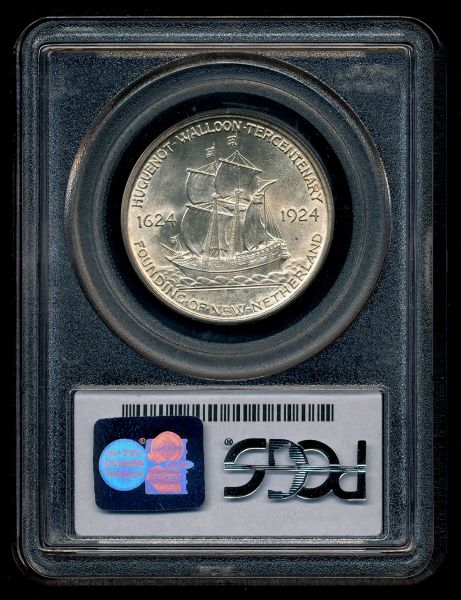 Huguenot-Walloon Tercentenary Book -- Title Page
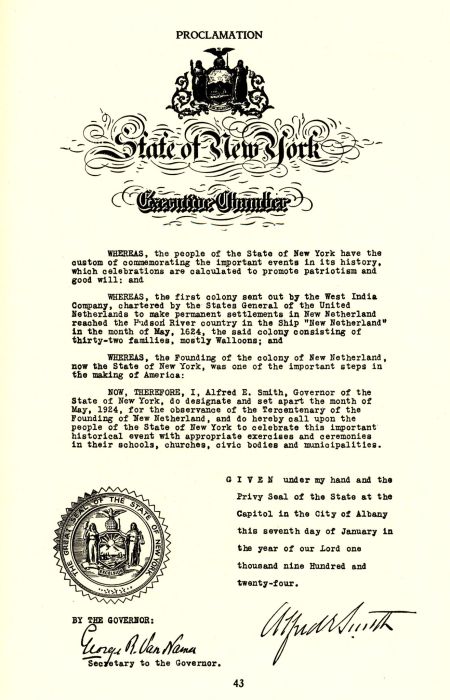
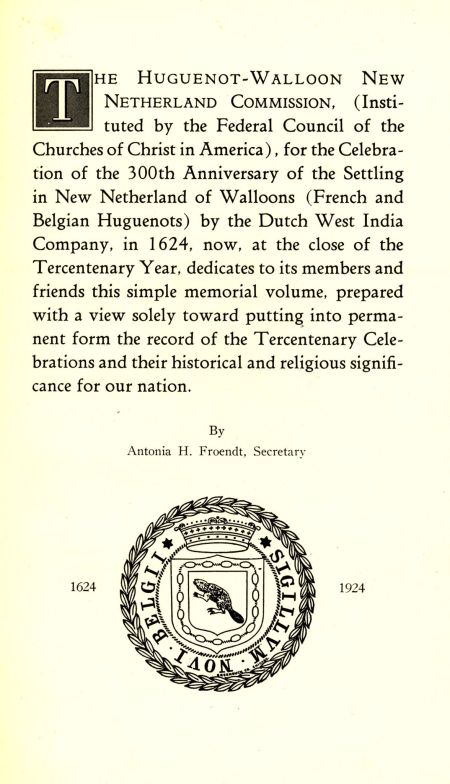 Huguenot-Walloon Tercentenary Book -- New York Proclamation
 Huguenot-Walloon Tercentenary Book -- Coin & Stamp Page 12
 Huguenot-Walloon Tercentenary Book -- Coin & Stamp Page 13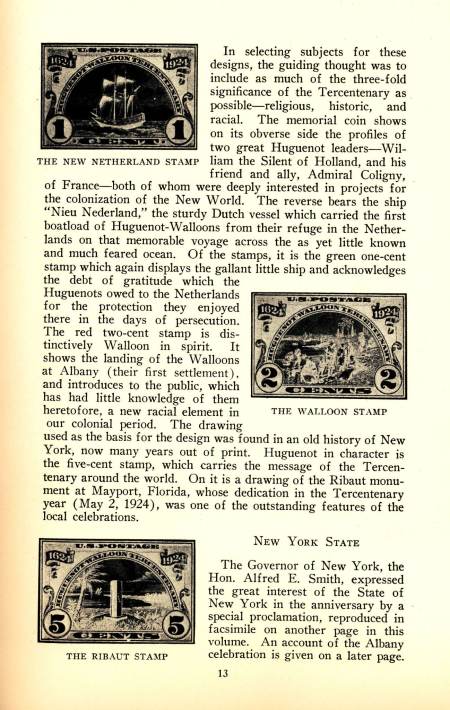







 Posted 05/04/2012 10:32 pm