During the classic era of US commemorative coins, bills proposing seven different commemorative coins were vetoed by the sitting US President. One bill each was vetoed by Herbert Hoover (75th Anniversary of the Gadsden Purchase) and Franklin Delano Roosevelt (400th Anniversary of Coronado's Expedition), while Harry S. Truman vetoed two different coin bills (Wisconsin Statehood Centennial and Minnesota Territorial Centennial).
The "King" of commemorative coin vetoes, however, was Dwight D. Eisenhower. On 3 February 1954, he vetoed three separate bills that would have given us the following half-dollars: a Northampton, MA Tercentennial piece, a New York City Tercentennial coin and a Louisiana Purchase Sesquicentennial piece.
Of these three, I would submit that the Louisiana Purchase Sesquicentennial was most worthy of a coin considering what the 828,000 square mile purchase of land from France meant to the growth and future of our country. You'll recall that the Louisiana Purchase was celebrated on a previous commemorative coin via the 1903 Louisiana Purchase Exposition gold dollar, but I doubt that coin factored into Eisenhower's thinking. The President was looking to support the Treasury Department's/US Mint's long-held view that commemorative coins were disruptive to our monetary system and that commemorative medals were better suited for such celebrations.
With the veto of these three bills and the striking of the last Carver-Washington half-dollars in 1954, the classic era of US commemorative coinage came to a close. Bills for commemorative coins continued to be introduced in Congress on occasion, but they rarely made it out of committee. And so, it would be more than 20 years before another commemorative coin would be struck in the US -- the three circulating commemoratives authorized to mark our nation's Bicentennial.
The void left by the lack of commemorative coins was filled for some collectors by the striking of national commemorative medals by the US Mint for various private sponsors -- the treasury finally got its way! As I've noted in other posts, these medals followed the same pathway to issuance that our coins did, they just lacked a denomination and legal tender status. I'll discuss these wonderful collectibles in another post.
For "visual interest," I've included an obverse and reverse view of a silver medal struck by the US Mint for sale during the Louisiana Purchase Exposition in 1904; the medal was also struck in bronze, brass and gilt.
Louisiana Purchase Exposition Silver Medal - Obverse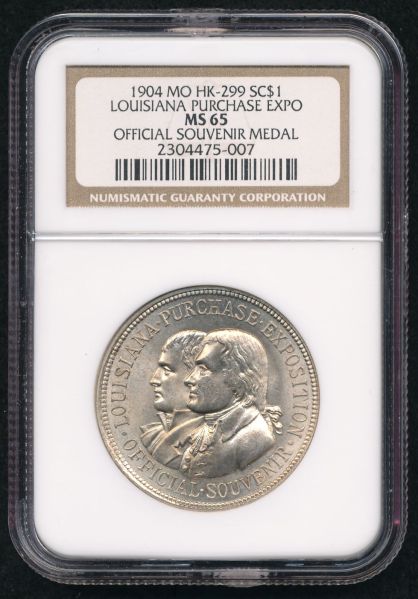 Louisiana Purchase Exposition Silver Medal - Reverse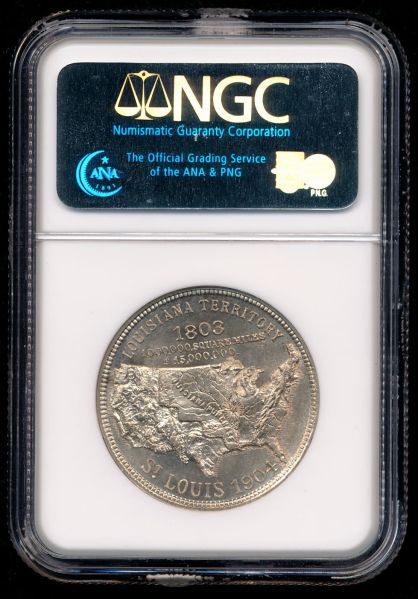






 Posted 07/30/2012 2:18 pm





