This post started out as my long overdue discussion of the 1997 Botanic Garden Coin & Currency Set, but as my fingers tapped away, I soon decided that it would be better if I first offered up a few words about the standalone commemorative silver dollar. So, here is the first of two topics.The US Botanic Garden dollar was issued to mark the 175th anniversary of the "roots" of the national garden. On May 8, 1820, President James Monroe signed into law a bill that allocated five acres of land in the District of Columbia for the purpose of creating a botanic garden. The "seeds" of the garden were first planted more than two decades before, however, when, in 1796, President George Washington corresponded with the Commissioners of the Federal District (the team that was then engaged in planning the city's layout) regarding the incorporation of a space in the capital city for a botanic garden.
Considering Washington's enthusiasm for botany and horticulture, his suggestion is not all that surprising; his Mount Vernon estate incorporated several gardens of his own design and he solicited seeds and plants from friends and colleagues the world over. Unfortunately, a national garden did not come to "fruition" (OK, I'll stop now.) during Washington's life as he died on December 14, 1799.
The Garden's silver dollar was authorized on September 29, 1994. It was included in the "Riegle-Neal Interstate Banking and Branching Efficiency Act of 1994." (Say that three times fast!) Though seemingly an odd place for language authorizing a commemorative coin, it was not the only coin included in the Act. Also authorized were coins for the 1995 Special Olympics World Games, National Community Service (1996), Robert F. Kennedy (1998) and the US Military Academy Bicentennial (2002). It was a matter of expediency for the various coin sponsors, the 103rd Congress was nearing its end (its last day would be December 1st) and each knew time was running out for them to get their standalone bills approved. Attaching them to a bill that was on a clear track to approval was an ideal solution.
As noted, the coin commemorates the 175th anniversary of the 1820 Act's approval and features the dual dates - "1820 - 1995." So, why was the coin not issued until 1997? The short answer is: the commemorative coin queue at the Mint was already quite full for 1995 and 1996!
On October 5, 1992, President George Bush approved the three-coin program for Civil War Battlefield Preservation that was specified to be issued in 1995. The following day, Public Law 102-390 was approved; it was the Act that authorized the massive coin program (
see Note) to mark the 1996 Atlanta Centennial Olympic Games. Add to these the 1995 Special Olympics silver dollar and the 1996 National Community Service silver dollar and the Mint had a very full plate.
Note :The Atlanta Olympics coin program included four CuNi half dollars, eight silver dollars and four gold half eagles, all to be struck in proof and uncirculated and available in a multitude of packaging options during 1995 and 1996. It was the largest and most varied US commemorative program ever authorized, and had the potential to uniquely challenge the Mint's production and marketing capabilities.So, it was agreed that the financial interests of the US Botanic Garden would be best served by not forcing another coin program upon the Mint (and collectors) in the 1995-96 period. The Botanic Garden program was thus moved to 1997 at which point it would face less intense competition for access to collector wallets.
The legislation approving the coin provided general specifications for its design, stating that the design "shall be a rose, the national floral emblem, and a frontal view of the French facade" of the Garden. The legislation did not specify which design element was to be used for which side of the coin. The side with the "French facade" and "1997" issue date is considered the obverse, with the emblematic rose and commemorative dates of "1820-1995" occupying the reverse. The obverse design was prepared by US Mint Sculptor/Engraver Edgar Z. Steever, IV; the reverse was modeled by U.S. Mint Sculptor/Engraver William C. Cousins.
An interesting note regarding the dates shown on the coin.The approved legislation for the coin does not mention the inclusion of the date "2017" on the coin; it only specifies that the commemorative dates "1820-1995" will be featured. In a statement entered into the
Congressional Record on August 3, 1994 concerning the Riegle-Neal bill, it was specifically stated that "the [Botanic Garden] coins shall be inscribed with the years 1820-1995 in order to properly commemorate the Garden's 175th anniversary. No other dates shall appear on the coin."
We know the released coin includes, on opposite sides, not only the commemorative "1820-1995' dates but also "1997" to indicate the year of issue. It appears the Treasury Department/US Mint believed the Botanic Garden legislation had enough leeway in its language to allow them to adhere to other
US coinage laws that require
US coins to feature the year of striking or issue and thus added "1997" to the coin.
The coin was available individually in proof and uncirculated. A proof version of the coin was also available in the 1997 Prestige Set (the last to be issued) and an uncirculated coin was included as part of a Coin & Currency Set. Though 500,000 coins were authorized, the actual mintage of the coin totaled just 248,176 across all options. Proofs outnumber uncirculated coins by a better than 3:1 ratio (189,671 to 58,505); the proof figure includes the 80,000 proof coins featured in the 1997 Prestige Set (the last-year set proved popular enough with collectors to achieve a sell out).
The proof version of the coin originally sold for $33 then $37 (pre-issue then regular price), the uncirculated for $30 then $32 and the Prestige Set for $44 then $48. The pre-issue price for the C&C set was $36; it would have advanced to $41 if it hadn't sold out during the pre-issue pricing period.
Today, individual coins are readily available in the marketplace as are the Prestige Sets; the Coin & Currency Sets are encountered in far smaller numbers, but there is almost always one or two available on
ebay. Current market prices for the individual coins are generally in the range of $25 to $35 for those in OGP, with prices just slightly higher for PF/MS-69 examples in PCGS/NGC holders. You should expect to pay $80 to $100 more for graded MS-70 examples.
C&C Sets, which feature a limited edition satin-finish
Jefferson nickel, routinely sell for $140 and up. I'll post about these sets in the near future.
In 1989, after years of interim maintenance efforts, it was determined that the aluminum superstructure of the Garden's Conservatory was in danger of failing and needed to be replaced; it opened to the public in 1933. The building was disassembled and replaced by a modern version of the same design; the reconstruction project lasted from 1997 to 2001. Surcharges collected from the sale of the silver dollar helped support the new Conservatory's construction. At a surcharge of $10 per silver dollar sold, the Botanic Garden coin program raised nearly $2.5 million to support the Garden's renovation/restoration - a most worthy use of collected surcharges! (At least IMO!)
1997 US Botanic Garden Silver Dollar - Obverse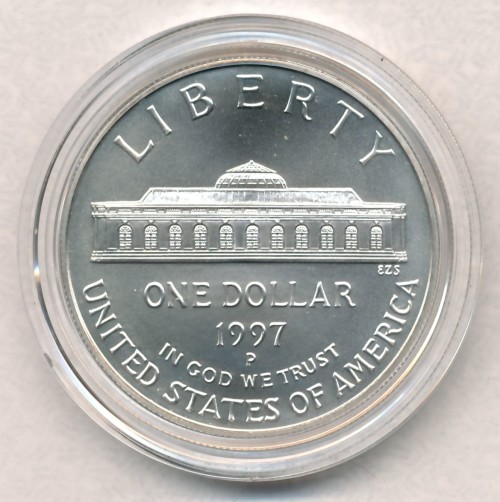 1997 US Botanic Garden Silver Dollar - Obverse
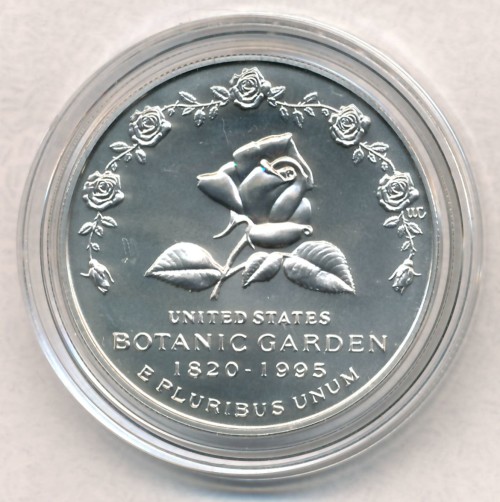 Read More: Commems Collection






 Posted 08/09/2016 12:09 pm





