For a discussion of the US Botanic Garden silver dollar itself, please see my earlier post here: US Botanic Garden Silver Dollar.
In a previous post, I wrote about the Thomas Jefferson Coinage & Currency Set that was released by the US Mint in 1994. (
Jefferson C&C Set post) The set features an uncirculated strike of the Jefferson commemorative silver dollar, a 1994 matte finish
Jefferson nickel and a $2.00 bill featuring Jefferson's portrait.
No C&C sets were issued in 1995 or 1996, likely due to the Mint being busy with an expansive program for the 1996 Atlantic Olympics. There were: 4 gold half eagles, 8 silver dollars and 4 CuNi half dollars struck for the Atlanta Games - 16 designs in total with each struck in proof and uncirculated. (Not to mention a large variety of packaging options!)
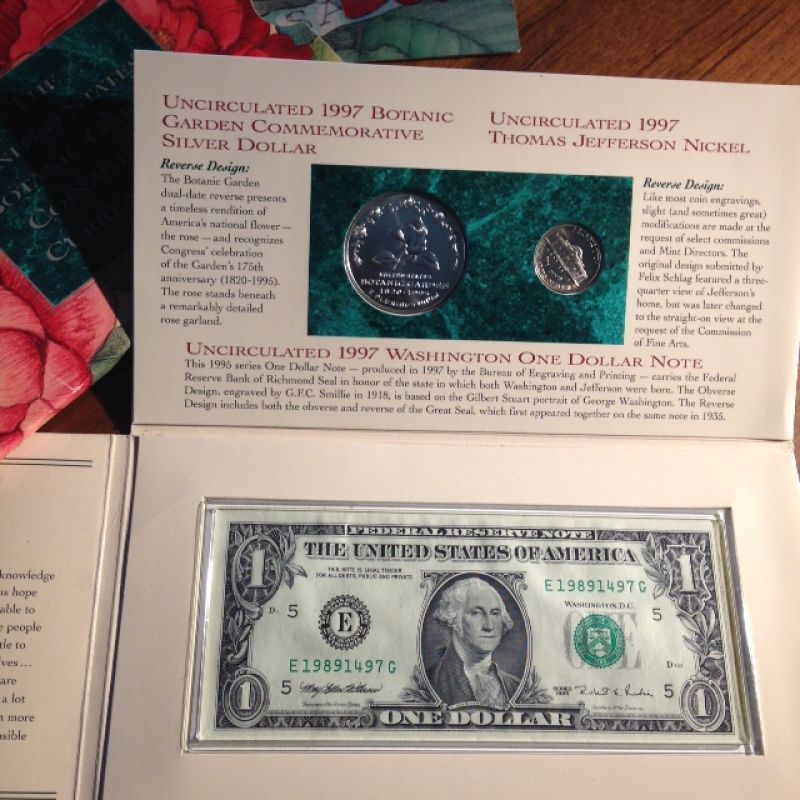
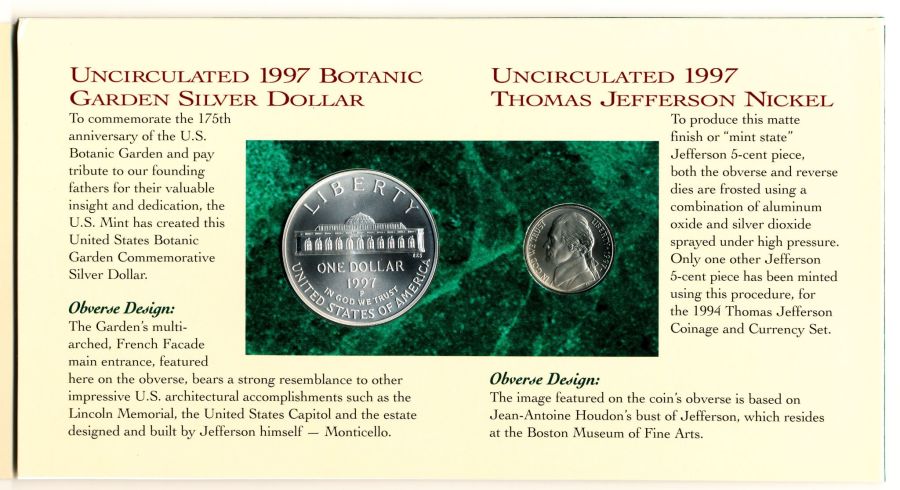
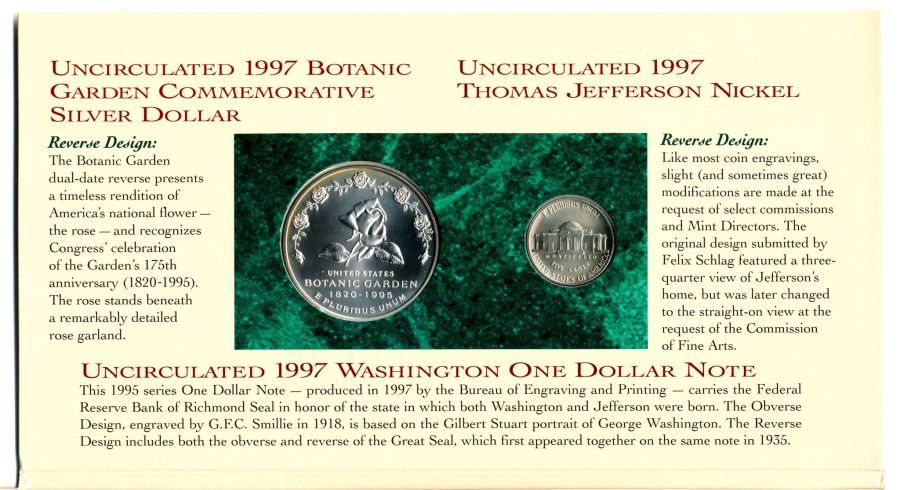
The Mint returned to the C&C set model in 1997 in support of the US Botanic Garden commemorative silver dollar. The set features an uncirculated version of the silver dollar along with a 1997 matte finish
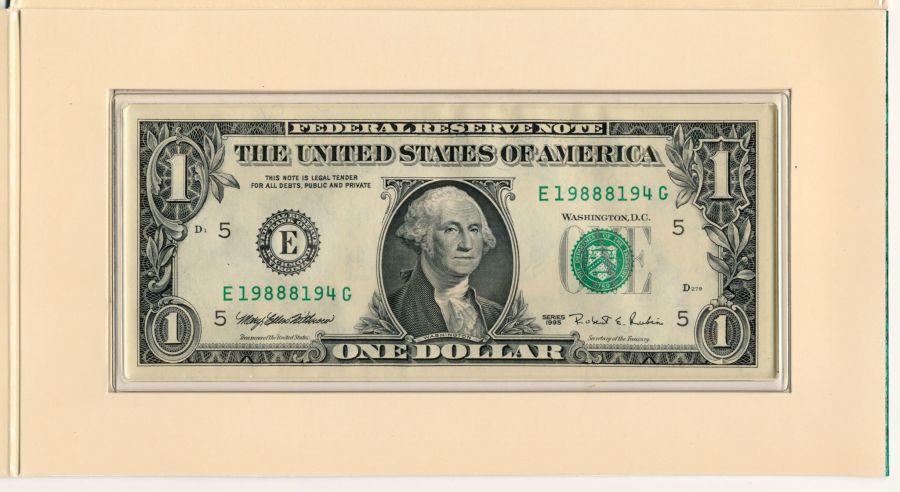
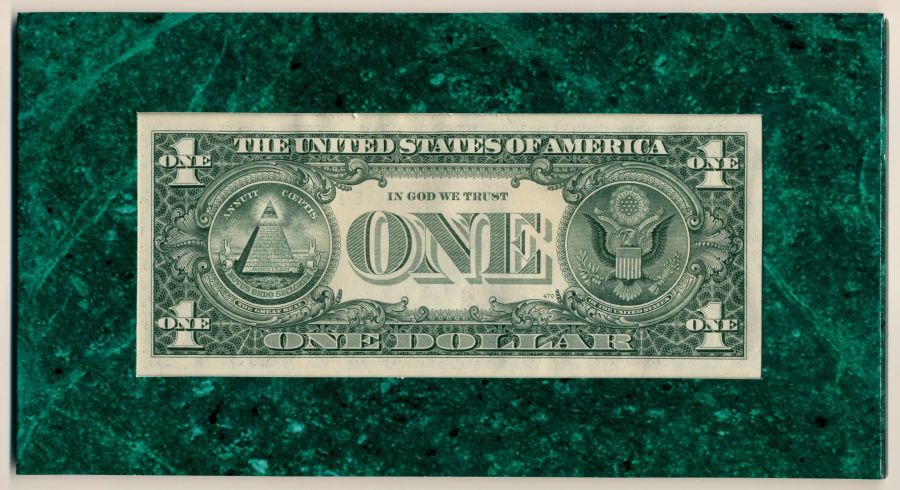
Jefferson nickel; the Mint created the matte finish on the nickel by using sandblasted dies and striking each planchet twice. The set also includes a $1.00 note from the Virginia Federal Reserve District.
The set also included a brief but informative booklet titled
A Living Memorial to our Founding Fathers: The United States Botanic Garden. It provides a concise history of the Garden and the roles George Washington, Thomas Jefferson, James Madison and James Monroe had in its founding. The numismatic components of the set are all embedded in a colorful folder that includes brief historical notes; the Certificates of Authenticity are printed on the back panel of the folder. The folder and booklet fit within a slipcase featuring the same color and design theme.
The sets went on sale, along with the other packaging options for the Botanic Garden silver dollar, on February 21, 1997. Collectors could call the Mint and order the individual proof and uncirculated versions of the coin, along with the 1997 Prestige Proof Set (the last year of such sets) that included a proof version of the coin. The C&C Set, however, could not be ordered over the phone.
In contrast to the "by mistake" open-ended production run for the Jefferson C&C set which resulted in total sales of 167,703 units, the Mint announced a production limit of 25,000 for the Botanic Garden set.
As such, the Mint anticipated a quick sell-out of the C&C sets, so it put in place an ordering process that it hoped would enable the largest number of collectors to acquire the set. Interestingly, it did not place an initial "per order" limit on the sets.
A summary of the ordering procedures:
1. Orders could only be placed via the mail; orders had to be postmarked no earlier than February 21, 1997 (the first day of sale for the coins).
2. Orders received that met the postmark criteria were sorted by the date and time of receipt. (Customers had to hope their local post office processed their outbound mail quickly!)
3. Orders were not immediately confirmed. The Mint first wanted to review the orders received to assess how many sets were being requested by each customer. If needed, it planned to retroactively place a "per order" limit on the sets to ensure a reasonably equitable distribution. Ultimately, it set a limit of five sets per order.
4. Once the limit was established, orders were confirmed and fulfillment began. Those ordering more than the established limit received the maximum number of sets allowed and a refund for any sets ordered above the limit.
The Mint announced that, on average, 1.93 sets were purchased per accepted order. Based on this, it would appear that about 12,950 orders were filled.
The pre-issue price for the set was $36. The regular price of the set was to be $41 after April 4, but the issue was completely sold out in less than a week. (The Mint announced on March 4th that the production limit had been reached on February 28th.)
The quick sell out of the sets suggests that even in 1997, a mix of collectors and speculators went after the limited edition C&C set. Prices rose on the secondary market quickly after the sell out was announced and selling prices in excess of $200 per set were not uncommon for several years after.
It should be noted that the primary interest in the set, as with the Jefferson C&C set, was caused by the inclusion of the satin finish
Jefferson nickel - not the included commemorative silver dollar. This has caused many of the sets to have had their nickel removed for placement in albums or submission to grading services. The mintage of 25,000 for the nickel is, by a wide margin, the lowest mintage of any non-proof nickel in the Jefferson series; the proofs of 1938-41 each had a mintage under 20,000.
In today's marketplace, the set can generally be purchased for between $140 and $160 via on-line auction sites such as
ebay, though sales outside of this range also occur with some frequency; for example, I've noticed a few go for lower prices over the past two months. I typically see the set listed for $175 or more on dealer web sites.
Following are images of the set's components.
1997 US Botanic Garden Coinage & Currency Set - Outer Sleeve - Front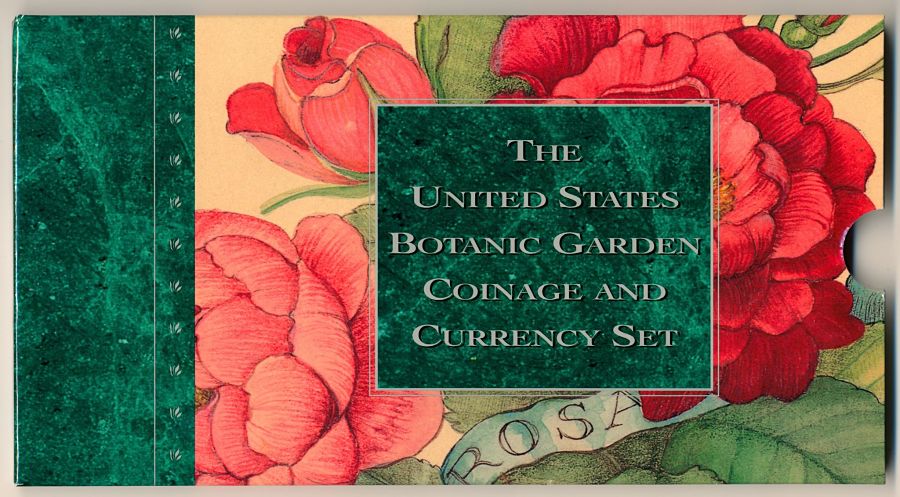 1997 US Botanic Garden Coinage & Currency Set - Outer Sleeve - Back
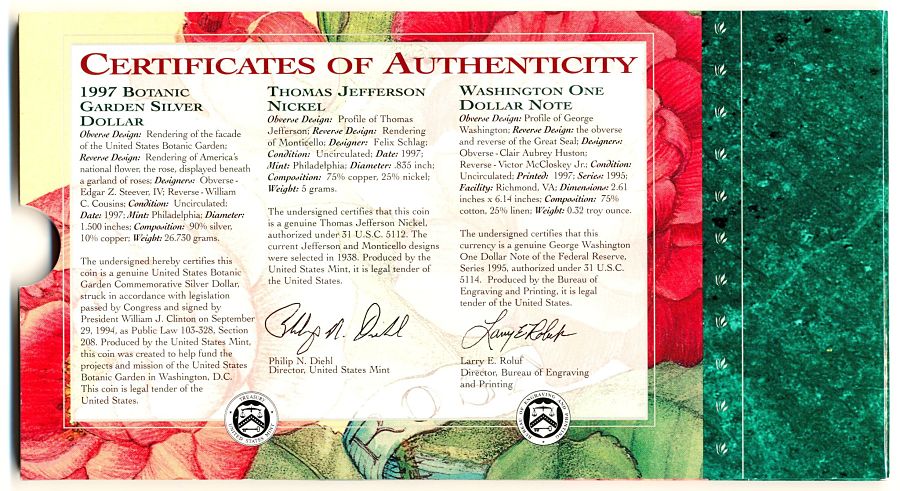 1997 US Botanic Garden Coinage & Currency Set - Coin Holder - Inner Left Panel
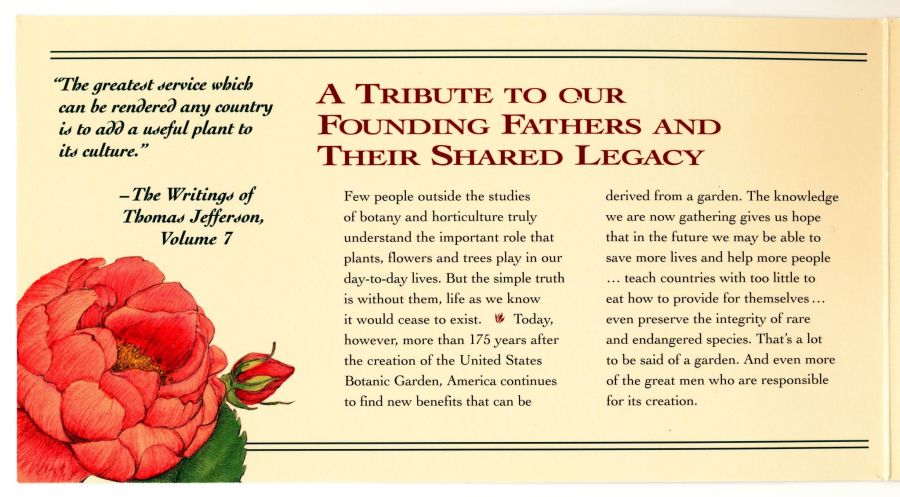 1997 US Botanic Garden Coinage & Currency Set - Coin Holder - Coin Panel / Obverse
  1997 US Botanic Garden Coinage & Currency Set - Coin Holder - Coin Panel / Reverse
 1997 US Botanic Garden Coinage & Currency Set - Coin Holder - Note Panel / Front
 1997 US Botanic Garden Coinage & Currency Set - Coin Holder - Note Panel / Back
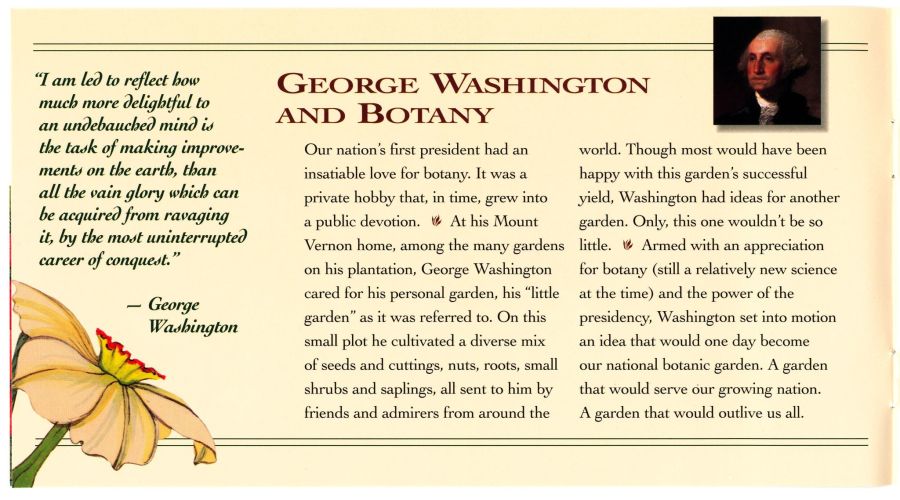
 1997 US Botanic Garden Coinage & Currency Set - Booklet - G. Washington Page
 Coming soon...a discussion of the American Buffalo Coinage & Currency set.Read More: Commems Collection






 Posted 08/21/2016 10:44 am