In honor of the upcoming Thanksgiving holiday in the US.
I first posted on the 1920 and 1921 Pilgrim commemorative coins more than five years ago - Where has the time gone! You can view them here:
1920 Pilgrim and
1921 PilgrimRead More: Commems CollectionAt the time, my posting approach was more in the style of show-and-tell vs. the historical narrative approach that I adopted in later posts. So, I thought I'd go back and present a bit more history related to the 1920 and 1921 Pilgrim half dollars.
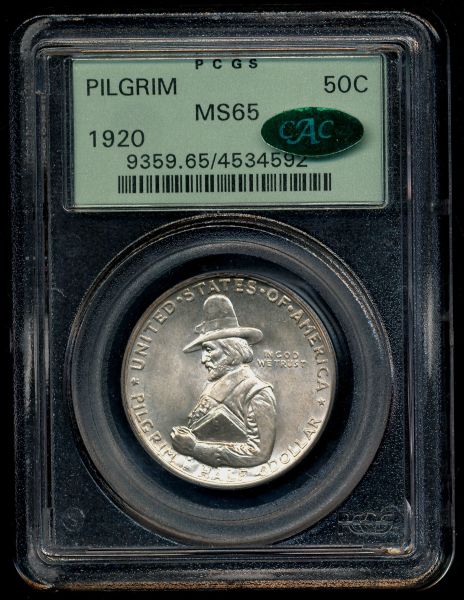
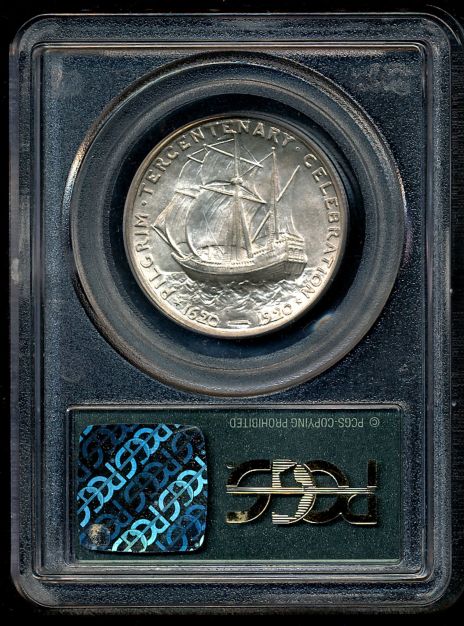
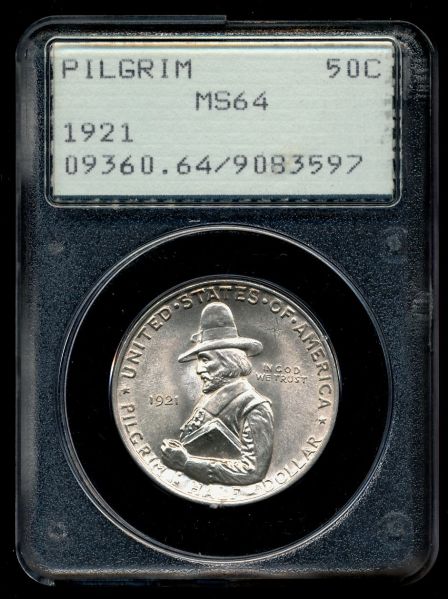
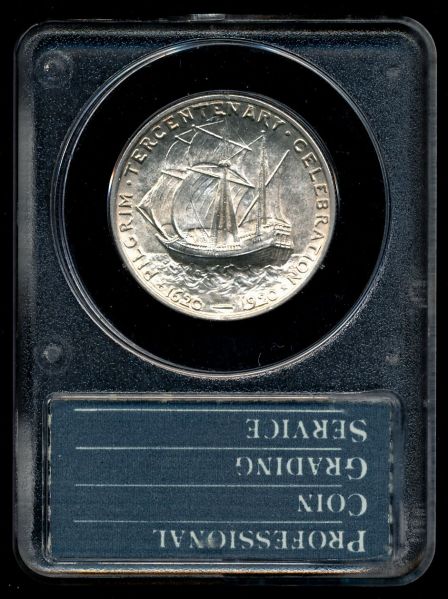
The 1920 commemorative half dollar that is commonly referred to as the "Pilgrim" among collectors was issued to commemorate the 300th anniversary of the landing of the Pilgrims in present-day Massachusetts.
The bill calling for the coin was introduced in Congress by Representative Joseph Walsh (R-MA) in March 1920. The bill moved quickly through Congress, with approval by the House coming on April 21 and by the Senate on May 3. The bill was signed into law by President Woodrow Wilson on May 12, 1920. Compare that to today's much more lengthy process!
Side Note #1: It is interesting to note that the label "Pilgrim" was not one that the first settlers used to refer to themselves. In fact, the term did not become regularly associated with them until approximately 1790 and did not become part of the common lexicon until the mid-1800s. Mayflower passengers who were seeking religious freedom in the New World (i.e., Protestant Separatists) referred to themselves as "Saints" and used the label "Strangers" in reference to the more secular passengers on board.The Pilgrim coin was, however, for all intents and purposes, an afterthought.
In May 1919, Congress appointed a joint commission "to confer with officials of the Commonwealth of Massachusetts and others relative to celebration of [the] landing of Pilgrims at Plymouth, Massachusetts." The commission included two Senators and four Representatives. It was tasked with learning about the celebratory programs and events being planned by officials in Massachusetts and then making recommendations to Congress for ways in which the US Government could participate in the celebrations.
Members of the commission made multiple trips to Massachusetts to meet with the Pilgrim Tercentenary Commission and the Provincetown Tercentenary Commission. Each of these Commissions had received money from the Massachusetts legislature and had developed significant plans for the redevelopment of the Pilgrim landing sites in Plymouth and Provincetown. Congress' commission came away impressed with the work each had accomplished and the plans that were in place.
Side Note #2: The famed Plymouth Rock was not the first place that the settlers who sailed on the Mayflower came ashore in the New World. On November 11, 1620 a group from the Mayflower waded ashore at a location today known as Provincetown, MA. Approximately five weeks later, the group sailed across Cape Cod Bay to the now famous site at Plymouth. It's interesting also to note that the November 11 date is based on the Julian calendar which was in use by England at the time vs. the more accurate Gregorian calendar in use by many other countries; England adopted the Gregorian in September 1752. Had England been using the Gregorian calendar in 1620, the date would have gone down in history as November 22!In February 1920, in its report to Congress, the US commission recommended that a nine-member United States Pilgrim Tercentenary Commission be established and that it be given access to a $400,000 appropriation that would be split between the two Massachusetts-based Commissions: $300,000 for the Pilgrim Tercentenary Commission and $100,000 for the Provincetown Tercentenary Commission. It also recommended that the Postmaster General be authorized to produce stamps for the historic anniversary. Each of these recommendations was included in a joint resolution of Congress that was signed into law by President Wilson.
Notice that the commission made no mention of a commemorative coin.
During a hearing before the House Committee on Coinage, Weights, and Measures on March 26, 1920, Representative Walsh stated "the matter of the coinage of 50-cent pieces did not occur to the committee [sic]" he went on to add "I am frank to say that it only occurred to me through having noticed upon the calendar the report from this committee with reference to the one-hundredth anniversary of the admission of the State of Maine."
It was clear from his testimony during the hearing that Walsh was not very familiar with US commemorative coins or the legislation necessary for each to gain approval. He did, however, do his homework on concurrent commemorative coinage legislation and based the language of his bill on the legislation for the Maine Statehood half dollar (which was, in turn, based on the approved legislation for the 1918 Illinois Statehood commemorative coin)..
As originally written, the Pilgrim bill called for the minting of 500,000 coins. During his remarks to the Committee, Walsh stated that he believed the landing of the Pilgrims had a "wider significance than that of the admission of a state" (referring to the 100,000 coins called for in the Maine bill) and that interest in the Pilgrim anniversary had already extended across the country vs. being restricted to Massachusetts or even New England.
While not challenging such assertions, Representative William Albert Ashbrook (D-OH) objected to the amount of silver that would be removed from circulation by producing 500,000 coins, considering that most would be saved as souvenirs vs. being placed in circulation. He suggested the striking of a more modest 300,000 coins. Walsh readily agreed to amend his bill to the 300,000 figure.
The Mint began delivering the coins to the Shawmut National Bank of Boston, the authorized distributor of the coins, in October of 1920; banks around the country that had requested coins for local distribution started to receive theirs in November and December. The coins were sold for $1.00 each.
History shows that 300,000 coins were more than enough to meet the demands of collectors and souvenir seekers among the general public. Just 152,112 of the 1920 issue were ultimately distributed. An additional 20,053 coins of a second variety featuring a small "1921" on the obverse were also sold. The combined total of just over 172,000 coins means that nearly 128,000 of the potential 300,000 were not needed.
So, fans of the 1920 and 1921 Pilgrim half dollars should thank the sponsors of the Maine Statehood Centennial piece - without them, the Pilgrim coin may never have happened!
Happy Thanksgiving!







 Posted 11/22/2017 7:55 pm





