Forty years ago this month, the 1978 Eleventh Commonwealth Games were held in Edmonton, Alberta, Canada (August 3 - 12). Forty-six members of the Commonwealth of Nations participated in ten athletic event categories: Athletics (i.e., Track & Field), Shooting, Gymnastics, Boxing, Cycling, Lawn Bowls, Wrestling, Badminton, Swimming/Diving and Weightlifting.
Canada led all teams in total medals won (109) and gold medals won (45); they were second in total silver (31, two behind Australia) and tied for first (with England) in bronze (33). Clearly, the home team did well!
To mark the games being hosted by Canada for just the third time - Hamilton, Ontario hosted in 1930 and Vancouver, British Columbia followed in 1954 - the
Royal Canadian Mint (
RCM) celebrated the Games with the issue of a commemorative silver dollar.
In its marketing of the SD, the
RCM described the coin as being a first for it: the first time it had struck a silver dollar with relief as well as incuse design elements.
The obverse of the coin presents the Arnold Machin portrait of Queen Elizabeth II in standard relief; all obverse inscriptions are also in relief.
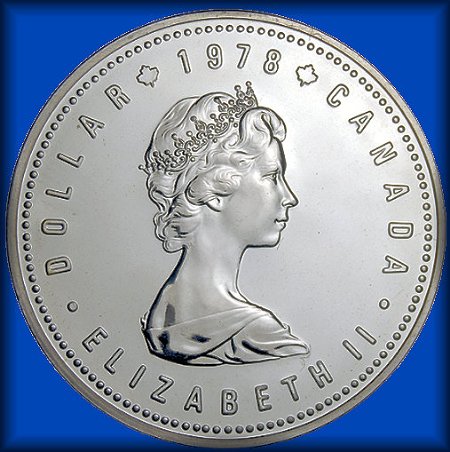
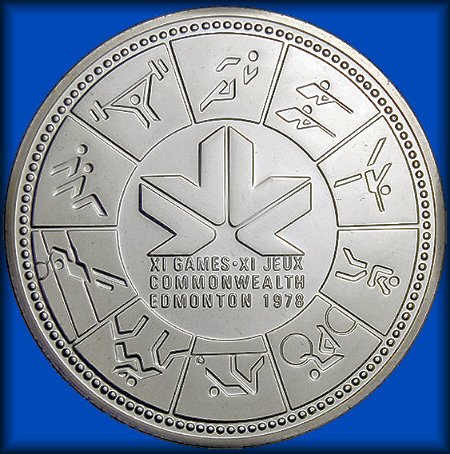
The commemorative reverse, however, features a mix of relief and incuse elements. It was designed by Toronto artist Raymond Taylor and engraved by Victor Cote. Raymond's design was selected from 34 submitted by Canadian artists.
Taylor's designs can also be found on the reverse of the 1970 Manitoba nickel dollar, and the reverse of the 1988 Figure Skating and Ski Jumping silver $20 coins issued as part of the
RCM's 1988 Calgary Winter Games series.
At the center of the 1978 SD's reverse, the Games logo and the inscription "XI GAMES - XI JEUX / COMMONWEALTH / EDMONTON 1978" are presented in relief. Surrounding this are 10 truncated pie segments in relief, each featuring an official pictograph (i.e., stylistic representation) of a sport included in the Games - each pictograph is incused or sunk into its assigned pie segment.
The
RCM's marketing claims aside, the coin features only the most basic implementation of the incuse design style. In fact, it can be realistically argued that simply pressing plain shapes into the coin's surface is not actually creating an incuse/sunken design but rather just a sunken area that is devoid of design.
For those unfamiliar with the incused engraving approach, it is a technique that instead of producing design elements that are raised above the surface / field of a coin (used for almost all coins) it creates elements that are sunk or pressed into a coin's surface.The
RCM used the incuse design technique much more effectively earlier this year on special versions of the 2018 Silver and Gold Maple Leaf coins, as well on its recent silver and gold "Welcome to the World" coin series in which the design of a new-born infant's feet is incused on the reverse.
A couple of interesting notes about the issue:
1) The obverse features a smaller than typical portrait of QE II; the portrait's size was reduced to make room for the inclusion of additional inscriptions.
2) The reverse of the coin did not feature the legend "CANADA" or the denomination "DOLLAR." The issue was the first SD in Canada's history (including SDs issued for circulation) to place these two inscriptions on the obverse vs. reverse.
The coin is 36.07 millimeters in diameter, weighs 23.3276 grams and has a composition of 50% silver and 50% copper. It was struck with a Specimen finish. The coin originally sold for $4.50 CAD. The coin was encased in a plastic capsule inserted into a plain black frame and then placed in a rectangular black leatherette clamshell case with a white slipcase. Mintage for the coin was 640,000, a figure that accounts for its ready availability and low price in today's market - the coin generally trades for under $10.00.
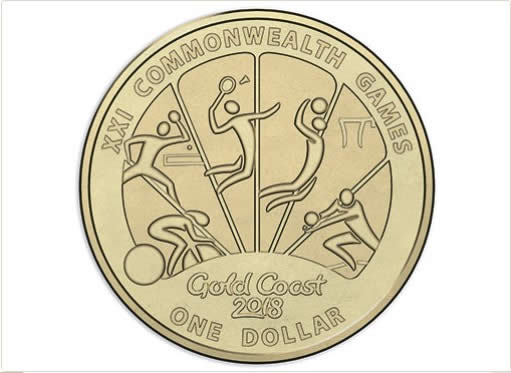
This year, the XXI Commonwealth Games were held in Australia in its Gold Coast region along its east coast. The Royal Australian Mint (RAM) issued a series of coins to mark the Games, including a series of $1 coins whose designs recall that of the
RCM's 1978 Edmonton issue. You can see them here
2018 Gold Coast Commonwealth Games Coins.
(You'll need to scroll through the coin images to see the $1 coins.)








 Posted 08/20/2018 1:28 pm





