| Author |
 Replies: 38 / Views: 10,164 Replies: 38 / Views: 10,164 |
|
|
|
Moderator
 United States
109671 Posts |
I use Numista everyday to research my coins - sometimes I use their forum to ask question about their site - quite helpful.  Numista is a Great resource to use. |
|
Pillar of the Community
United States
3015 Posts |
Yes, numista is definitely worth the effort as I use it all the time and I am a regular contributor with 83 as of today validated pages added from my own collection with more to come. I use numista on the 20 questions forum game here, and for my own research on some scarce items in my collection that otherwise I may know next to nothing about. So yes, two thumbs up for Numista from whatever I may need it for! |
|
Bedrock of the Community
Canada
10030 Posts |
Yes Numista is a good site , you can list all your coins and when done it will tell you what you have for countries and how many in each.
|
|
Valued Member
United States
227 Posts |
I guess I'll be the outlier and say it isn't overly useful from my perspective.
A lot of info seems to be missing.
The indexing is horrible. Searching for something like "numista saxony bartgroschen" pulls up a Numista page of 802 "Items from the Electorate of Saxony (Albertinian Line)" in an order that I've never been able to figure out for any coin.
The rarity index values are not accurate.
I don't think I've ever seen a coin with valuations.
The page for "spitzgroschen" has "See also # Cat or feline."
It's just really hit or miss for my interests, and I've never seen anything on the site that's not in a reference I already own. (To be fair, I have most references, so maybe it's more useful to others.)
Note: I focus on medieval European coins, so my perspective of the site is entirely from that lens.
|
|
Pillar of the Community
Russian Federation
5186 Posts |
Quote:
Note: I focus on medieval European coins, so my perspective of the site is entirely from that lens. Medieval European coins have a ton of varieties, most of which are fairly rare. Valuations require multiple recorded values for the same variant; this is unlikely to happen in a field as immense as medieval Europe. The rarity index values are just "how many Numista members have this". I suspect that most medieval European coins are not actually listed by any Numista members. The missing info is usually just because no one added it yet; Numista is fundamentally a collaborative database. It is also usually hard to add coins that aren't in any major references yet, which would explain why you're not finding anything new. The ordering is generally by denomination and then by date, though they might have changed it recently. It can indeed get confusing, especially when denominations are nontrivial and/or entered incorrectly. There is an intra-site search function, which mostly works. On my own end, with a much more modern focus, I'm annoyed by the relatively recent (post-2020, I think) decision to merge the exonumia catalog into the main catalog, in a way that makes it strongly nontrivial to look for many kinds of coins without a gazillion irrelevant results for random tokens/medals/rounds. This is unlikely to come up anywhere near as much for medieval coins, though. |
|
Pillar of the Community
 United States
4623 Posts |
Numista is crowdsourced. If you have information, feel free to add it.
-----Burton 50+ year / Life / Emeritus ANA member (joined 12/1/1973) Life member: Numismatics International, CONECA Member: TNA, FtWCC, NETCC, EveryCountry (online) coin club Owned by three cats and a wife of 40+ years (joined 1983) Author: 3rd Edition of the Sample Slabs book, https://www.sampleslabs.info/ |
|
Bedrock of the Community
United States
19679 Posts |
I've had reasonable success using Numista.
|
|
Bedrock of the Community
United Kingdom
19131 Posts |
I have reached a milestone on Numista! Still a long way to go if I list my entire collection, but I have now listed 500 items from 100 countries! 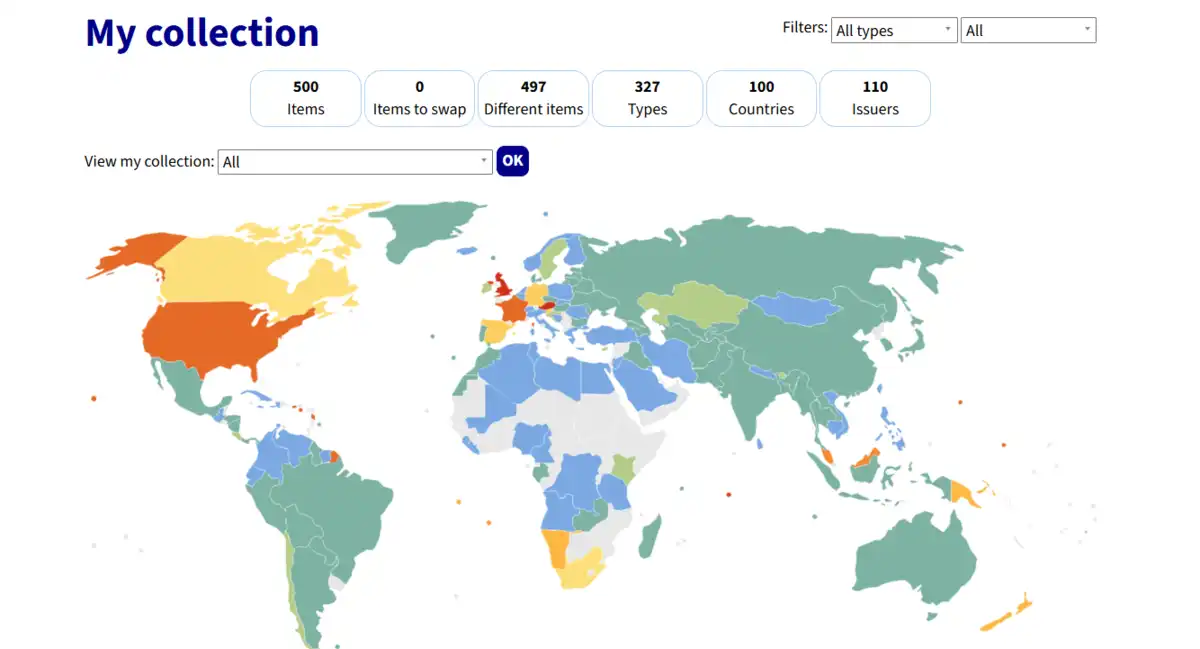 |
|
Bedrock of the Community
United States
19679 Posts |
Five hundred items from 100 countries....excellent!
|
|
Moderator
United States
197789 Posts |
Quote:
I have reached a milestone on Numista! Still a long way to go if I list my entire collection, but I have now listed 500 items from 100 countries! Outstanding!  |
|
Moderator
United States
109671 Posts |
Fantastic Milestone NumisRob |
|
Moderator
United States
109671 Posts |
This is my Numista World map as of today. 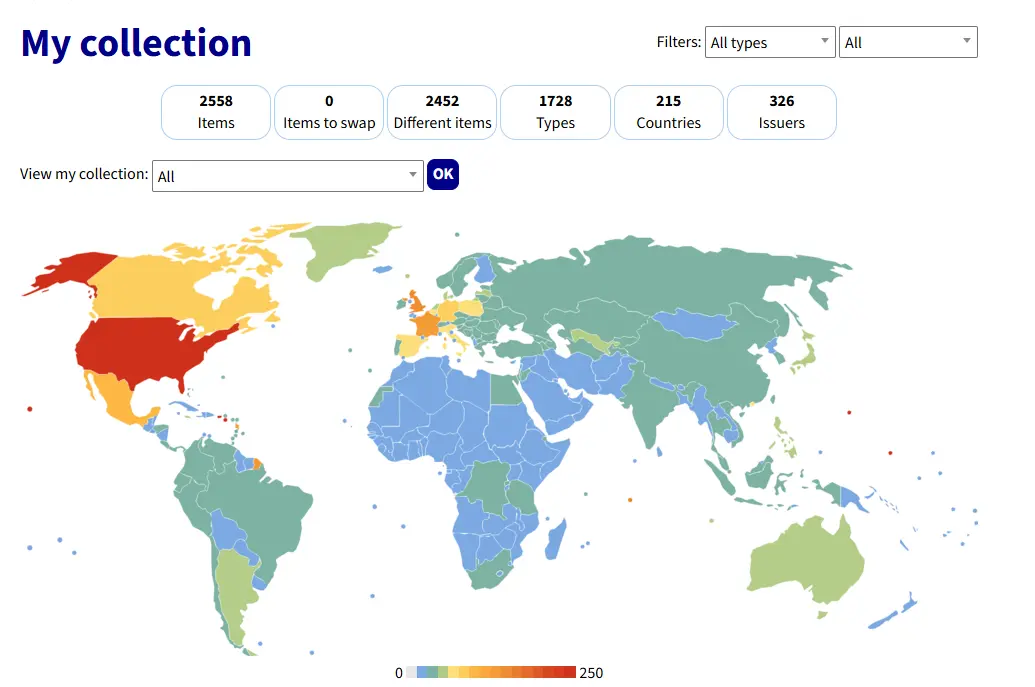 |
|
Bedrock of the Community
Canada
10030 Posts |
Dearborn 215 countries doing great, congrats
|
|
Pillar of the Community
United States
6895 Posts |
Quote:
This is my Numista World map as of today. What does the bottom of that map look like?  |
|
Pillar of the Community
United States
8074 Posts |
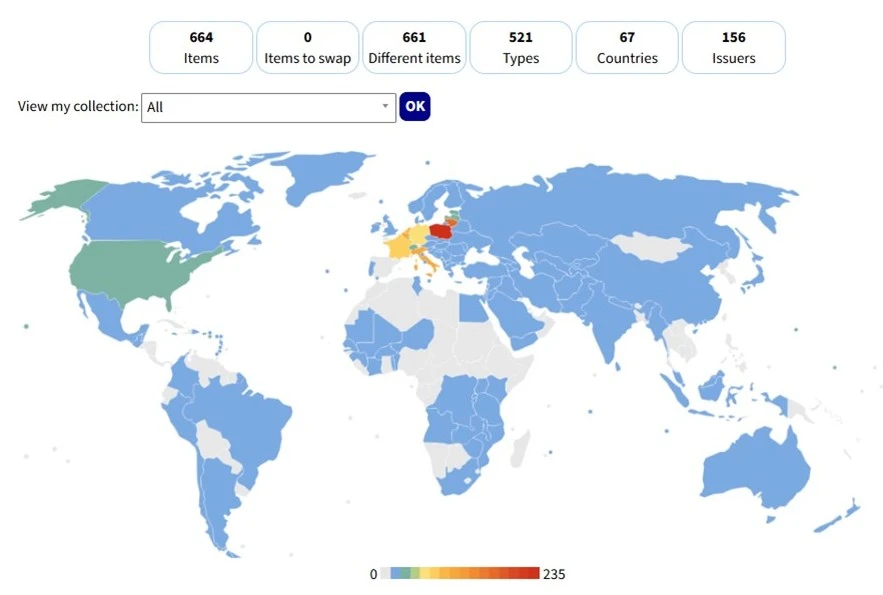 My collection map is strongly "bimodal." Hotspots in Europe (especially Poland, Lithuania, Italy, Low Countries) where I collect older stuff according to certain themes, and lots of blue (1 per country) for my birthyear collection. Also the ratio of "Issuers" to "Countries" is higher than either Dearborn or NumisRob probably because I have a lot of German States and Italian States coins. There's also this chart: 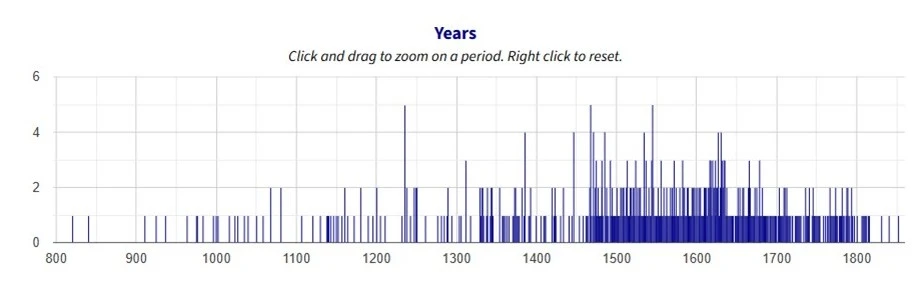 It might help me track my OFEY runs, except it also catches undated coins by the first year of their date range, so I would need to find a way to exclude those. Numista is different things to different collectors. If your collection is very specialized, like samoth, I agree it's not terribly useful, because you already have the specialty catalogs that feed Numista. If you collect mostly modern world coins, you can find them in the KM catalog (though there are mistakes and omissions there which are sometimes corrected in Numista). If you like to see patterns like in these charts, or if you just want to keep track of what you have, Numista can be a nice tool, though if you're handy with creating your own database, then you can customize its design more narrowly for your needs. If you get familiar with using the various filters, etc in doing searches, it can be helpful for figuring out your unknowns. But not always, since some of the listings are missing data (weight, diameter...). Edited by tdziemia
08/22/2026 10:31 am
|
| |
Replies: 38 / Views: 10,164 |





 First Page


 Posted 05/15/2026 06:38 am


