Depending on die state, there are several die markers that
may be on the 1918-D/1917-D
DDO. Not all of them will appear on most coins. Lack of a marker is not decisive. Presence of multiple markers is an indicator, but is also not decisive. Many of these markers appear on other Buffs of various dates. The mm position exists on other 1918-D Buffs, as well.
There are a number of charts, line drawings, and alignment indicators showing the location of the "7" relative to the second hubbed date (1918). Some of these show the "7" relative to the first "1" and the "9", and may be helpful.
Here are the markers that I have seen (and argued about) over the years.
Obverse:

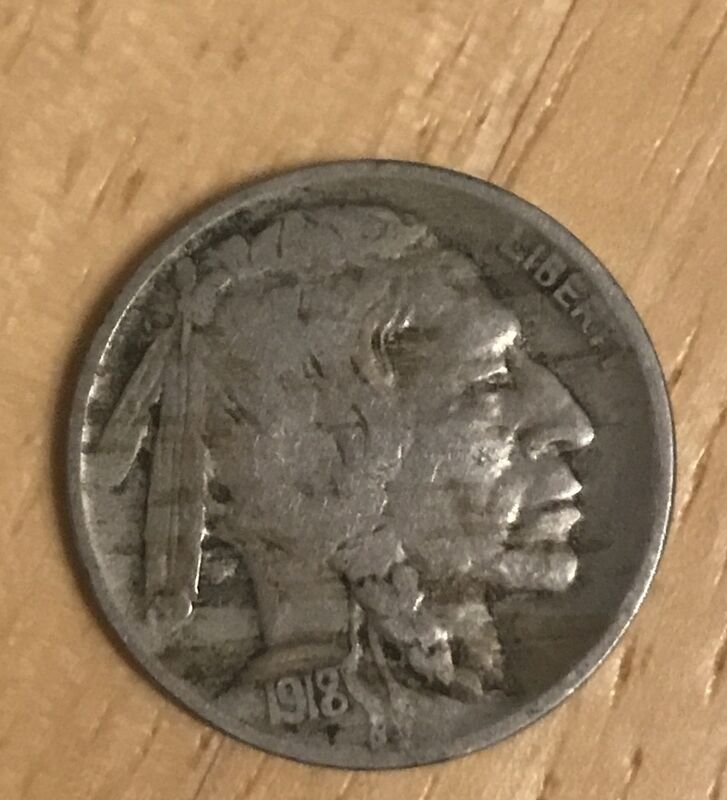
The most prominent marker (and the one that is universally accepted) is a WNW-ESE light die crack from the hair immediately above the knot, angling slightly downward toward the crease in the lips. The crack starts at the SE corner of the first tuft of hair above the knot. It ends on the cheek, but aligned with the westernmost crease in the lips.
There is a small die chip below the right lower horizontal of the "E" in LIBERTY. When this appeared on the die is anybody's guess, and whether it eventually wore away is everybody's arguing point.
There are die polishing lines straight below the "LIB" of LIBERTY (from the LIBERTY/right rear leg clash). These are in line with the letters, and barely angled. These will not exist for all die states. On some coins, a remnant of the leg clash may be visible at the base of the "I" in LIBERTY. This, too, either was polished away or wore away on later die states.
There may be a very weak die crack from the eyebrow north, then curving west toward the juncture of hair and the forehead. This is unlikely to be seen on any circulated coin. Frankly, it may well not be seen on an UNC coin.
There may be a light die gouge straight east from the tip of the nose,
very near the rim. This is also difficult to see on a circulated coin, and very likely would blend with the rim on coins below EF.
Reverse:
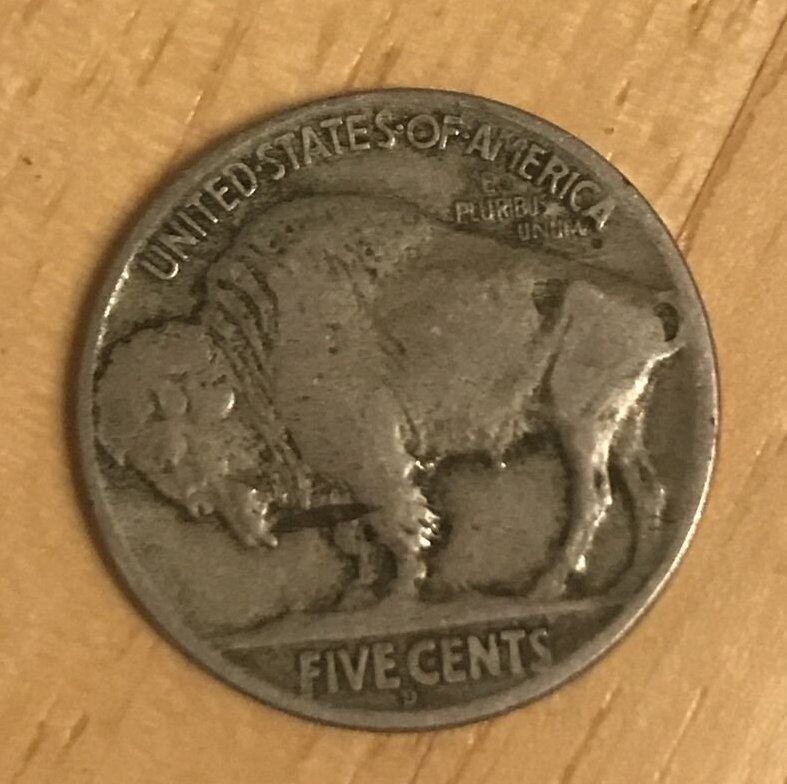
The mm location is a key, but is not decisive. Everone agrees with the mm ;position. On a Buff, the "E" on FIVE always has a chiseled lower horizontal, with a NE-SW angle. This is a design element, and not a marker. It is the measuring point for mm position, however. The SW end of that chiseled design is directly in line with the westernmost tip of the top serif of the mm on the 1918-D/1917-D
DDO. The mm is completely below the line extending from the bottom of the "E" in FIVE to the bottom of the "C" in CENTS. The mm is positioned roughly one-third of the distance between the "E"-"C" bottom line and the rim.
There is a
very small die gouge immediately above the curl of the tail, adjacent to the rim. This is usually blended into the rim on average circulated coins.
What would be very helpful would be clear photos of the obverse and reverse. The posted pics are too blurry to be sure. Closeups of "LIBER" of LIBERTY, the area at the rim straight east of the tip of the nose, the date, the cheek between the top of the ribbon and the crease of the lip, the mm position, and the curl of the tail could be helpful.
To get a good, clear picture, use a cell phone. Place the phone on a stack of 3 or 4 books, with the coin filling the complete frame of the photo. A dark solid color surface beneath the coin helps. Focus the camera and adjust the lighting. Use the highest resolution picture setting, and then copy the photo and crop it for the detailed shots. Reduce the resolution to upload the full coin pics.
FWIW, I think you
may have it. The date looks right, but is blurred. I
think I see the dot below the SE corner of the "E" in LIBERTY and I
think I see the eastern half of the knot-to-lips die crack. I even
think I see the small gouge above the curl of the tail. The mm position looks right. (After all that thinking, my wife probably thinks I'll see UFOs next.)
Let's see your in-hand photos. We're pulling for you!









 Posted 03/17/2021 1:17 pm





 , details for the damage on the back, but 100% the 8/7


