The 1995-96 commemorative program for the 1996 Atlanta Olympic Games stands as the largest US coin program (in terms of distinct coins) in either the classic or modern era of commemoratives. The two-year program included four CuNi-clad half dollars, eight 0.900 fine silver dollars and four 0.900 fine gold half eagles ($5 coins) - half were issued in 1995, half in 1996. As each was available in Proof and Uncirculated versions, a "one of every coin" collector needs 32 distinct coins to have a complete set!
For discussion here, I present the 1996 Atlanta Olympics High Jump silver dollar.
The obverse design of the High Jump silver dollar was created by Calvin Massey, an independent professional artist. US Mint Sculptor-Engraver (and future Chief Engraver of the US Mint)
John Mercanti modeled Massey's design in preparation for the creation of the coin's dies. Massey's initials are seen at the rim at approximately the 4:30 clock position; Mercanti's "JM" initials follow the "CM" of Massey.
The design features a female high jumper in mid-jump - shown at the moment she is clearing the bar. She is jumping with her back to the bar (i.e., the "back-first technique), a style developed and popularized by Dick Fosbury - it became famous internationally after he used it to win the Gold Medal at the 1968 Olympic Games in Mexico City.
Fosbury began developing his new jumping style while still in High School in 1963/64. It went on to become known as the "Fosbury Flop." Far from being a "flop," thee approach proved to be a very effective high jump technique and has been adopted by essentially all high jumpers around the world. At the Games in Mexico City, Fosbury used the technique to establish an Olympic record (at the time) with a jump of 7' 4-1/4". (Just FYI, the current World record (men's) for the high jump was set by Javier Sotomayor in 1993; he successfully completed a jump of 8' 1/4" (2.45 meters).
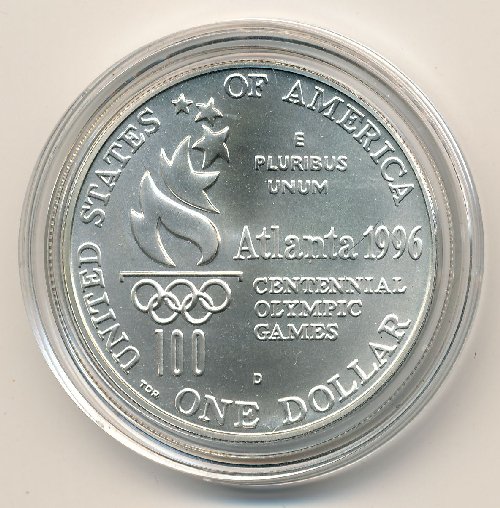
The four silver dollars of 1995 and the four silver dollars of 1996 each share, as a group, a common reverse design. The reverse design for each year includes the logo/emblem created by the Atlanta Committee for the Games of the XXVI Olympiad (ACOG). From Olympics.com, the emblem is described as follows:
"The base of the torch mark logo, made of the five Rings and the number 100, resembles a classical Greek column and recognizes the centennial of the Games. The torch mark's flames gradually evolve into a perfect star symbolizing each athlete's pursuit of excellence. The gold color in this logo represents gold medals. The green represents laurel branches worn by winners in ancient times, as well as Atlanta's reputation as the City of Trees."
Emblem of Atlanta Committee for the Games of the XXVI Olympiad (ACOG)
The reverse of the 1996 dollars feature ACOG's logo/emblem at left, with commemorative inscriptions to the right of the emblem and legally-required inscriptions around the rim. The coin's design captures the stylized design of the ACOG emblem and its flames into stars, depicting one partial star and three fully-formed stars. The design and modeling are the work of US Mint's Sculptor-Engraver
Thomas D. Rogers, Sr.
The Proof version of the coin carried an issue price of $34.95 ($30.95 Pre-Issue); the regular prices of the Uncirculated coin was $31.95 ($27.95 Pre-Issue). The authorizing legislation for the coins specified a maximum of 1,000,000 coins for the issue, but actual sales fell far short of such a figure. The Proof version of the coin sold 127,173 units, with the Uncirculated version selling 16,485. The 143,658 total coin sold is just ~14.4% of the maximum allowed!
The coins were available individually, as well as part of 32-coin, 16-coin, 8-coin, 4-coin and 2-coin sets - lots of options for the collector!
1996 Atlanta Olympics High Jump Silver Dollar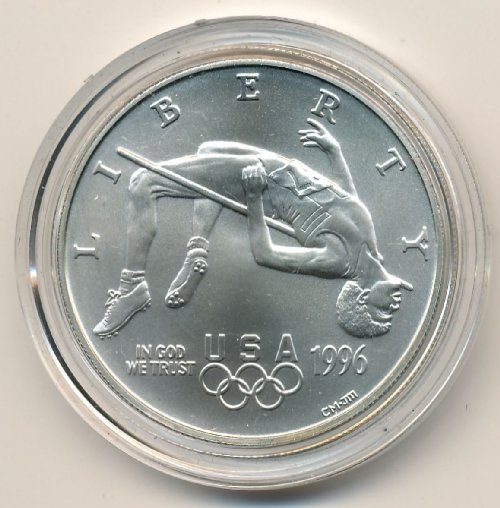
For other of my posts about commemorative coins and medals, check out:
Read More: Commems Collection.










 Posted 11/22/2021 05:34 am


