For background on ARBA and its medal program, see:
US Mint ARBA Medals - Part I And now, the medals...Though it was originally hoped that the first commemorative medal would be struck by the Mint and released in 1971, various delays caused their approval to be pushed into early 1972. With the approval of PL 92-228 in February (see Part I, link above), the ARBC and the Mint were able to coordinate on the first medal of the series and have it ready for launch on July 4, 1972. Medals were produced in 1972, 1973, 1974, 1975 and 1976; a distinct design was used for each year. In 1972, only bronze medals were issued; from 1973 through 1976, bronze and sterling silver medals were issued.
(Note: All of the images presented are of the medals in their Philatelic-Numismatic Cover (PNC) sleeves, and, as a result. are not perfect!)1972 ARBA Medal: George Washington/Sons of Liberty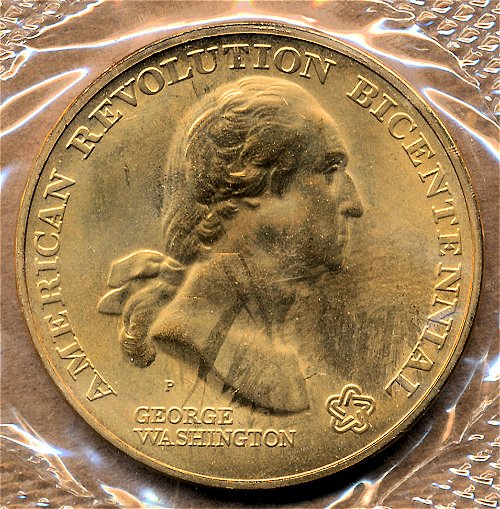
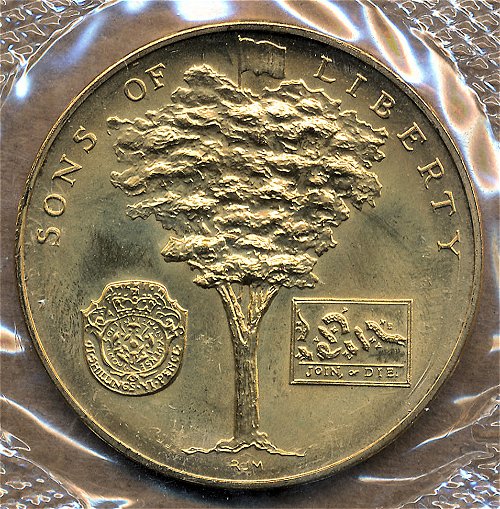
A right-facing portrait of George Washington, based on the famous Houdon bust, is featured on the obverse of the
1972 medal; the reverse design depicts the Liberty Tree - symbolic of the Sons of Liberty - as its central element with a tax stamp at the lower left representing the oppressive Stamp Act and the "Join or Die" cartoon of Benjamin Franklin at the lower right recalling the need for the colonies to unite in their fight against the Crown and for their freedom. Ralph Menconi was the medal's designer/engraver.
1973 ARBA Medal: Samuel Adams & Patrick Henry/Committees of Correspondence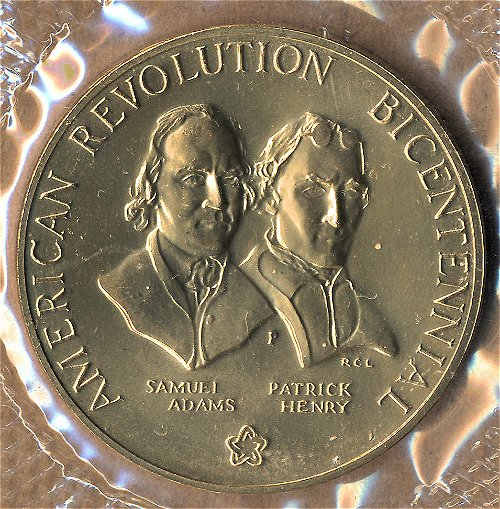
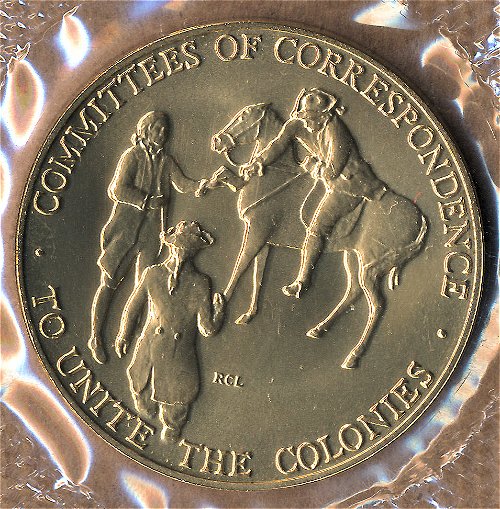
Front-facing, three-quarter portraits of Samuel Adams (left) and Patrick Henry (right) are presented on the obverse of the
1973 medal. The reverse depicts a mounted express rider that delivered important messages for the Committees of Correspondence; the Committees were groups of colonial patriots in various towns across the colonies that kept each other apprised of British activities of oppression and to encourage American resistance. Richard Layton was the designer/engraver.
1974 ARBA Medal: Samuel Adams & Patrick Henry/First Continental Congress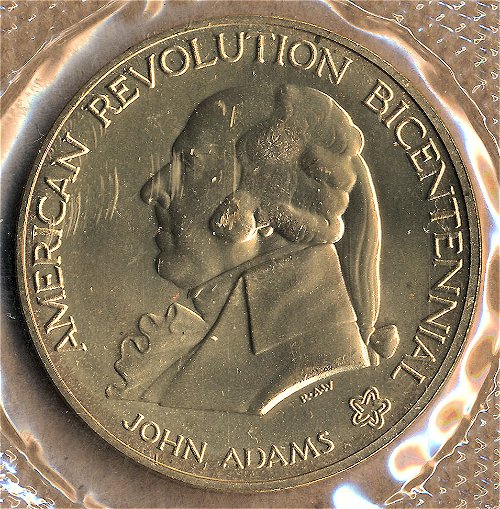
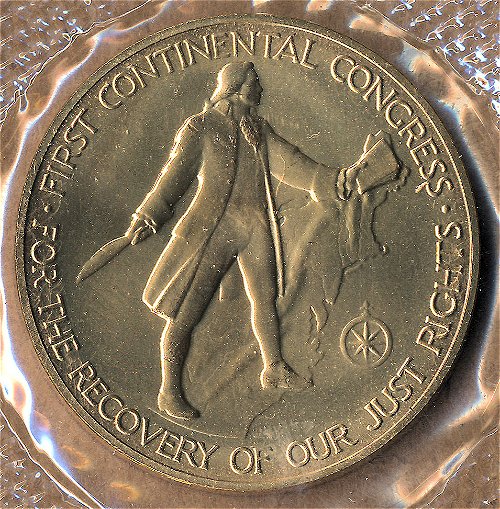
The obverse of the
1974 medal features a left-facing profile portrait of John Adams. Adams was a member of the First and Second Continental Congresses and also was elected as the second US President. The design of the medal's reverse commemorates the First Continental Congress. It depicts an unnamed member of the Congress superimposed over a relief map of the east coast of America. The medal is the work of Robert Weinman, the son of
Adolph Weinman (of Winged Liberty Head/Mercury Dime and
Walking Liberty half dollar fame).
1975 ARBA Medal: Paul Revere/Lexington-Concord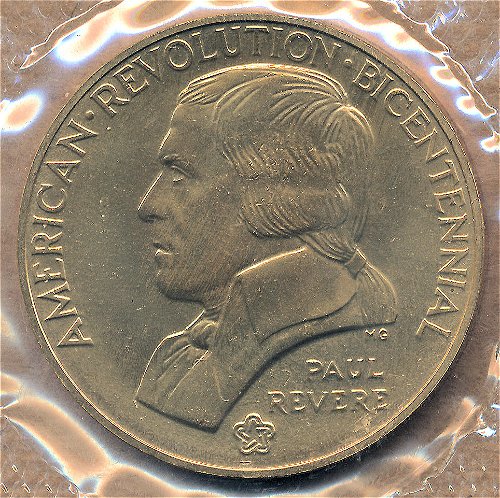
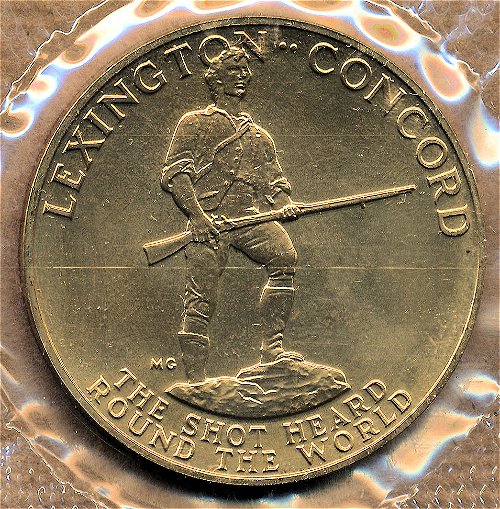
Paul Revere was depicted on the obverse of the
1975 medal, shown via a left-facing profile portrait similar in style to 1974's John Adams portrait. The reverse of the medal depicts Henry Hudson Kitson's
Lexington Minute Man statue which stands in the Lexington Battle Green in Lexington, MA. Kitson's work should not be confused with Daniel Chester French's more famous
Concord Minute Man statue which is found today in Minute Man National Historical Park near Lexington, MA. Margaret Grigor was the designer/engraver of the medal.
1976 ARBA Medal: Thomas Jefferson/Declaration of Independence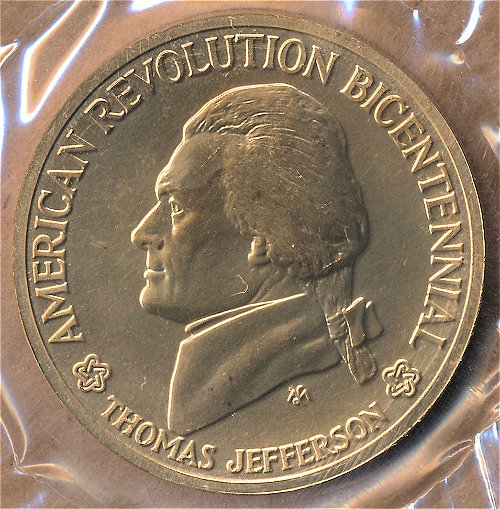
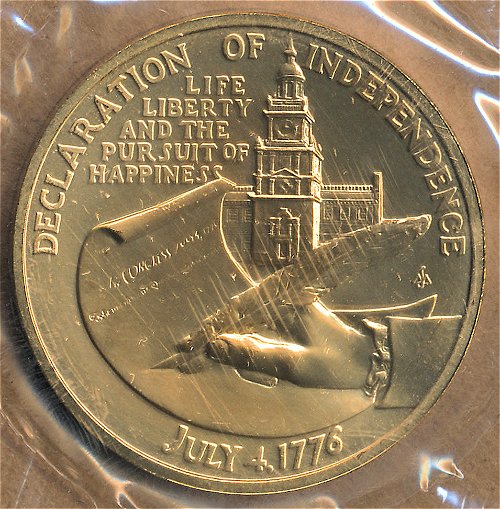
Fittingly, the
1976 medal, released during the 200th anniversary year of the US
Declaration of Independence, presents the primary author of the
Declaration, Thomas Jefferson, on its obverse. The portrait is very similar to the one found on the
Jefferson nickel of 1938 to 2004; that portrait was created by
Felix Schlag based on the Houdon bust of Jefferson. The reverse presents Independence Hall, where the
D of I was signed, in the background with a hand signing the document with a quill pen in the foreground. The medal's design is the work of Michael Lantz.
Series InformationNote: For more information about the history depicted on each of the medals, click on the PNC link below.
The obverse of each medal features the inscription "American Revolution Bicentennial" along with a small version of the official logo developed by the ARBC.
The bronze medals were offered in two packaging options each year: 1) housed in a small black plastic hinged case, and 2) in a philatelic-numismatic cover (PNC) which included a block of four Bicentennial stamps. The medals in the plastic cases are dated for the year of their issue; the medals in the PNCs are not dated (the postmark on the envelope indicates their year of issue). As the medals are the same, the absence/presence of the date is the way to know where individual medals originated.
To review the PNCs, including the informative insert that came with each cover, visit:
ARBA PNCs - 1972-76.The bronze medals in the plastic cases sold for $3.50; the medals in the PNCs sold for $5.00.
The silver medals of the series feature the same designs as their bronze counterparts. The sterling silver medals were encapsulated and placed into a clam shell case. The case for the 1973 medal was a blue leatherette clam shell ; for the 1974-76 medals, the case was black, soft-to-the-touch and more box-like - it was hinged.
The 1973 silver medals sold for $10 each; the price was raised to $15 each for the 1974 through 1976 issues. The silver medals are dated with their year of issue. (As noted above, no silver medal was struck in 1972.)
The silver medals were struck in sterling silver (0.925 fine). The medals weigh 480 grains (one troy ounce), so the medals contain 0.925 troy ounces of pure silver.
All of the medals, bronze and silver, were struck at the Philadelphia Mint.
Here are the final production/sales figures for the individually-packaged medals:
1972: Bronze - 672,200; Silver - NA
1973: Bronze - 237,790; Silver - 208,120
1974: Bronze - 188,308; Silver - 150,428
1975: Bronze - 327,677; Silver - 212,542
1976: Bronze - 151,140; Silver - 147,159
Here are the PNC production/sales figures:
1972: 791,000
1973: 475,812
1974: 511.428
1975: 668,419
1976: 446,939
FYI: No other US-produced PNC comes close to any of these sales numbers.Note: Selling prices and mintage/production figures are per the US Mint.In addition, the US Mint also struck a National Bicentennial Medal in various compositions and sizes. It, in all of its versions, will be a topic for another post I am preparing. Stay tuned!
(A favor, if you happen to see the text of this post re-published on another site, please let me know. I have begun to see the content of my posts (word for word) elsewhere without any credit given to me or CCF. I'm all about sharing accurate information, but I don't support outright theft!)







 Posted 01/31/2022 8:03 pm


