NGC -
Three Cent Nickels were struck in 75% copper and 25% nickel with a silver-gray color, but the coin submitted to NGC appeared to be made entirely out of copper.
Numismatic Conservation Services® (NCS®), a professional coin conservation company affiliated with NGC, recently received a coin that the submitter believed to be a rare die trial of an 1874
Three Cent piece. The submitter hoped that NCS conservation would improve the coin's eye appeal since at first glance it appeared to be corroded. This turned out not to be environmental damage, however; instead, it was a clue to this coin's nefarious origins.
A die trial is a coin struck using standard dies but in a different metal. These pieces were often used to test and inspect the dies; for example, a ten dollar gold piece might be struck in tin, a very malleable metal, to make sure that there were no die defects before regular production began. In the second half of the 19th century, die trials were commonly made for sale to collectors in sets, rather than simply test the dies.
Three Cent Nickels were struck in 75% copper and 25% nickel with a silver-gray color, but the coin submitted to NGC appeared to be made entirely out of copper. J. Hewitt Judd, author of United States Pattern Coins, identifies a copper die trial 1874
Three Cent piece as Judd-1348. Only three examples are known to exist, and a genuine specimen would be worth thousands, if not more.
The coin submitted to NGC had several pits and raised lumps, which led the owner to think that it was corroded. These issues, however, are the result of the technique used to create this fake. Termed "spark-erosion counterfeits," these coins are made through a process called electric discharge machining (EDM). EDM works by suspending a genuine coin in an electrolytic solution next to a piece of die steel. An electric current is introduced and the genuine coin emits sparks that etch its design into the die steel.
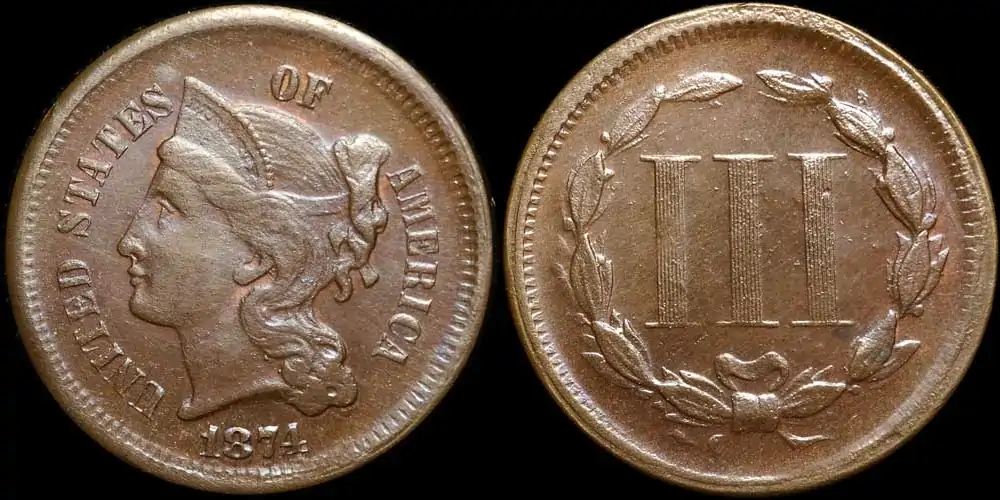 Counterfeit 1874 Three Cent Nickel
These tiny sparks leave pits and raised areas on the dies that are then transferred to any coins that are struck. In an effort to remove these imperfections a counterfeiter will often heavily polish the dies, which will then make the struck coin's surfaces mirrored, similar to a proof issue. In the case of this 1874
Three Cent piece, the fields are only moderately reflective and there are numerous lumps and pits from the spark-erosion process.
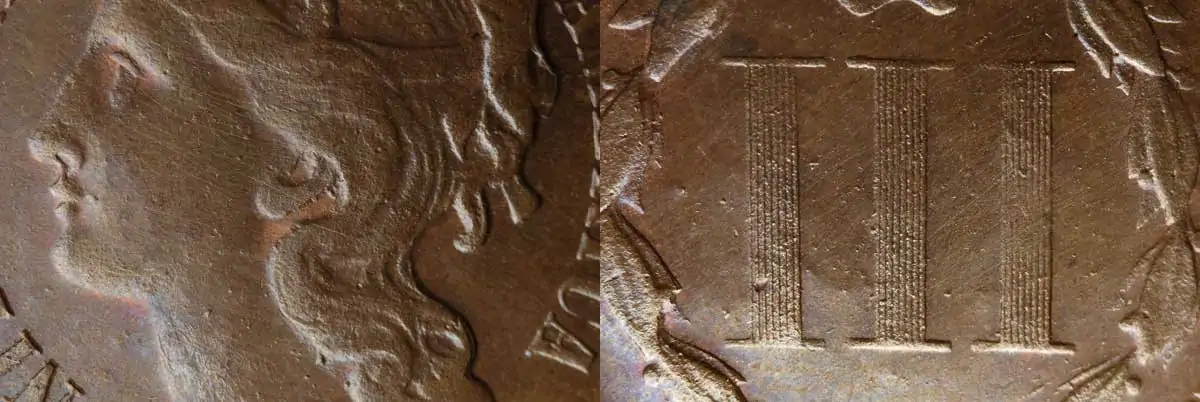 Counterfeit 1874 Three Cent Nickel
This counterfeit was probably copied directly from a genuine, circulation issue 1874
Three Cent Nickel. Spark-erosion is a decent method to copy a coin's details, so the weakness of the design elements of this fake is probably a result of the weakness in the copied coin. Nonetheless, this process can be quite time consuming for the counterfeiter and presents numerous challenges. It is therefore relatively rare to come across these spark-erosion counterfeits.
Read More: Counterfeit Detection Series Check out 1874 Three Cent Nickels on ebay
.













 Posted 08/10/2023 3:54 pm


 Uncirculated American Silver Eagles




