In January 1947, Charles Wayland Brooks (R-IL) introduced a Joint Resolution in the Senate that called for silver half dollars to be struck "in commemoration of the two-hundredth anniversary of the birth of General Casimir Pulaski." A companion Joint Resolution was introduced in the House of Representatives by Robert Allen Grant (R-IN) in April 1947.
Casimir Pulaski was one of several European military officers who fought on the side of the colonists during the American Revolution. The Marquis de Lafayette (France), Comte de Rochambeau (France), Comte de Grasse (France), Tadeusz (Thaddeus) Kosciuszko (Poland) and Baron von Steuben (Germany) are a few others that come immediately to mind. Without the experience of these officers siding with the Americans, it is impossible to know if the results of the Revolution would have been the same - though it seems likely not.
Casimir Pulaski in defense of Czestochowa, Poland by Juliusz Kossak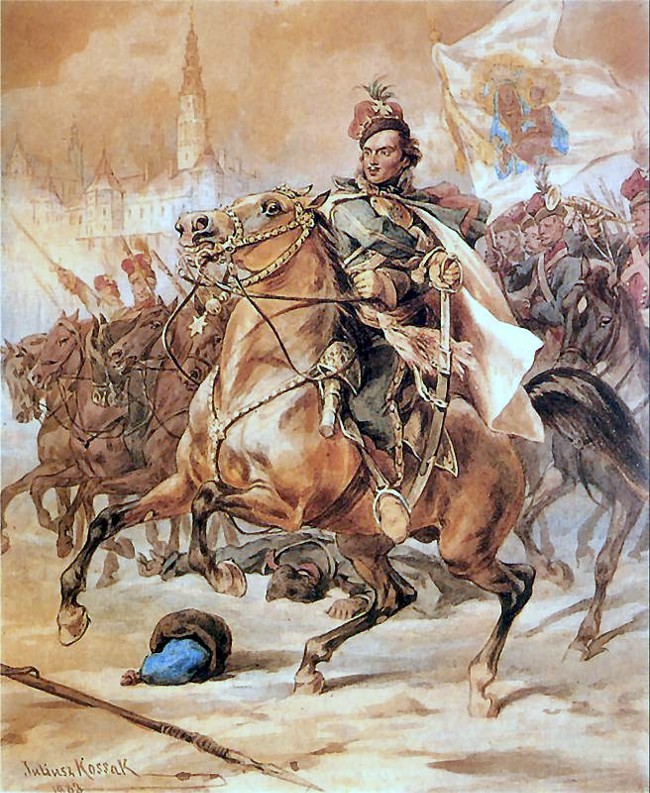 (Image Credit: Original Painting: Juliusz Kossak. Image of painting, Public Domain.)
Pulaski was born on March 6, 1748 in Warsaw, Poland-Lithuania to a military family.
(Note: I've seen three different birth years assigned to Pulaski: 1745, 1747 and 1748. The bill syncs up with a "1748" birth year.) Before going to America in 1777, Pulaski demonstrated his military acumen at home by leading troops in Poland's insurrection against Russia beginning in 1768. He was a skilled horseman who was adept at leading cavalry troops (he helped George Washington form America's cavalry). Somewhat ironically, he died after being wounded leading a cavalry charge at the Battle of Savannah; he died while being treated aboard the USS
Wasp, a merchant schooner that had been refitted for use as a warship by the Continental Navy.
Pulaski came from a family with a military background; his family had fought in several battles along with King John III Sobieski against the Turks of the Ottoman Empire during the late 17th century. Casimir definitely "
inherited" his father's military acumen.
The companion Resolutions called for up to 100,000 half dollars of standard specifications to be struck for "any committee or group organized for the purpose of the observance of the two-hundredth anniversary of the birth of General Pulaski." As such, the coins would have been made available to multiple groups as long as any such group paid in advance for the coins it ordered; coin orders had to be for a minimum of 5,000 coins (no maximum order size was specified - theoretically, one group could have requested the entire authorized mintage). The coins were to be dated "1948" regardless of when struck, and coining authority was set to expire at midnight on December 31, 1948. The "any committee" provision of the resolutions was highly unusual among commemorative coin legislation - approved or unsuccessful - single sponsorship was the general rule.
The Senate Resolution was referred to the Senate Committee on Banking and Currency; the House Resolution was referred to the House's committee of the same name. The Senate Committee reported the Resolution favorably along with a recommendation that it pass. The House version was never reported out by its Committee.
As was the case with the Reading, PA coin bill that I recently discussed (See link below), I can't find a direct account of the Senate Resolution being formally considered and passed in the Senate, but there is record of the House receiving it from the Senate and treating it as a Senate-passed proposal by referring it to its Committee on Banking and Currency. The resolution was never reported out of the House Committee, however, and was never considered by the full House. As such, the resolution eventually died for lack of action.
Pulaski played an important role in the War effort, leading American troops until his death in October 1779. IMO, a commemorative half dollar in his honor would have been a fitting tribute.
Though Casimir Pulaski was not honored by a commemorative half dollar in 1948, he had been honored by the US Government in previous years. In 1910, a nine-foot-tall Equestrian Statue of Pulaski was dedicated as a Memorial to honor his contributions to the fight for American freedom; Congress had authorized the statue for erection in Washington, DC in 1903. The bronze statue was created by Polish sculptor Kazimierz Chodzi#324;ski and placed on a pedestal designed by architect Albert Ross.
Casimir Pulaski Monument in Washington, DC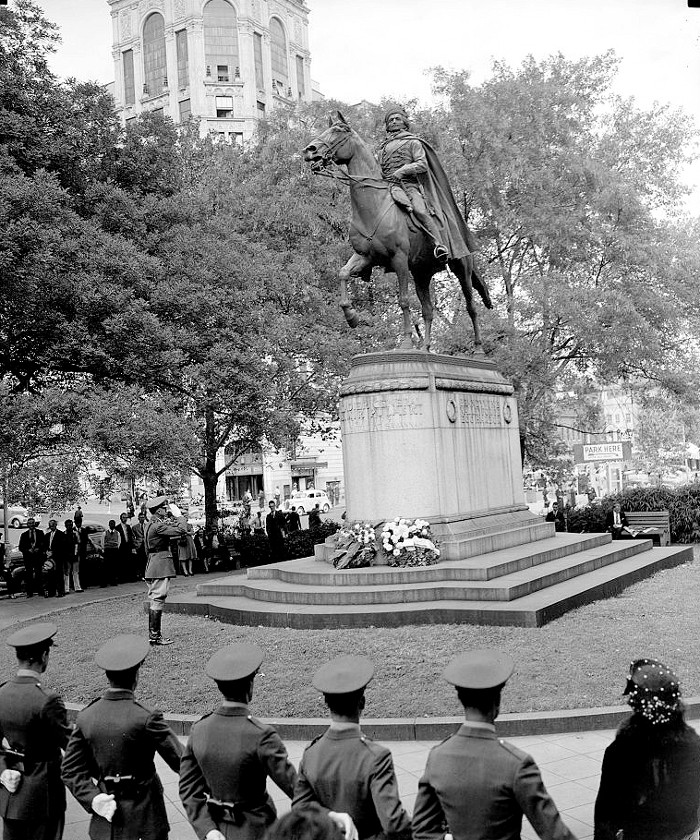 (Image Credit: Library of Congress, Prints and Photographs Division. Public Domain.)
In 1931, the Post Office Department honored Pulaski with a 3-cent commemorative stamp.
1931 General Casimir Pulaski Stamp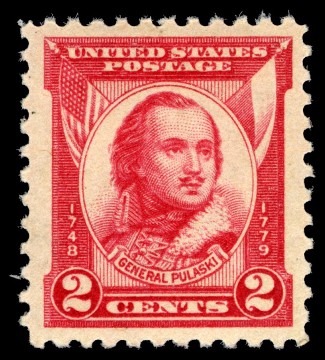 (Image Credit: Smithsonian National Postage Museum. Fair Use; education,)
For the discussion of the Reading, BA Bicentennial coin bill, see:
-
1937 Reading, PA BicentennialFor other of my topics on commemorative coins and medals, including more What If? stories, see:
Commems Collection.







 Posted 12/20/2022 2:06 pm





