In February 1925, companion bills were introduced in the House of Representatives and Senate that called for half dollars "in commemoration of the one hundred and fiftieth anniversary of the founding of the State of Kentucky and of the first permanent English settlement west of the Alleghenies at Harrodsburg, Kentucky, on June 16, 1774...and, in further commemoration of the heroism of the pioneers who in the defense of this settlement aided materially the cause of American independence and who now are buried in Kentucky's first cemetery on Fort Harrod Hill; and in further commemoration of the fact that this place was laid out and surveyed by Daniel Boone and that here General George Rogers Clark planned the conquest of the Northwest."
The House bill was introduced by Ralph Waldo Emerson Gilbert (D-KY) (no relation to the poet) and the Senate bill by Augustus Owsley Stanley (D-KY). The House bill was referred to its Committee on Coinage, Weights, and Measures, while the Senate bill was referred to the Senate Committee on Banking and Currency.
Side Note: At the time of introducing his bill, Senator Stanley was just two weeks away from completing his final term in the Senate; the Kentucky coin bill was the last bill he introduced in Congress.Present-day Kentucky, in its entirety, was originally a western territory under the jurisdiction of Virginia. Daniel Boone was among those who explored and surveyed the frontier land, doing so in 1769 and 1770. In 1774, the first permanent settlement west of the Allegheny Mountains was established by James Harrod. Originally called "Harrodstown" (sometimes "Harrod's Town,") it is today known as Harrodsburg. In 1775, Boone established a road through the Cumberland Gap for settlers to more easily travel to and settle in the Kentucky territory - the area's population grew as a result.
Daniel Boone Portrait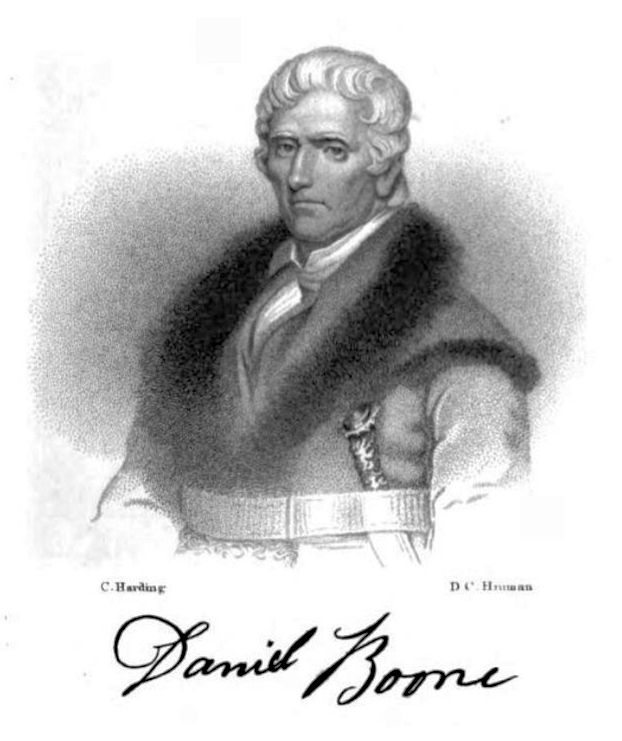 (Image Credit: Library of Congress, Prints and Photographs Division. Public Domain.)
The Virginia legislature created Kentucky County on December 7, 1776 (effective on December 31, 1776), with Harrodstown being named as its County Seat; the new county was split off from Virginia's Fincastle County and represented the region west of the Allegheny and Cumberland Mountains. In the years that followed, the area's growing population believed its interests would be better served if Kentucky's government was separate from Virginia's. The appropriate steps were taken, and Kentucky became the 15th State of the Union on June 1, 1792.
Map of Kentucky County (as of December 31, 1776)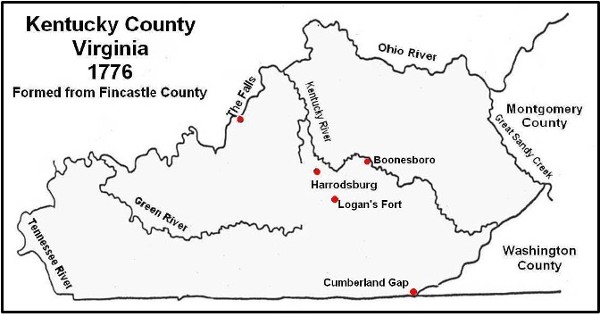 (Image Credit: Pike County Historical Society. Fair use, education.)
(Obviously, the history of Kentucky is a story much longer than can be covered here, so I encourage those with an interest to use their favorite internet search tool for more. To get folks started, here's a link to the Kentucky Department of Tourism web site:
Kentucky History.
The Kentucky coin bills called for the striking of up to 500,000 half dollars at any/all of the US Mint facilities, but did not specify a date to appear on the coins or an expiration date for coining authority. Technically, the Kentucky Pioneer Memorial Association of Harrodsburg, KY - the coin's sponsor/beneficiary - could have parlayed its coin bill into a mult-mint (i.e., P/D/S) and multi-year commemorative coin program. Considering the Association was already playing a bit loose with the State's founding date, (1774? 1775? 1776?), it is not difficult to believe that it would be OK with ordering additional coins in years beyond 1925 if it believed it could continue to sell them at a profit.
Neither of the bills was reported out by its respective Committee, nor was it considered by its respective full chamber. As a result, the 1925 Kentucky coin bill did not enjoy the same success as those that called for the 1925 California Statehood Anniversary, the 1925 Fort Vancouver Centennial and the 1927 Bennington-Vermont Independence Sesquicentennial hafl dollars or the 1925 Norse-American Centennial medal - all bills contemporary to the Kentucky coin bill.
For my topics on commemorative coins and medals, including more on the Daniel Boone commemorative half dollars and more What If? stories, see:
Commems Collection.







 Posted 12/24/2022 06:12 am


