My recent post regarding the 1936 Arkansas Statehood Centennial / Robinson Half Dollar and the consideration of it depicting Hernando de Soto rather than Senator Robinson, along with the post's ensuing discussion, made me think about US Mint-struck commemorative pieces in my collection that feature a portrait of de Soto -- the 1969 silver and bronze medals struck to commemorate the Memphis Sesquicentennial in 1969. So...
In May 1968, during the Second Session of the 90th Congress, Dan Heflin Kuykendall (R-TN), on behalf of himself and Leonard Ray Blanton (D-TN) and Robert Ashton Everett (D-TN), introduced a bill in the House of Representatives that called for the striking of medals "in commemoration of the one hundred and fiftieth anniversary of the founding of the city of Memphis (which anniversary will be celebrated ln 1969)." The bill was referred to the House Committee on Banking and Currency.
A companion bill was introduced in the Senate two days later by Howard Henry Baker, Jr. (R-TN) for himself and Albert Arnold Gore (D-TN); the House bill proceeded more quickly.
The proposals sought up to 100,000 medals for the Memphis Sesquicentennial Corporation ("Corporation"); the size(s) and metal(s) of the medals were to be determined by the Secretary of the Treasury after consultation with the Corporation.
The House Committee reported the bill without amendment and with a recommendation to pass. The bill was considered in the House, and was passed without objection. Representative Kuykandall offered the following as part of his Extended Remarks about the bill:
"Memphis has enjoyed a long, rich, and exciting history which officially began with its founding in 1819 by a group of land-grant owners led by Andrew Jackson who subsequently became the seventh President of the United States. From a population of 500 when it was incorporated in 1826, Memphis has blossomed into a bubbling metropolis of more than 624,000 and is now the 20th largest city in the Nation and the seventh fastest growing major city. Today more than one-third of the Nation's cotton crop is bought or sold each year by members of the Memphis cotton Exchange, making Memphis the largest spot cotton market in the world. It is also the world's largest producer of cottonseed products, the world's largest interior cotton warehousing center, the world's largest hardwood lumber market and producer of hardwood flooring, the largest producer of persimmon golf club heads, the South's largest livestock and meatpacking center, the South's largest producer of mixed feeds, and the South's largest distributor of drugs and chemicals. In addition, the Memphis Medical Center is the fl.nest and largest in the South and it is continuing to grow at a rapid pace. These are but a few of the many outstanding distinctions and achievements that will be recognized during the celebration of Memphis' 150th anniversary." (FWIW: the 2020 Census estimated the Memphis population to be 631,326 - reflecting minimal net growth since 1969.)
The bill was sent to the Senate where it was immediately referred to the Senate Committee on Banking and Currency. A month later, Senator Michael Joseph Mansfield (D-MT) requested that the Committee be discharged from further consideration of the bill and that the full Senate take up its consideration. No objections to Mansfield's request were raised; the bill was considered and passed without objection.
The bill was then examined and signed in each chamber,before being presented to the President for final approval. President Lyndon Baines Johnson signed the bill into law on October 17, 1968.
About three weeks after the House passed its bill, and a week after the Senate concurred and passed the same, the Senate considered its original companion bill and passed it without objection. (I wonder if some Senators experienced dejà vu?) This made for an unusual situation: the Senate passed two bills with the same provisions - one that originated in the House, a second of its own initiation. The House bill was the one that proceeded and became law, but the Senate version was "on the books" as being passed and ready for concurrence by the House - at least until the 90th Congress adjourned!
The obverse of the medal features the triple-conjoined portraits of Hernando de Soto, the Spanish explorer who led the first European expedition through present-day Tennessee, Andrew Jackson, part of the group that founded Memphis and William Christopher "WC" Handy, musician and songwriter who had a strong association with Memphis. He wrote the hit song "The Memphis Blues" and was often referred to as the "Father of the Blues" a genre of music that was/is a big part of the Memphis music landscape (think Beale Street). Below the portraits is the two-line inscription: MEMPHIS / SESQUICENTENNIAL 1819-1969".
The reverse of the medal features the modern Seal of Memphis. The Seal presents four historically important components of the City's economy: the City's prominent position in the hardwood industry is symbolized by the Oak Leaf (upper left), the Gear (upper right) represents Memphis' industrial sector, the steamboat (center) is meant to reflect the central role the Mississippi River had in the City's development as well as its ongoing vitality and the cotton boll (bottom) represents the City's prominent position within the cotton industry. The graphic elements are enclosed in a square with rounded corners, with "MEMPHIS / TENNESSEE" and "SHELBY / COUNTY" enclosed within the square's framing band. The Seal was designed by Aldred Lewis Aydelott in 1962.
The medal was designed by Everett Burr, designer of the Arkansas Statehood Centennial half dollar; he won an open design competition for the medal. All of the medals were struck at the Philadelphia Mint. An initial batch of 10,000 silver medals was struck, with a second batch of 10,000 following a second order from the Corporation. The second run of silver medals featured "MS II" on the reverse to differentiate them from the first run. 20,000 of the bronze version were initially struck; no second batch was produced.
1969 Memphis, TN Sesquicentennial Medal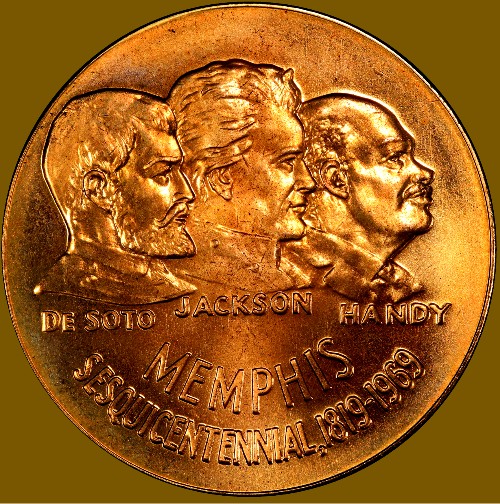
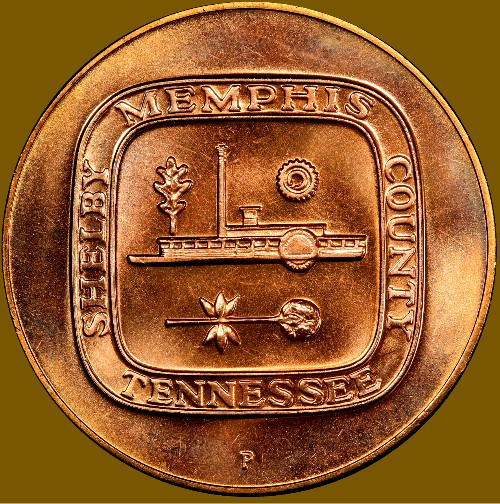
For other of my posts about commemorative coins and medals, see:
Commems Collection.








 Posted 07/28/2023 08:58 am


