In September 2006, during the Second Session of the 109th Congress, Deborah Price (R-OH) introduced a bill in the House of Representatives that called for three Silver Dollars to be struck "in commemoration of the 75th Anniversary of the opening of the National Archives Building."
The National Archives was established in 1934 when President Franklin Delano Roosevelt signed into Law a bill that created the National Archives of the United States "for the purpose of receiving, preserving, and supervising the use of certain Government papers and records." At the time, construction of the National Archives Building was nearing completion and it would begin receiving documents in 1935.
The bill's "Findings" section provides brief background information on the Archives:
"The Congress finds as follows:
(1) The year 2010 commemorates the 75th Anniversary of the opening of the National Archives Building, which houses the Declaration of Independence, the Constitution, and the Bill of Rights (known collectively as the Charters of Freedom).
(2) The National Archives and Records Administration has, over the course of its history, established itself as public trust on which our democracy depends and has proven itself to be a vital and invaluable resource within the Federal Government.
(3) The National Archives and Records Administration has expanded its role as the nation's recordkeeper and raised its public profile as democracy's beacon.
(4) The National Archives and Records Administration serves American democracy by ensuring that the people can discover, use, and trust the records of our government.
(5) The National Archives and Records Administration fulfills this role by—
(A) preserving for the American people and their public servants the records of our Federal Government;
(B) ensuring continuing access to the essential documentation of the rights of American citizens and the actions of their Government; and
(C) promoting democracy, civic education, and historical understanding of our national experience.
(6) In 1935, the National Archives Building was opened on the Washington Mall, featuring a grand rotunda designed for the display of the Declaration of Independence, the Constitution, and the Bill of Rights."
It's interesting to note that only a small percentage of the documents created by the Government are stored by the National Archives - 1% to 3%. Most are not of enough legal or historical importance to be kept!National Archives Building Rotunda where "Charters of Freedom" are on Display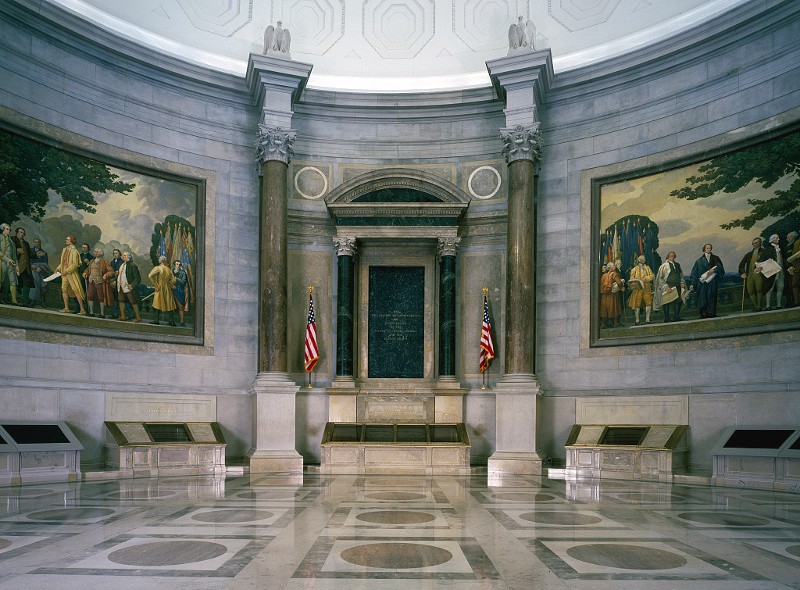 (Image Credit: Library of Congress, Prints and Photographs Division. Public Domain.)
The mintage of the coin was left, with upper limits, to the Secretary of the Treasury to decide the appropriate quantity, but was fairly specific in the designs for the coin:
"(1) IN GENERAL -- The design of the coins minted under this Act shall be emblematic of the National Archives Building and shall honor the National Archives and Records Administration as a public trust on which our democracy depends and of the Charters of Freedom that the Administration enshrines for posterity.
(2) OBVERSE -- The obverse of the coins minted under this Act shall be representative of the 75th Anniversary of the National Archives Building.
(3) REVERSE --
(A) DECLARATION OF INDEPENDENCE.—Not more than 350,000 of the $1 coins minted under this Act shall feature an image of the Declaration of Independence.
(B) UNITED STATES CONSTITUTION.—Not more than 350,000 of the $1 coins minted under this Act shall feature an image of the Constitution of the United States.
(C) BILL OF RIGHTS.—Not more than 350,000 of the $1 coins minted under this Act shall feature an image of the Bill of Rights."
So, it appears the bill would have created a program of three silver dollars that shared a common obverse with differing reverses. The language specifying the obverse design, however, had enough "flexibility" to enable a different obverse design for each of three coins if so desired.
The issue price of each of the coins was to include a surcharge of $10, with the collected funds to be split 50/50 between "the Foundation for the National Archives and the National Archives and Records Administration Trust Fund to be used for the purpose of supporting public programs, educational outreach activities, and archival programs of the National Archives and Records Administration."
Upon its introduction, the bill was referred to the House Committee on Financial Services, which further referred it to its Subcommittee on Domestic and International Monetary Policy, Trade, and Technology. No further action was taken on the bill and it died with the adjournment on the 109th Congress.
I remember visiting the National Archives Building as a teen, and being excited to see, firsthand, the original Declaration of Independence, the Constitution and the Bill of Rights. It was also very interesting to learn of the various safeguards that were in place to protect them, and how the documents were moved below ground - within their protective cases - after public visiting hours each day. It was a very impressive scene!
The fact that this coin proposal failed was/is a disappointment to me. I would have gladly signed up for a set of silver dollars honoring the US' "Charters of Freedom."
For other of my posts about commemorative coins and medals, including more What IF? stores from the classic and modern eras of US commemorative coins, see:
Commems Collection.









 Posted 10/24/2023 05:35 am


