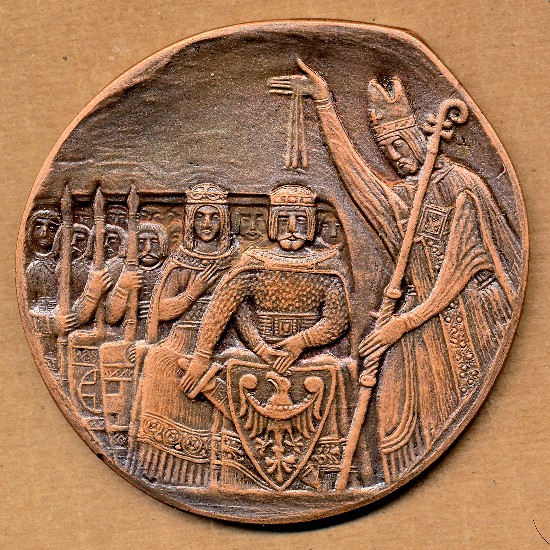
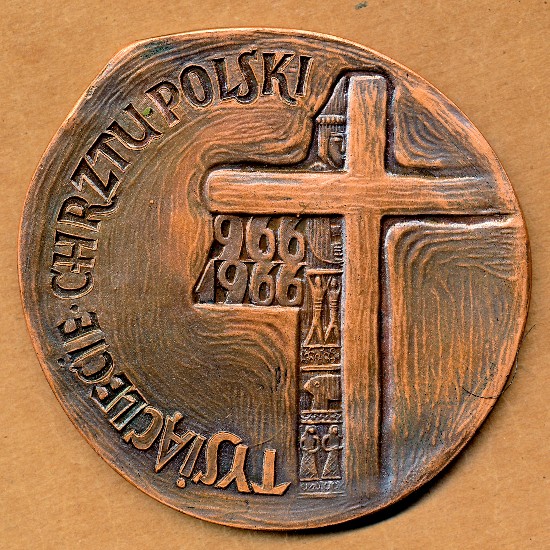
After the George Washington Carver - Booker T. Washington commemorative half dollar was approved, the Congressional tide turned away from commemorative coins in favor of national commemorative medals. It was generally presumed that medal bills passed by the US Congress and signed into law by the US President would be struck by the US Mint. This was not always the case, however. Here's the story of one such medal introduced in the 89th Congress.
In January 1965, Representative Roman Conrad Pucinski (D-IL) introduced a bill in the House that called for medals to be struck "to commemorate the one thousandth anniversary of the founding of Poland." Upon its introduction, the bill was referred to the House Committee on Banking and Currency.
The year that was to be celebrated by the medal, 1966, reflected a political milestone with religious underpinning. During the early 960s, the Piast Dynasty began to unite various Slavik tribes within the boundaries of present-day Poland; Mieszko I was the leader at the time. In 965, Mieszko I formalized his negotiated alliance with Bohemia via his marriage to Doubravka, the daughter of Bohemia's ruler Boleslav I. In 966, Mieszko I agreed to be baptized and thus brought Christianity to Poland - it is often referred to as "The Baptism of Poland." This move aligned Poland with much of Europe, as well as with the Pope and Catholic Church. The 966 event is generally pointed to as the starting point for Poland as a united nation.
The Polish-American Congress, Inc.(PAC) - the medal's sponsor - was not bashful with its request. The bill called for the striking of one million medals! The sponsor was empowered to decide the size(s), metal(s) and design(s) for the medal, but the Secretary of the Treasury needed to approve such decisions before the medals were to be struck. The minimum order size for the medal was 2,000 pieces and production authority expired on December 31, 1966.
Note: The Polish-American Congress, Inc.describes itself as a "National Umbrella Organization" that currently represents "at least 10 million Americans of Polish descent and origin." Its Mission Statement reads: "We are dedicated to unify Americans of Polish descent, fight for their interests, promote respect for Polish heritage and history, and advocate for Poland!" Its membership consists of Polish-American organizations and individuals. At some level, I see it as a Political Action Committee, even though it doesn't appear to officially identify itself as such.The Pucinski bill was slow to be reported out of Committee - the House Committee did not report the bill until late in October 1965. The Committee did ultimately favor the bill, however, reporting it with a recommendation to pass with inclusion of a minor amendment. The amendment was a simple correction to an errant word within the bill - it replaced "communication" with "commemoration" in a line referring to the anniversary being commemorated.
When brought up for consideration in the House, a few questions were asked about whether the proposed medal would be struck in gold or silver, and whether copper from the US' Strategic Stockpile would be used. Representative Leonor Kretzer Sullivan (D-MO), a member of the Banking and Currency Committee and thus someone who was fully familiar with the bill, rose to address the questions and stated that no precious metals were to be used and that "The copper will come from the same stockpiling source from which we get the metal for our coinage." (i.e., from the nation's stockpile vs. new purchases on the open market). Representative Sullivan also addressed a question regarding potential costs to the American taxpayer related to striking the medals by verifying that there wouldn't be any such cost as the sponsor was to be liable for all costs/expenses.
Note: I'm not sure how Representative Sullivan could definitively declare that no silver or gold medals would be struck. The Act signed into law did not prohibit the use of such metals, so their use was a possibility if the sponsor could convince the Secretary of the Treasury.With the questions addressed to satisfaction, the House moved forward and passed the bill (with the minor amendment discussed above). It was then sent to the Senate for its consideration. Upon its receipt, the bill was referred to the Senate Committee on Banking and Currency.
As with the House Committee, the bill experienced a "slow go" in committee and did not get reported until July 1966 - 19 months after its introduction in the House! While the bill was being considered within Committee, Representative Pucinski wrote to the Senate Committee and requested that the expiration of coining authority be moved to December 31, 1967 vs. December 31, 1966. The request was made as it was believed the 1966 date "would cause an unnecessary strain on the facilities of the U.S. Mint to require these medals to be struck within the remaining months of this year."
The Senate Committee agreed to the extension request and recommended that the amended bill pass. The Treasury Department went on record as having no objections to the bill passing.
The Senate considered the amended bill, passed it without objection and sent it back to the House. The House considered the bill's date change, concurred with the Senate amendment and passed the bill. The final version was then examined and signed in each chamber before being presented to the President. US President Lyndon Baines Johnson signed the bill into law on August 5, 1966.
The US Mint, however, did not strike the medal.
Several different medals for the occasion were struck in the US, as well as in Poland - Poland also issued several commemorative coins to mark the milestone.
Just conjecture on my part, but the PAC my have believed that by the time its medal's designs were approved and struck by the US Mint its offering would have been so "late to the game" that effective marketing of the piece would have been difficult. How do you sell one million medals when the event you are commemorating has already passed?
For more of my stories about commemorative coins and medals, see:
Commems Collection.







 Posted 07/01/2024 11:28 am