In March 1936, a Subcommittee of the Senate Committee on Banking and Currency met to review a full agenda of coin and medal proposals: six commemorative coins (Delaware, Long Island, Bridgeport, Wisconsin, a Texas design change amendment and New Rochelle), two commemorative medals (Jefferson Davis, Robert E. Lee), a new three-cent coin and a proposal to strike commemorative medals in lieu of commemorative coins.
I found the medals vs. coins part of the Hearing the most interesting.
LW Hoffecker, representing the American Numismatic Association (
ANA) and its members as Chairman of the organization's Legislative Committee, was at the Hearing to support the continuation of the US commemorative coin program. He was asked about replacing commemorative coins with commemorative medals. From his reply:
"Medals are unpopular. A good many people will buy coins because they know they are always worth their face value...Very few collectors will collect medals."
While not my opinion, it is one that is difficult to argue against when speaking about many collectors.
Frank G Duffield, former
ANA President and then-current editor of the
ANA's
The Numismatist magazine, was also in attendance. He joined the discussion of medals vs. coins by relating stories of the 1925 Norse-American Centennial medal and its sponsor:
"These people asked for a commemorative coin, and Congress declined to give them a bill, and they substituted a medal. The medal contained exactly the same amount of pure silver, and the same amount of alloy as a regular half dollar. They have been on the market since 1926, and they sold originally at a dollar a piece, and they are still selling at about $1.65.
"I want to call attention to this: At the present time, and since 1928, 2 years after the issue came out, there have been two thicknesses of the coin, but of the same size and dimensions. Now, one of these contained the same number of grains of silver as the United States half dollar, and they are on the market designated as thick and thin, and one does not contain the same amount of silver as a half dollar, which shows that someone outside the mint has issued either the thick one or the thin one. You might term it a fraud, because I can't give it any other name. Now they also issued in bronze with silver over it. So that to substitute a medal for a coin in this commemorative series would make it open to that objection. I do not think there would be anything to prevent someone from imitating that medal."
I was very surprised when I first read these statements. I thought, "How could the editor of
The Numismatist, have such an erroneous view of the Norse-American medal?" It was issued in 1925 - not 1926 - and the US Mint struck both silver varieties - Thick and Thin - not just one. No fraud involved! Also, while the "Thick" variety of the medal could be found selling for $1.65 at the time, the "Thin" variety typically sold for more - often 3x to 5x more - as its mintage was less than 18% of the "Thick" variety (6,000 vs. 33,750).
Another case of "Skew the facts to fit your narrative!" Duffield's statements were not challenged by members of the Committee, so it appears they were accepted at
face value. 
Ultimately, in 1939, Congress passed legislation that reshaped the US commemorative coin series, but it never did acquiesce to Treasury Department preferences and pass legislation that forced the substitution of commemorative medals for commemorative coins.
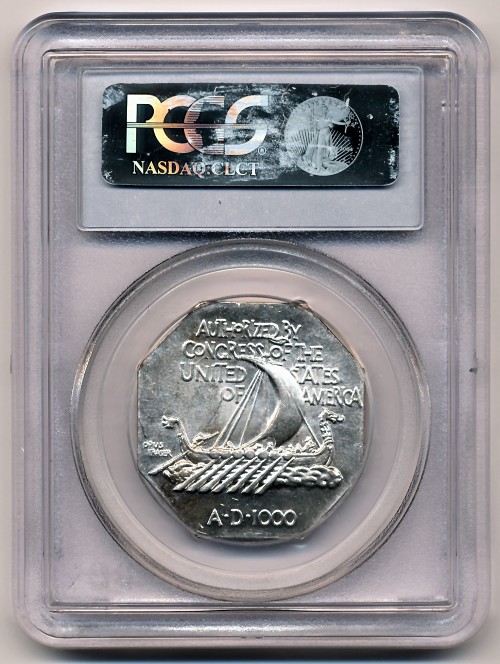
1925 Norse-American Cenrennial Medal - Thick Variety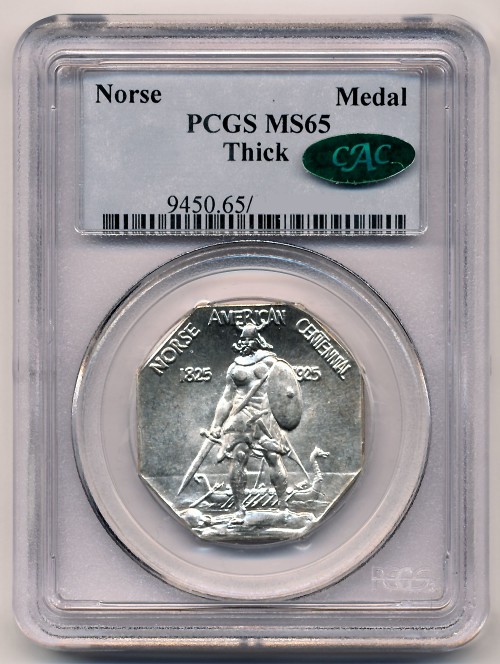
For more of my stories about commemorative coins and medals, including more on regulating the classic-era US commemorative series, see:
Commems Collection.










 Posted 07/21/2024 1:40 pm


