A bill calling for the striking of "medals in commemoration of the 150th anniversary of the founding of the State of Mississippi" was introduced in the US Senate in January 1967 by James Oliver Eastland (D-MS); Eastland served in the Senate from 1941 to 1979.
In introducing his bill, Senator Eastman remarked:
"On December 10, 1817, Mississippi became the 20th State of the Union, having been a territory from 1798 until admission. There are few States in the Union whose history is as colorful and varied as that of the State of Mississippi. It is believed that Spanish explorers were the first Europeans to enter what is now the State of Mississippi in about 1540. Before that time, the State was occupied by Indian tribes.
[...]
"In addition to its historic position, Mississippi has supplied the Nation with great leaders, scientific discoveries, agricultural and industrial wealth, and made many contributions to the arts."The bill was referred to the Senate Committee on Banking and Currency. The bill, however, did not progress further and was supplanted by a House of Representatives companion bill with the same provisions. The House bill was introduced by Gillespie V. "Sonny" Montgomery (D-MS) in May 1967 and was immediately referred to the House Committee on Banking and Currency.
The bill called for the striking of up to 100,000 medals for the Agricultural and Industrial Board of the State of Mississippi ("Board"). The size and composition of the medals was to be determined jointly by the Board and the Secretary of the Treasury (at the time, Henry H. Fowler).
As Senator Eastman had done, Representative Montgomery offered remarks at the time of the bill's introduction, including:
"Along with the introduction of my bill in the House, Senator James O. Eastland introduced an identical bill in the Senate. The introduction of the two bills came about through the cooperation of the Mississippi Agricultural and Industrial Board, the Sesquicentennial Commission, and the Mississippi Numismatic Society. The bill will authorize the mint to strike the medals, the design of which will be determined by the Mississippi Agricultural and Industrial Board. Present plans call for the medals to feature on one side the great seal of the State of Mississippi as it first appeared, and on the reverse side the medal will carry the image of Mississippi's first Governor, David Holmes."The bill had a smooth sail through Congress. The House Banking Committee reported the bill favorably without amendment which led to the House subsequently passing it without debate. The bill was sent to the Senate, where it was immediately referred to the Senate Committee on Banking and Currency. The Senate Committee also reported the bill favorably without amendment. As such, the bill passed in the Senate without issue.
The bill was examined and signed in each chamber, and then sent to the President for approval. The Mississippi Statehood Sesquicentennnial medal bill was authorized via Public Law 90-128 on November 4, 1967 via the signature of US President Lyndon Baines Johnson.
The slow Congressional journey and late approval of the bill - ultimately, less than a week before Mississippi's Statehood anniversary and planned celebration - forced the Board and the Sesquicentennial Commission to look elsewhere in the Fall for the striking of its medal so that it would be available as a souvenir as part of the celebration.
The medal was designed by H. Alvin Sharpe of New Orleans. Sharpe is credited as the "Father" of the Mardi Gras doubloon as it was his idea to create a lightweight souvenir that could be thrown to the Mardi Gras crowds from parade floats - the first taker was the Rex Crewe who ordered 80,000 doubloons for the 1960 parade.
The execution of the medal's design (see description above) was fairly "flat" and, IMO, lacks the depth of character of engravings created by the skilled sculptor-engravers of the US Mint. Sharpe engraved his design directly into the steel dies vs. creating a larger-format plaster model that would be reduced onto dies. As a result, the medal has, unsurprisingly, the look-and-feel of one of Sharpe's Mardi Gras doubloons. Sharpe's "HAS" initials are found on the medal's reverse.
The medal was produced in four versions:
1. 0.999 Fine Silver, with limited mintage of 500, priced at $15.00
2. 12-gauge two-tone bronze, Open-ended mintage, priced at $5.00
3. Golden Bronze, Open-ended mintage, priced at $3.00
4. Aluminum, Open-ended mintage, priced at $1.00
1967 Mississippi Statehood Sesquicentennial Medal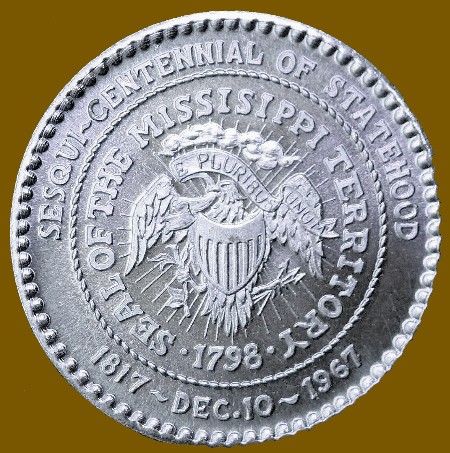
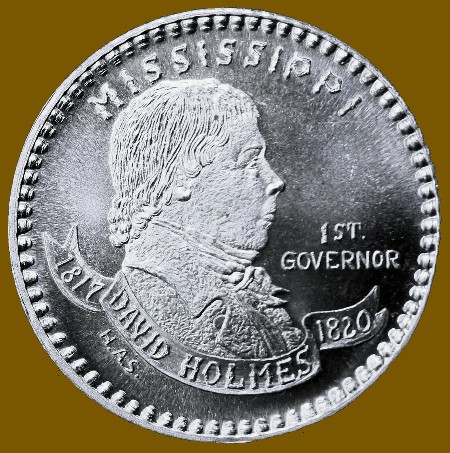
Over the years, I have been fortunate enough to come across an example of each type: silver, two-tone bronze, golden bronze and bright aluminum. I also have a Mississippi Sesquicentennial medal struck by Heraldic Art as part of its commemorative series; Ill dig mine out and post an image soon.
For more of my topics on commemorative coins and medals, including other What If? stories, see:
Commems Collection.







 Posted 11/05/2024 2:39 pm





