In April 2021, during the 117th Congress, Paul A. Gosar (R-AZ) introduced a bill in the House of Representatives ("House") that called for a three-coin commemorative program - Gold Half Eagle, Silver Dollar and Copper-Nickel (CuNi) Clad Half Dollar - to commemorate "Cesar Chavez's work for the betterment of legal workers."
Cesar Chavez - Circa 1979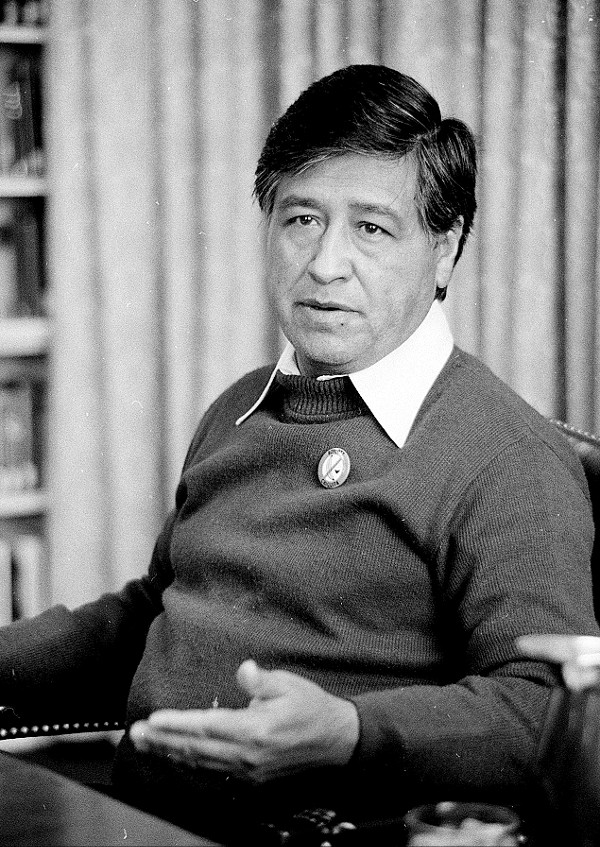 (Image Credit: Library of Congress, Prints and Photographs Division. Public Domain.)
The proposal sought up to 50,000 Gold Half Eagles, 400,000 Silver Dollars and 750,000 CuNi Clad Half Dollars. Proof and Uncirculated versions of each were to be struck.
As is standard for current-day commemorative coin proposals, the bill included a "Findings" section that provided background and context for the coin request:
The Congress finds the following:
(1) Cesar Chavez was born on March 31, 1927, in Yuma, Arizona.
(2) In 1962, Chavez founded the National Farm Workers Association, which later became the United Farm Workers, to improve the wages and working conditions for American farmworkers.
(3) Chavez's union drew on the imagery of civil rights to use nonviolence and mass mobilization to improve the conditions of persecuted and impoverished American workers.
(4) Chavez believed that preventing illegal immigration was an essential prerequisite to improving the circumstances of American farmworkers.
(5) In 1969, Chavez led a march to the Mexican border to protest illegal immigration, joined by Senator Walter Mondale and Martin Luther King's successor as head of the Southern Christian Leadership Conference, Ralph Abernathy.
(6) Chavez noted that it is "almost impossible to start some effective program to get these people their jobs back from the braceros" once employers replace them.
(7) In the 1970s, Chavez combined a campaign of identifying and reporting illegal workers with a campaign to boycott nonunionized farms in order to protect the labor of the unionized American worker.
(8) Chavez recognized that flooding the labor market with people from abroad undermines the unionized American worker.
(9) In 1979, at the National Press Club, Chavez emphatically supported enforcement of immigration laws, stating that "people are being hurt and being destroyed, and with the complicity and with the help, of the Federal Government".
(10) President Clinton recognized Chavez's work saying, "We can be proud of his enormous accomplishments and in the dignity and comfort he brought to the lives of so many of our country's least powerful and most dispossessed workers."Note: Cesar E. Chávez died in April 1993 at the age of 66 in San Luis, Arizona.The designs for the coins were to be "emblematic of Cesar Chavez and his fight to defend the interests of American farmworkers, his birth in Yuma, Arizona, and his commitment to and work for American agricultural workers. At least one coin design shall include the name and likeliness of Cesar Chavez" Such a broad scope could have resulted in a diverse selection of designs; at a minimum, I believe it would have eliminated the use of a common design pair across all three coins.
The Secretary of the Treasury was to select the final designs for the coins in consultation with the Commission of Fine Arts ("CFA") and representatives of the Smithsonian Institution. The Citizens Coinage Advisory Committee ("CCAC") was designated for a design review role.
The Issue Price of each coin was to include a surcharge:
- $35 per Gold Half Eagle;
- $10 per Silver Dollar; and
- $5 per Clad Half Dollar.
Collected surcharge funds were to be paid to the Smithsonian Institution "to support the development, maintenance, and repair of the National Museum of the American Latino, and for educational and commemorative programs of American Latino heritage and culture."
Upon its introduction, the bill was referred to the House Committee on Financial Services; it went no further.
Note: In 2004 and 2005, bills were introduced that called for a Congressional Gold Medal to be awarded to Cesar Chavez; neither bill was approved, however.As Representative Gosar is still in Congress, its always possible that he could re-introduce his Chavez coin bill. The lack of co-sponsors for the original bill, coupled with its lack of action in the House, suggests that Gosar would best focus his efforts elsewhere. To me, honoring the legacy of Chavez seems more like something to be better addressed via a Congressional Gold Medal vs. a coin program. Maybe that effort will be renewed at some point.
Note: Chavez was posthumously awarded the Presidential Medal of Freedom - the highest civilian honor in the US - in 1994; it was presented by US President William "Bill" Clinton. Cesar's widow, Helen Fabela Chavez, accepted the medal on his behalf.Chavez's life and legacy have also been recognized by the Federal Government via the Cesar E. Chávez National Monument (aka Nuestra Señora Reina de La Paz - Our Lady Queen of Peace) in Keene, California. It was established in 2012, and is managed by the US National Park Service ("NPS"). From the NPS web site for the Monument: "Widely recognized as the most important Latino leader in the United States during the twentieth century, Cesar Chavez led farm workers and supporters in the establishment of the country's first permanent agricultural union. His leadership brought sustained international attention to the plight of U.S. farm workers, and secured for them higher wages and safer working conditions." To learn more, visit the Monument's site at:
-
Cesar E. Chávez National MonumentChavez, and his wife, are buried at the site.
For more of my topics on commemorative coins and medals, including more What If? commemorative coin stories, see:
Commems Collection.










 Posted 08/07/2025 12:10 pm


