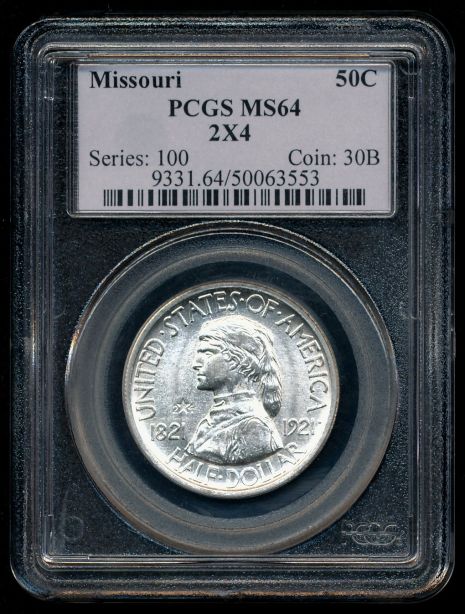
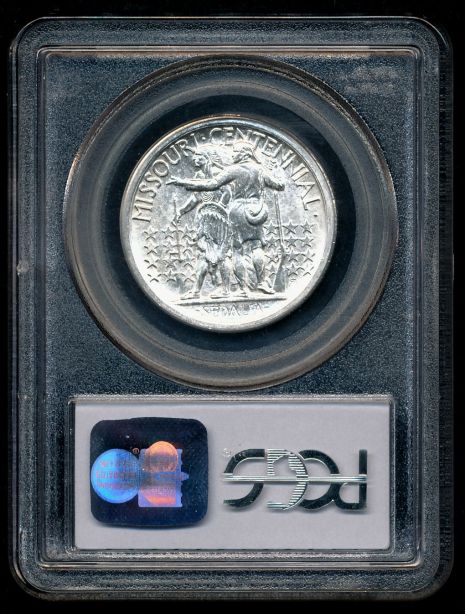
Time for a few tidbits about the 1921 Missouri Statehood Centennial Half Dollar...Tidbit #1During the weeks leading up to the Missouri half dollar becoming available to the public, newspapers touted the coin as "a truly Missouri coin" - apparently quoting from a press release by the Centennial Commission. The assessment was based on the coin's designs:
Obverse - a left-facing portrait of Daniel Boone
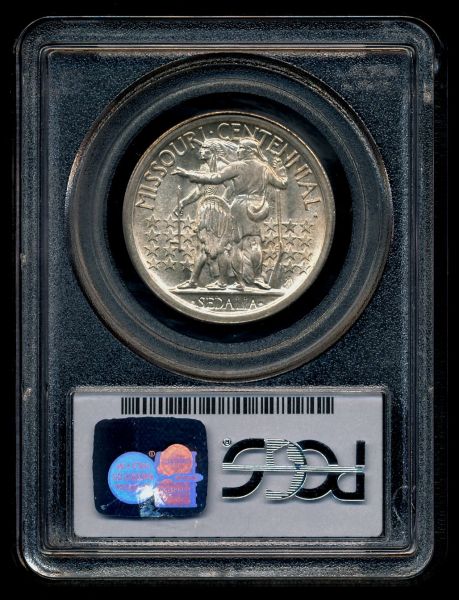
Reverse - a standing Boone speaking/negotiating with a Native American chief. Behind the two figures are 24 stars which are symbolic of Missouri being the 24th state admitted to the Union.
Boone (b. 1734; d. 1820) moved to present-day Missouri in 1799 to escape the financial difficulties he faced in Kentucky. He was granted land by the Spanish who governed the area at the time (referred to as Upper Louisiana or Spanish Illinois). He served as a Syndic under the Spanish - a local judge and administrator.
Spanish claims on the area were ceded to France in 1800; France sold the territory to the United States in 1803 - the Louisiana Purchase between US President Thomas Jefferson and Napoleon Bonaparte, First Consul of the French Republic (i.e., Head of State and, realistically, dictator).
Boone built a house in "Missouri" and remained there until his death. In many ways, he continued his life as a frontiersman - exploring and hunting - until he was physically unable to do so. Though linked to Missouri via joint history, Boone never lived in the State of Missouri, he died while it was still a US Territory (1812-1821).
Tidbit #2United States ("US") President Warren G. Harding was tentatively scheduled to visit the Missouri Centennial Exposition on Wednesday, August 10, 1921 - the 100th Anniversary of the admission date for Missouri into the Union. Harding did not attend, however.
Pure speculation on my part, but if Harding had attended the Exposition I bet he would have been presented with at least one of the half dollars.
Tidbit #3Neither the bill that proposed the Missouri half dollar, nor the Public Law that authorized its striking, lists a sponsor/responsible financial party for the coin. The Missouri Centennial Commission would step in to take charge of the coin and its administration, but at the time the coin proposal was introduced in Congress (January 1921), the Missouri State Historical Association was on record with its support for the coin.
Tidbit #4In the Summer of 1921, it was being reported that 250,000 of the Missouri half dollars were being struck by the Mint. Such reports were apparently unaware that the Missouri Centennial Commission did not order the full authorization of Missouri coins - it ordered just one-firth of the authorization - 50,000 coins. No additional coin orders were placed. So, in the end, just 20% of the coin's authorized mintage was struck.
1921 Missouri Statehood Centennial Half Dollar - Plain Variety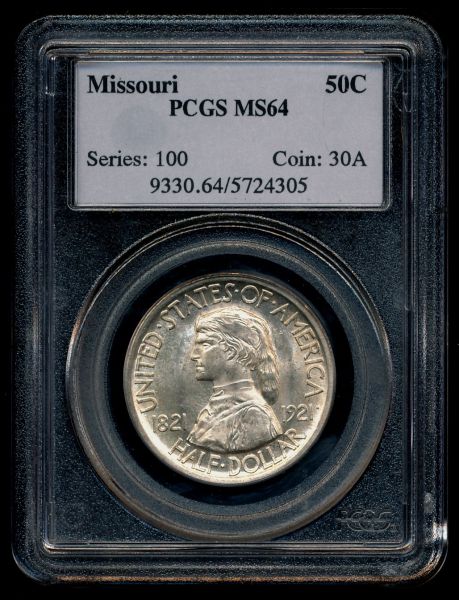
For other of my posts about commemorative coins and medals, including more on the Missouri, see:
Commems Collection 








 Posted 03/08/2026 2:18 pm