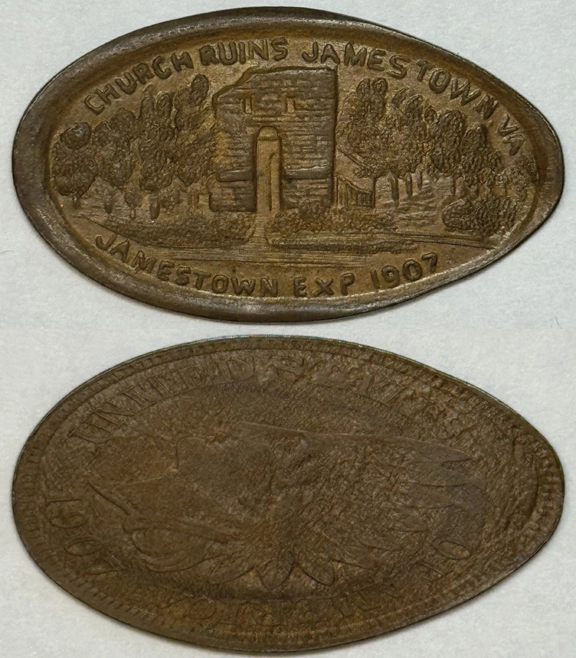
I previously posted about a failed attempt to secure a commemorative coin to support the 1907 Jamestown Ter-Centennial Exposition; you can read about it here:
-
What If? 1907 Jamestown Exposition $2The Exposition was held to mark the 300th anniversary of the original settlement at Jamestown by Captain John Smith and a group of 104 men and boys who were among the 144 that had ventured across the Atlantic Ocean to the New World on three small ships: the
Sarah Constant, the
Godspeed, and the
Discovery. The crews of the ships (numbering 40) returned to England under the command of Captain Christopher Newport.
The Jamestown Ter-Centennial Exposition was held on a 367-acre site on the shore of Hampton Roads, at Sewell's Point, in Norfolk County, VA (about 30 miles north of the original Jamestown settlement site) from April 26 through November 30, 1907. The original Jamestown site was not selected for the Exposition as it was deemed too difficult to reach by car or rail and did not have the needed infrastructure in place to support the Exposition and its expected crowds.
Jamestown Exposition - Administration Building - Modeled After Thomas Jefferson's Monticello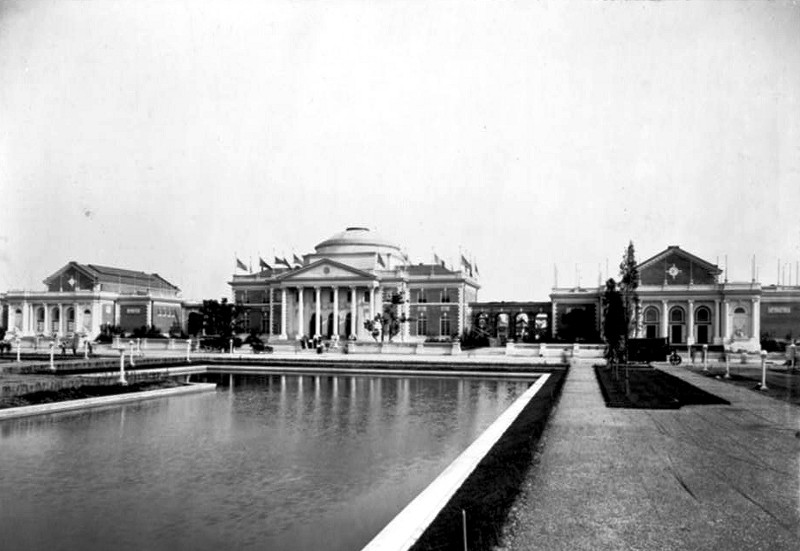 (Image Credit: Library of Congress, Prints and Photographs Division. Public Domain.)
The Exposition was held simultaneously with the International Military and Naval Celebration event organized by the United States. More than a dozen countries, including Great Britain, France, Germany, Brazil and Argentina, participated in the Congressionally-authorized, international, military-focused Celebration event, but, such participation prevented official participation in the Exposition (though some countries did have unofficial exhibits or exhibits mounted by private organizations from the country in the Exposition).
From its inception, the Military and Naval Celebration was designed/intended to be an international event - its invitations from President Theodore Roosevelt reflected this. In contrast, Roosevelt did not extend international invitations for the Exposition - Congress did not authorize it to be an international event. Regardless, the private Exposition Company sought participation from other nations and attracted more than a half dozen countries/organizations that did not participate in the Celebration event to create official exhibits at the Exposition. These included Mexico, Nova Scotia (Canada), Haiti, Dominican Republic and the International Bureau of American Republics, among others.
In addition to the limited international component, 21 States participated via a dedicated building; of these, only North Dakota was west of the Mississippi River, however. California, Oklahoma and South Carolina exhibited but did not have dedicated buildings.
My favorite State Building is that of Pennsylvania - it was a reasonable facsimile of the famed Independence Hall in Philadelphia.
Pennsylvania Building - Replica of Independence Hall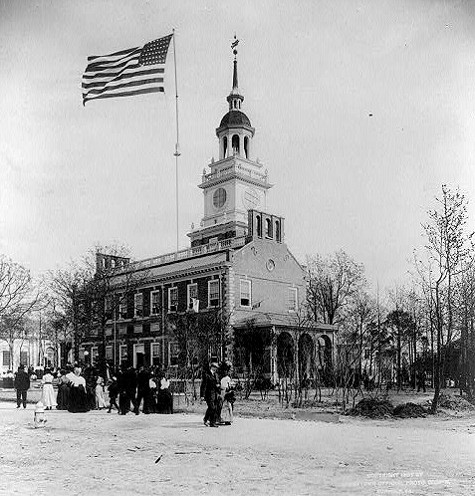 (Image Credit: Library of Congress, Prints and Photographs Division. Public Domain.)
The Exposition included an entertainment midway - it was called the "Warpath." In this area, visitors could find a "Wild West Show," a "Wild Animal Show,"an Ostrich Farm, entertaining exhibits such as a reproduction of a Klondike Gold Mine, a deep sea diving display, a Colonial Virginia display among others.
1907 Jamestown Exposition - View of Warpath (Note "Ostrich Farm" at Right)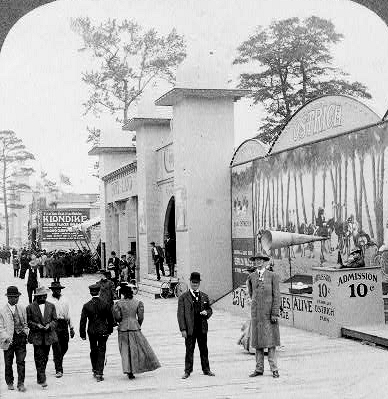 (Image Credit: Library of Congress, Prints and Photographs Division. Public Domain.)
Congress created the Jamestown Tercentennial Commission to oversee the Government's participation and exhibits. This led, subsequently, to Congress formally authorizing US Government participation in the Exposition; the US Mint was part of the Government's exhibit. Initially, Congress appropriated $250,000 for the Jamestown Exposition Company - plus funds for the Government's Buildings and exhibits. It later appropriated an additional $350,000 and, later still, authorized a loan of $1 million to the Exposition Company. The Exposition Company had ongoing financial troubles!
Attendance at the Exposition was approximately 2.75 million, with ~1.4 million paid admissions. Against a forecast of 5 million, however, the numbers were a disappointment and certainly contributed to the financial losses suffered by the Exposition. Construction and fitting out of the Exposition buildings/grounds were not completed by the time the Exposition opened - some projects continued for months - which led to initial as well as lingering negative publicity which directly contributed to poor paid attendance.
Though it was unsuccessful in securing a commemorative coin, the Exposition did feature Mint-struck commemorative medals - they were struck on the Exposition grounds within the US Mint Exhibit. Medals were struck in silver, bronze, silver-plated bronze and gold-plated/gilt bronze.
1907 Jamestown Ter-Centennial Exposition Official Medal - Gilt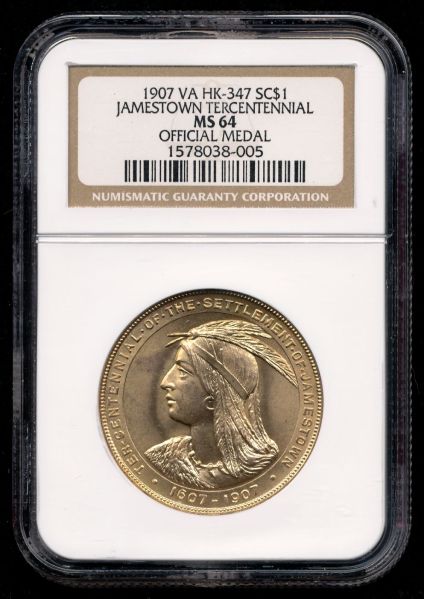
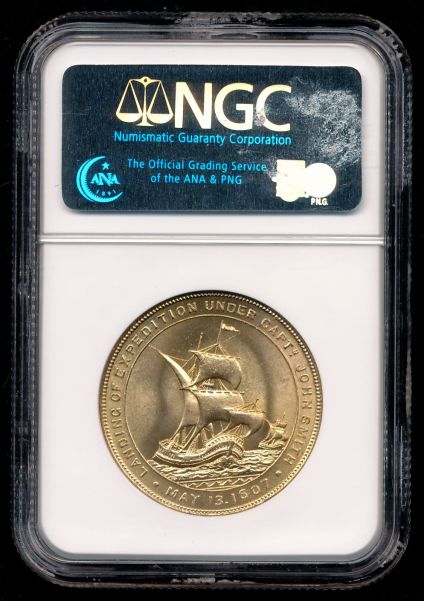
On the medal's obverse is a left-facing portrait of Pocahontas. Encircling the portrait at the beaded rim is the inscription: "TER-CENTENNIAL • OF • THE • SETTLEMENT • OF • JAMESTOWN"; "• 1607 - 1907 •" is seen below the portrait.
Note: Pocahontas befriended the early Jamestown settlers, and helped ensure their survival. Refer to this National Park Service account of Pocahontas for more: Pocahontas: Her Life and Legend.The medal's reverse depicts a sailing ship - likely the
Sarah Constant, Captain John Smith's lead ship, based on visible masts - at center with a second ship in the background to the right. The central ship design is encircled at the rim by "LANDING OF EXPEDITION UNDER CAPT
N JOHN SMITH; "• May 13. 1607 •" is below the ship at the rim.
The medal was the work of George Morgan, with an assist by
Charles Barber.
Side Notes:
1. The Exposition site went on to be redeveloped and form part of the US Naval Base at Hampton Roads - a major Navy facility that is now 4,000 acres in size!
2. Many of the US warships that took part in the Celebration event would later be part of Roosevelt's famed "Great White Fleet" global tour to publicize US power.For other of my topics on commemorative coins and medals, see:
Commems Collection.







 Posted 05/26/2023 3:07 pm


 Uncirculated American Silver Eagles