To be clear, this is a story about a National Commemorative Medal proposed in the United States ("US") Congress - NOT a commemorative coin.In 1988 and 1989, during the 100th and 101st Congresses, respectively, Helen Delich Bentley (R-MD) introduced proposals that directed "the Secretary of the Treasury to coin and sell a national medal of honor of the members of the armed forces of the United States who served in the Korean conflict." (A commemorative medal rather than a commemorative coin.)
Note: Representative Bentley's first bill was introduced in June 1988, her second bill was introduced in January 1989.The bills included a "Findings" section that provided context and background:
"The Congress hereby finds--
"(1) that it is in the national interest to issue a national medal honoring the courage and dedication of the men and women who served in the armed forces of the United States in the Korean conflict;
"(2) that the men and women who served in the armed forces of the United States in the Korean conflict made sacrifices that deserve recognition by the United States; and
"(3) that the issuance of a national medal is a fitting and suitable way for the United States to express its thanks and gratitude to those members of the armed forces of the United States who served in the Korean conflict."Regarding the designs for the medal, the Secretary of the Treasury was to "encourage and consider the submission of designs for the medal from Korean veterans, medallic artists, and other interested parties." From this, it seems plausible to consider that an open public design competition would have been held.
Also, the Secretary of the Treasury was to "solicit and consider the views of bonafide organizations which are comprised, in whole or in part, of Korean veterans and which represent the views of Korean veterans." Though no direct sponsor was listed for the commemorative medal, the bill clearly sought engagement of Korean veterans organizations in the design process.
The Commission of Fine Arts was mandated to approve any potential designs before the medals could be struck.
As noted, the medal bill did not list a sponsor/beneficiary. The medals were to be sold by the Mint, with the Secretary of the Treasury directed to support sales of the medal by developing a marketing plan that would "elicit as much public response as possible."
Without a named beneficiary, the Issue Price of the medals was not specified to include a surcharge amount, but was to be set "at a price sufficient to cover the cost of such medals, including labor, materials, dies, use of machinery, and marketing and overhead expenses."
The bills did not specify a size (or sizes) for the medal, or the metallic composition(s) to be used (e.g., bronze and/or silver). IMO, a bronze medal seems very likely, with a silver medal being a good possibility. The Mint struck a "Young Astronauts" medal set in gold, silver and bronze at roughly the same time the Korean War Veterans medal was proposed, so it was a possibility that a similar set could have been produced.
Each of the bills was referred to the House Committee on Banking, Finance and Urban Affairs, with a further referral to its Subcommittee on Consumer Affairs and Coinage. Neither bill, however, progressed past its Committee referral.
Collectors of the modern US commemorative coin series are likely familiar with the 1991 Korean War Memorial 38th Anniversary Silver Dollar. The medal proposals discussed here helped pave the way for the 1991 Silver Dollar by jump starting the conversation in Congress regarding a numismatic commemorative for Korean War veterans.
1991 Korean War Memorial Silver Dollar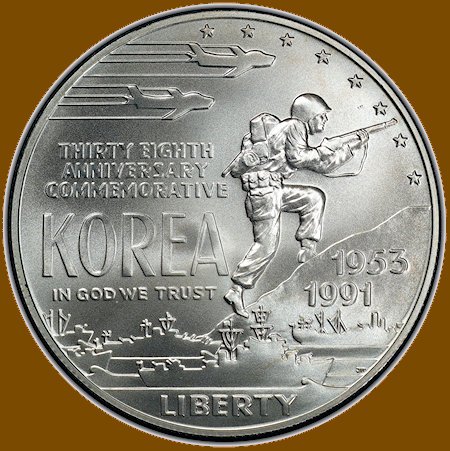
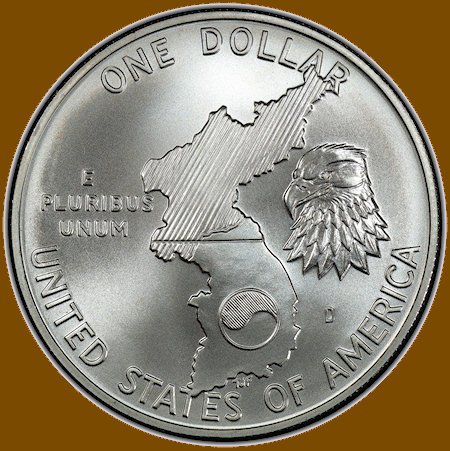
For more on the 1991 Korean War Memorial Silver Dollar, see:
-
1991 Korean War ArmisticeFor other of my posts about commemorative coins and medals, including other What If? stories, see: [b]
Commems Collection 






 Posted Today 4H 5M ago





