Posted 10/30/2011 10:42 pm


I'll have to provide a short history of Roman coinage in order to answer your question properly
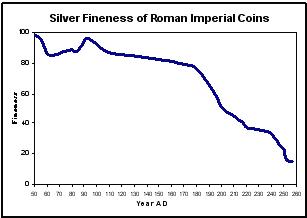
When first introduced the denarius contained nearly 4.5 grams of pure silver and remained that way throughout most of the Republican period. With the establishement of the Imperial system the denarius remained fairly constant under the Julio Claudians at 4 grams of silver. With the accession of Nero, however, the content was debased to 3.8 grams, perhaps as a reflection of the high cost of rebuilding the city and his palace, after the fires.
By the reign of Caracalla in the early 3rd century AD, the denarius had dipped to less than 50% purity. In 215 AD he introduced the Antoninianus, commonly referred to as the "radiate" due to the obverse images of the emperors with a radiate crown. The 60% pure silver Antoninianus was valued at two denarii, but contained no more than 1.6 times the amount of silver of the denarius.
By the reign of Valerian (253-260 AD), the antoninianus was only 20 - 40% silver. When Valerian was captured by the Sassanians, his son, Gallienus, issued bronze antoninianii with a silver coating. His need of coinage was so desperate that he was minting up to one million coins per day.
This constant debasement of Roman coins was finally countered by Aurelian in 274 AD. He set the minting standard for silver in the antoninianus at twenty parts copper to one part silver, and the coins were actually stamped as containing that amount. In 301 AD, Diocletian developed a strict system of purity standards with the gold Aureus struck at 60 to the pound, a new silver coin struck at the old rates during the reign of Nero, and a new large bronze coin that contained two percent silver. He eliminated the Antoninianus and replaced it with several new denominations like the Argenteus and the Follis.
I hope this answers your question about purity. Obviously, not a short and sweet answer as it fluctuated depending on the political environment. Imagine, one million coins per day struck the old fashioned way.
Now to the other part of your query. Gil-galad is correct about first collecting base metal coins until you are familiar with Roman coins and how to attribute them. However, if you have the money and want to collect silver coins, I would recommend only buying from reputable dealers. Yes, the price may be somewhat higher, but you will probably not have to deal with being sold a faked coin. And if you are sold a fake, a reputable dealer will refund your money. Maybe start by looking at the dealers on vcoins.com or forumcoins.com, both very reputable and offer 100% guarantee of authenticity. If you want to look at ebay sellers, I will be glad to provide a list of names of sellers I have bought from in the past with satisfaction. I just think that kind of information should be passed in a PM. So if you or anyone else is interested, just send me an email.
I hope I have answered your questions, and good luck. This is a great and rewarding hobby.
Regards,
JW
When first introduced the denarius contained nearly 4.5 grams of pure silver and remained that way throughout most of the Republican period. With the establishement of the Imperial system the denarius remained fairly constant under the Julio Claudians at 4 grams of silver. With the accession of Nero, however, the content was debased to 3.8 grams, perhaps as a reflection of the high cost of rebuilding the city and his palace, after the fires.
By the reign of Caracalla in the early 3rd century AD, the denarius had dipped to less than 50% purity. In 215 AD he introduced the Antoninianus, commonly referred to as the "radiate" due to the obverse images of the emperors with a radiate crown. The 60% pure silver Antoninianus was valued at two denarii, but contained no more than 1.6 times the amount of silver of the denarius.
By the reign of Valerian (253-260 AD), the antoninianus was only 20 - 40% silver. When Valerian was captured by the Sassanians, his son, Gallienus, issued bronze antoninianii with a silver coating. His need of coinage was so desperate that he was minting up to one million coins per day.
This constant debasement of Roman coins was finally countered by Aurelian in 274 AD. He set the minting standard for silver in the antoninianus at twenty parts copper to one part silver, and the coins were actually stamped as containing that amount. In 301 AD, Diocletian developed a strict system of purity standards with the gold Aureus struck at 60 to the pound, a new silver coin struck at the old rates during the reign of Nero, and a new large bronze coin that contained two percent silver. He eliminated the Antoninianus and replaced it with several new denominations like the Argenteus and the Follis.
I hope this answers your question about purity. Obviously, not a short and sweet answer as it fluctuated depending on the political environment. Imagine, one million coins per day struck the old fashioned way.
Now to the other part of your query. Gil-galad is correct about first collecting base metal coins until you are familiar with Roman coins and how to attribute them. However, if you have the money and want to collect silver coins, I would recommend only buying from reputable dealers. Yes, the price may be somewhat higher, but you will probably not have to deal with being sold a faked coin. And if you are sold a fake, a reputable dealer will refund your money. Maybe start by looking at the dealers on vcoins.com or forumcoins.com, both very reputable and offer 100% guarantee of authenticity. If you want to look at ebay sellers, I will be glad to provide a list of names of sellers I have bought from in the past with satisfaction. I just think that kind of information should be passed in a PM. So if you or anyone else is interested, just send me an email.
I hope I have answered your questions, and good luck. This is a great and rewarding hobby.
Regards,
JW