| Author |
 Replies: 100 / Views: 16,797 Replies: 100 / Views: 16,797 |
|
|
|
Pillar of the Community
France
1591 Posts |
Can one of you post pictures of those cast klippe ?
BTW, I wonder, with all this silver discovered under the sea ... I'm sure it won't be long till counterfeit rings get some of the scrap coins (too damaged to have a numismatic value) - and use this silver to make their fakes :(
Edited by MathieuMa
04/18/2012 03:38 am
|
|
Pillar of the Community
United States
1962 Posts |
This thread, while touching on lots of good points, is really heading all over the place... started discussing the cast portrait 8R w/Morelos C/Ms, then it went to cast SUD vs. cast OF A STRUCK-type SUD, now on to cast Klippes? All have the common link of being some form of "cast" Mex 8R, but involve different factors... Kind of dilutes the usefulness of each thread. FYI - As most of you will remember, the SUD piece mentioned here is really a logical continuation of our previous discussion on these: https://goccf.com/t/109327Regarding this current ebay piece ( 190665906643) - I agree, definitely a cast forgery of the "struck-type" SUD... design/surfaces look nothing like the (as made) "cast-type" SUD. Then about the Klippe... ColonialJohn, you also started to (cryptically) refer to this in a resurrection of an earlier thread on Klippes: https://goccf.com/t/90207I think most readers really have no idea what pieces you are referring to, as they were never mentioned. A little searching leads me to believe you're talking about the pieces offered recently on ebay by seller "numismexico": 251033600280260996171045 The fact that they are shown in Pradeau back in 1938 means they are at least that old, and Sedwick thinks they date from ca. 1900... then, are we perhaps just looking at numismatic tribute replicas along the lines of that 1686 Lima tribute "Royal"? The 1734 is very crude and has some cartoonish detail - clearly not faithfully executed, couldn't (shouldn't) have fooled anyone into thinking it was authentic money. The 1733 is somewhat better in its rendering of detail, but still it isn't a great replication overall. So I guess one can discuss whether these "could" have been fake money... but if nothing else, they clearly shouldn't fool coin collectors in 2012 into thinking they are authentic mint-struck Klippes from 1733-34. Edited by realeswatcher
04/18/2012 05:37 am
|
|
Pillar of the Community
France
1591 Posts |
Yes, I was about to say something as the thread was becoming messy.
We should have one thread per coin (or at least type) - even when talking about those forgeries IMHO.
I saw those coins from numismexico, but I thought they were not that old. Considering what was said, I thought we were talking about better quality copies :)
|
|
Pillar of the Community
United States
1761 Posts |
Actually all these may be from the same counterfeiting operation by melting down various real and counterfeit 8 reales. These are not recent imported Chinese fakes (predominantly Fe/Ni alloys - most are MAGNETIC) - your facts are right in your post - for now maybe circa 1900. I will know more in a month. Tokenmast let me know if you want me to analyze your ctmk. coins. Contact me privately. We have done E-Bay business before. My user name is johnmenc.
|
|
Pillar of the Community
United States
5362 Posts |
I really think that linking discussions of counterfeit cast coins of the same, or even different vintages, does not really "dilute" the subject.
Actually we are talking about coins that fall into the same general Class - "Numismatic Forgery" - they were made as collector coins of some type. How deceptive or fraudulent the intent behind their manufacture may vary by type but I do not think any of these examples were "circulating" as either Contemporary Counterfeits or Bullion forgeries (Boston Types).
Counterfeit collecting (and the study of forgery in general) is not as simple as it is often portrayed, because all counterfeits were not made for the same purpose. The only way to distinguish the various types is quite often to discuss them TOGETHER.
As I said the coins in this post are all "Numismatic Counterfeits" which I refer to as Class 3. A counterfeit that falls into this class can vary in production date from 1700 AD for some Roman Coins to yesterday for any number of 19th and 20th century coins. This wide range of production of 300 plus years or so results in a wide range of manufacturing techniques that may be found when dealing with Numismatic Forgeries.
A complete discussion of Counterfeit Classification here is likely inappropriate but for the curious - I classify counterfeits into 4 general types.
Class #1 is composed of forgeries made to enter circulation along side of original mint made coins of the same type - at FACE VALUE.
Class #2 is composed of Bullion Forgeries (unauthorised restrikes) which were made to circulate in Bullion markets at the prevailing rates along side bullion originals of the identical type. These circulate at "intrinsic value".
Class #3 is composed of all coins regardless of date of manufacture and metallic content which were produced to replicate collector coins often referred to as Numismatic Frauds.
Class #4 is composed of real host coins that have been ALTERED in some fashion to make them appear to be worth more as collector items.
|
|
Pillar of the Community
France
1591 Posts |
Hum, I see what you mean.
But then, when refering to other coins / topic, please add links to the proper page :D
It was pretty hard to follow on the previous page.
|
|
Pillar of the Community
United States
1761 Posts |
Bob - These (4) classes look familiar. <BG>.
|
|
Pillar of the Community
 United States
648 Posts |
Photos (easier to follow )of counter marks not mine  ly class 5 ? real ? 4 ++? 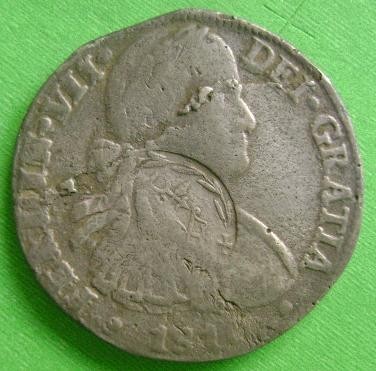 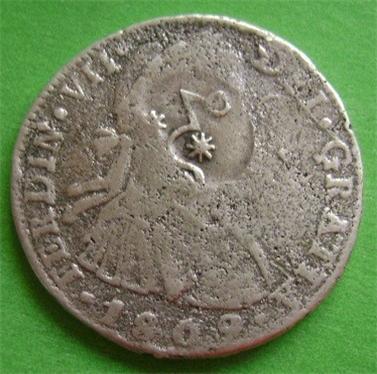 I like how compression of host coin under mark looks Quote:
Class #4 is composed of real host coins that have been ALTERED in some fashion to make them appear to be worth more as collector items. hummm  Is not that what the counter stamp did ? except the collector was spending them  back in the day That being said, why would the silver SUD be accepted? On the street.  |
|
Pillar of the Community
France
1591 Posts |
Those two are from the same seller on ebay - mexicollection. He knows his stuff and is quite good at detecting fakes - which is positive (I wouldn't buy that kind of coin from a regular ebay seller) There were genuine cast coins during the independence war, so those are quite hard to detect (modern VS ancient). Actually as you said, the counterstamp here can add a lot of value to the coin, depending on what it is :) |
|
Pillar of the Community
United States
5362 Posts |
The Class #4 Altered Original does include any host coins to which a forged counterstamp has been added. These are seen all the time on ebay. The forger takes a common low grade host and improves the value several fold by adding a fake C/S. Look for MS stamps applied to VERY well worn hosts. Always make sure the wear looks sensible. For example, if a perfect MS Morelos stamp (applied during the War) is seen on a very well worn struck regal coin from 1812 - one has to worry about forgery simply because the 1812 would not have worn too much between 1812 and the application date of the stamp. It is the same clue that is seen on forgeries where the wear on one side or the edge does not match the other TWO sides. It is a fraud that is essentially the same thing as altering a date or mint mark or assayer mark to create a rarity from a common coin. When authenticating a counterstamped coin it is ONLY the stamp that needs verification initially. The host is treated secondarily. If the stamp is fake then the original is treated as damaged. |
|
Pillar of the Community
United States
648 Posts |
Thank You Again swamperbob Collecting skill just took a leap ! mexicollection. preferred seller in my book now too !  MathieuMa |
|
Rest in Peace
United States
9104 Posts |
|
|
Pillar of the Community
France
1591 Posts |
class 3, no ? (fake coin with fake mark)
|
|
Pillar of the Community
United States
5362 Posts |
A modern fake with or without a chopmark is a Class 3 fake. The fake chop mark is also Class 3 just like any counterstamp would have to be. You can not improve or change the class of a Modern Fake by altering it.
I have actually seen a Modern Counterfeit that was altered in an attempt to make it more valuable, by changing the legend to make it look like a die error - that too is just a Class 3 - just an altered one.
But in some cases other classifications can be effected.
An original host coin marked with a Contemporary Counterfeit Counterstamp becomes a Class 1 as soon as it is stamped. It becomes a fraud that was perpetrated along side the original versions. These are far rarer than the case where a Modern (Class 3) stamp is applied.
To be in Class 4 you usually (but not always) start with an original coin to which a stamp has been added. But there are other instances of Class 4 as well. Original Coins redated to appear to be a different date or any other alterations made to a real coin will fall in Category 4. Coins that have been drilled and repaired are Class 4. A real coin that has been mined to steal silver is a Class 4. Real coins where the edge has been filed off and a fake edge applied to cover the damage are Class 4.
I have a few interesting Class 4 coins were the portrait has been re-engraved in part or completely to make it look totally different. Hobo engravings are Class 4.
Class 4 also includes things made to resemble coins. The most common examples are Buttons, but there are also political tokens, advertising tokens, religious medals, even some modern tourist fantasies and restrikes are Class 4 as well as MARKED replicas of all sorts that were never intended to be passed off as real.
Class 4 is my catch all for oddities that do not fall neatly into Classes 1,2 or 3.
If someone cares to divide Class 4 he can write the book. I will leave them as subclasses 4a, 4b etc.
Of course for every list there are always odd ball exceptions and things that fall into more than one spot.
Consider as an example a Class 1 counterfeit host coin marked with a Modern Forged counterstamp? The host would be a Class 1 but the stamp is Class 3. I own one example of this where a Riddell listed counterfeit 1832 Do 8R was counterstamped TEXAS 8 REALES to make it a Fantasy of the Republic of Texas. The stamp which is actually listed in Rulau dates to the 1950's but the host is pre-1845. It is a Class 1 with Class 3 damage.
The rarest of these exceptions, which I have encountered so far, is in my opinion the mix of a Contemporary Class 1 Counterfeit of some sort that was stamped with a later date REAL contemporary counterstamp - which in effect authenticates a forgery. I own 2 examples of this. The first is a Class 1 1834 Mexican 8R with a real Philippines YII stamp. The second combination is a Real Spanish American host 8R which was counterstamped with a forged British Honduras GR counterstamp (KM-4) making it legal at 6s 1d instead of 4s 6d. In the process the coin became a Class 1. This counterfeit combination was then counterstamped by Brazil with real dies making it a 960 reis coin (KM 326). While this coin could be considered a REAL coin, I class the coins in Class 1 but with notes.
|
|
Pillar of the Community
France
1591 Posts |
|
| |
Replies: 100 / Views: 16,797 |








 First Page
 Previous Page


 Posted 04/18/2012 05:35 am


