







 First Page




 Posted 02/21/2007 6:53 pm


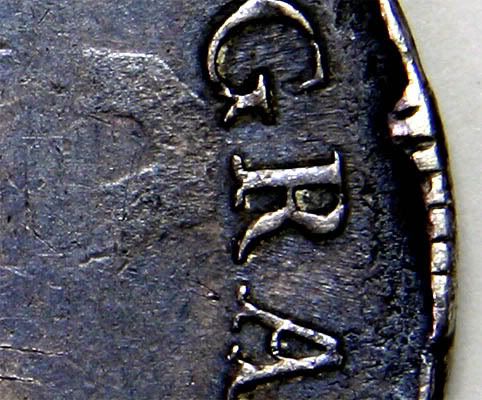
Roman - nice example - a very heavy fin that the screw press didn't completely press out evenly. For some reason the flat bar stock must have been very irregular at that point - perhaps at the end of the bar. The fins are far more common than the partially detached burrs.
It is also a nice example of an OLD clash - so old that flow erosion has etched lines over the clash.
Other evidence of a rather late stage die are the dots in the R and A above the crossbars (in your enlargement) and the loss of the top of the R in the denomination. Both are forms of flow erosion of the die. The dots are also a form of "ghost doubling" in an early stage. As a die wears out a ghost image will sometimes appear next to a die feature. The poor man's double die 1955 cent is an example everyone has seen.
There are many theories floating around as to how ghost images happen but my belief is that it is a simple physical factor associated with most metals. Everyone knows (or should know) that striking a coin makes it HARDER. This happens with most metals. Hammering them increases hardness. Therefore the impression of the hub or master punch into the softened face of the die blank causes a slight change in the hardness of the die metal right around the feature being impressed - but leaves the surrounding metal just a small bit softer. When the die is used (after uniform hardening in a furnace) this differential hardness remains. Repeated striking of coins wears the surface of the die but NOT evenly. It wears MOST in the softer portions of the die. This leaves a hump on the die surface where it is harder and a valley where it is softer. This creates the "ghost" outline on all sides of the feature. But a stronger or deaper impression on the side with the higher stress in the strike.
It is also a nice example of an OLD clash - so old that flow erosion has etched lines over the clash.
Other evidence of a rather late stage die are the dots in the R and A above the crossbars (in your enlargement) and the loss of the top of the R in the denomination. Both are forms of flow erosion of the die. The dots are also a form of "ghost doubling" in an early stage. As a die wears out a ghost image will sometimes appear next to a die feature. The poor man's double die 1955 cent is an example everyone has seen.
There are many theories floating around as to how ghost images happen but my belief is that it is a simple physical factor associated with most metals. Everyone knows (or should know) that striking a coin makes it HARDER. This happens with most metals. Hammering them increases hardness. Therefore the impression of the hub or master punch into the softened face of the die blank causes a slight change in the hardness of the die metal right around the feature being impressed - but leaves the surrounding metal just a small bit softer. When the die is used (after uniform hardening in a furnace) this differential hardness remains. Repeated striking of coins wears the surface of the die but NOT evenly. It wears MOST in the softer portions of the die. This leaves a hump on the die surface where it is harder and a valley where it is softer. This creates the "ghost" outline on all sides of the feature. But a stronger or deaper impression on the side with the higher stress in the strike.


