| Author |
 Replies: 15 / Views: 1,910 Replies: 15 / Views: 1,910 |
|
|
Valued Member
 United States
306 Posts |
Hi,
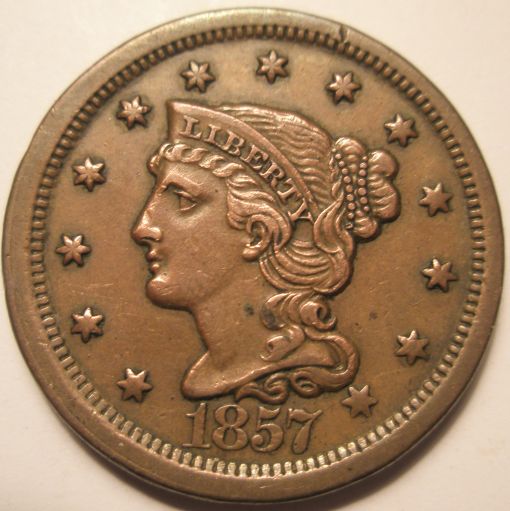
I finally decided to start a large cent collection. I've finished the Lincoln and Indian series.
The reason for the post is that need information on what I'm getting myself into! What reference books are the best ones to have? Who are the authorities on these cents?
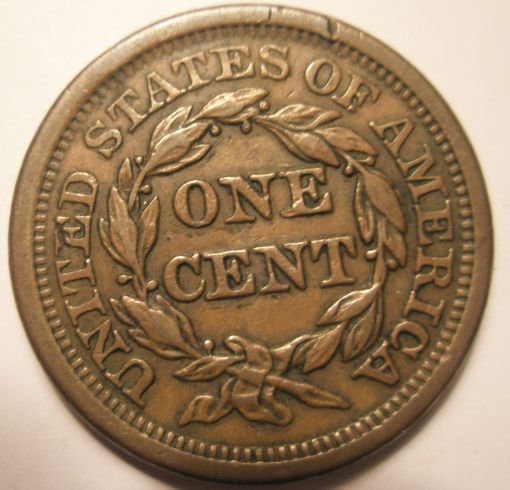
The plan is to start out with matron from 1837 to 1857. And get to know the coins. I've always heard varieties will be the biggest problem.
Dansco album seems filled with varieties. Whitman seem more in line for a date series (I like them better). But what other albums are out there. For now it's just 2x2's.
Thanks for the assist. Terrell
|
|
|
|
Valued Member
United States
246 Posts |
are these the large british cents ?
|
|
Valued Member
 United States
306 Posts |
|
|
Valued Member
United States
246 Posts |
oh . I really haven't got into those yet.. they are quite pricy. I just started on the brittish large cents. I am like you with the wheats and the indians. good luck, I can't help at all
|
|
Moderator
 United States
16697 Posts |
I'm currently working on this set. Here is my advice. Stick with a date set, forget the varieties. Some can be quite affordable while others, like the Chain and Wreath, can set you back some, even in low grades. I'm personally collecting G-VF as long as their problem free which could be a challenge if your not use to handling old copper. Many have surfaces that have been altered or recolored. Tom Reynolds is a good source as well as local shows with someone who specializes in Large Cents. I've bought from Tom Deck who has some very reasonable prices and just simply, a real good guy. http://www.largecents.net/swcoin.ecrater.com
Edited by vermontensium
05/05/2012 10:46 pm
|
|
Rest in Peace
United States
9104 Posts |
Quote:
are these the large british cents ? No, those are pennies. |
|
Valued Member
United States
309 Posts |
hey tepritts,
I can't offer much in this area you are focusing on but I can wish you good luck on your endevor and say some of us will be looking forward to learning from your experience.
Best.
|
|
Bedrock of the Community
United States
20753 Posts |
Quote:
No, those are pennies.
But isn't that what we have too. Only for some reason some, not many, call them Cents.  Meanwhile back to those Large things. Here is my advise. DON'T. I have well over 100 Albums and only one of them is for Large Cents. I have numerous duplicates of normal, nice to look for, fun to find coins but NO duplicates of those Large Cents. I'm still missing about 15 or 20 of them and have been looking for a long, long time. I go to coin shows about 2 to 4 times a Month and out of all the coins not commonly there, it's those Large Cents. My Album is a Whitman, year only set, yet so many of those are so expensive and for a coin that is almost worn flat. I noticed in the Red Book they start with a grade of AG not just G-4 like normal coins. Makes for a nice looking set but the prices are just ridiculous. |
|
Pillar of the Community
United States
8904 Posts |
Edited by Moe145
05/06/2012 6:35 pm
|
|
Bedrock of the Community
United States
20753 Posts |
Quote:
I mean, just look at this! It's too cool to be ignored!! I've bought cars for less than that coin is worth. |
|
Pillar of the Community
United States
531 Posts |
As you can probably tell from my screen name, I like all things copper. Tom Reynolds told me years ago that a date set is the way to go with the US Large Cent. Variety collecting becomes quite specialized and without very deep pockets a collector just won't be able to make much progress. Actually completeing a variety set is virtually impossible. Several very large sets have been sold in the last few years, and the prices were incredible. Those coins have now been distributed throughout the collecting community and may never be reassembled again. One bit of advice I would offer. Consider joining Early American Coppers (EAC) ( http://www.eacs.org/). Their publication, Penny-Wise is full of member generated research. You will also get the ability to purchase the necessary reference books directly from the authors. |
|
Moderator
United States
16697 Posts |
I agree, EAC is the way to go ;-)
swcoin.ecrater.com
|
|
Pillar of the Community
United States
4433 Posts |
Hi tepritts ... Sounds like you're taking a more methodical approach to collecting and see it as more of a journey to learn and less so to plug holes in an album. IMHO, the large cents are best suited to that approach. There are many rare varieties out there, waiting to be discovered by those with the interest and patience to study. I've found three such pieces in recent years! While building a library can be costly, there's information aplenty on websites and in auction archives. For starters, visit the EAC website: http://www.eacs.org/links.html Check out the dealer offerings, annotations and pics. You can see what books the dealers prefer, and they'll gladly answer questions. You can typically find EAC-affiliated dealers at at most shows, and I've yet to find one who's reluctant to shar their knowledge. While IMHO, the quality of a Whitman album isn't as good as Dansco, Whitman does make a year set album for large cents. Most large cent collectors that I know tend to prefer using the older, manila/white envelopes. There's something to be said for holding an old copper in your hand, studying it and then tucking it away in its labeled envelope! So much to learn .... so little time!  |
|
Bedrock of the Community
United States
17884 Posts |
My advice is at first just work on a date set, maybe just a date set of a specific type. The late dates is a good choice for that 1840 - 57. It is definitely doable, and can be done in nice grade without breaking the bank. Then you can work your way on back if you wish.
If you find that the large cents agree with you and you want to dabble in the varieties (And no one says you have to do varieties) I would suggest starting with one of the middle dates. You don't have to do all the middle dates. You will probably find that there is one date in particular that you especially like, and try doing a variety set of just that one year. Once you finish it you can do another year and so on. just be careful though because the varieties can become very addictive.
The reason I suggest the middle dates is because the early and middle dates are much easier to attribute than the late dates, and the early dates are much more expensive. The early dates are good for people with deeper pockets and the late dates are good for people with masochistic tendencies.
More advice on the middle dates. As a beginner avoid 1834 to 39 until you have some experience under your belt. They are tougher to attribute. Stay away from 1822, 1825, and 1830, probably 1827 as well. 1822 has N-9, 13 and 14. N-9 is tough and costly but possible, N-13 probably high three figures for a low grade coin, and N-14 well there are only five known. But if you can cherry pick an N-14 then by all means go ahead and do 1822. 1825 was easy until the long lost N-5 showed up. The count is now exactly one piece seen since 1882. Once again learn what to look for and maybe you can find the second one. 1830 has N-9 and N-11, mid four figure coins even in low grade need I say more. 1827 has N-10, 11, and 12. Rare coins, can be done but will dent your pocketbook. Don't get me wrong there are still so good challenges in the other years as well but not on the level of the ones I've mentioned. (1816 N-6, 1817 N-17, 1818 N-4, 1820 N-14, 1824 N-5 etc.) But the other years are definitely doable.
If you want to do early date you might try the Classic heads 1808 to 1814. Can be done as either a date set or a variety set. Nothing really rare but the 1809 is tough and the 1811 and 13 are scarce. The real challenge here is finding decent coins. As a rule the classic heads come on dark rough porous planchets, even in the higher grades.
Edited by Conder101
05/07/2012 11:51 am
|
|
Rest in Peace
United States
9104 Posts |
Quote:
But isn't that what we have too. Only for some reason some, not many, call them Cents. It's not difficult, turn the coin over, and it tells you what it is. Bankers call them pennies. Keep in mind these are the same geniuses who will cheerfully hand you a roll of silver dimes for $5. Or the mint, which pays 60% more to create a product than they can sell it for. |
|
Pillar of the Community
United States
2295 Posts |
Very impressive info. Thanks for sharing. I've been thinking about getting into large cents for a few years now. Maybe this will be the year.  |
| |
Replies: 15 / Views: 1,910 |
|






 Posted 05/05/2012 10:14 pm