| Author |
 Replies: 10 / Views: 5,854 Replies: 10 / Views: 5,854 |
|
|
New Member
United States
6 Posts |
Hello, I have two gold Queen Victoria Coins, each from a different year. I'd be so grateful if you could help me understand the value, rarity etc of these coins. Thank you! The first one has Queen Victoria with a crown on one side, and says 1891 with a warrior on a horse on the other side. The second one has Queen Victoria (simpler image) on one side and says 1869, and the other side the crest with the crown on it.  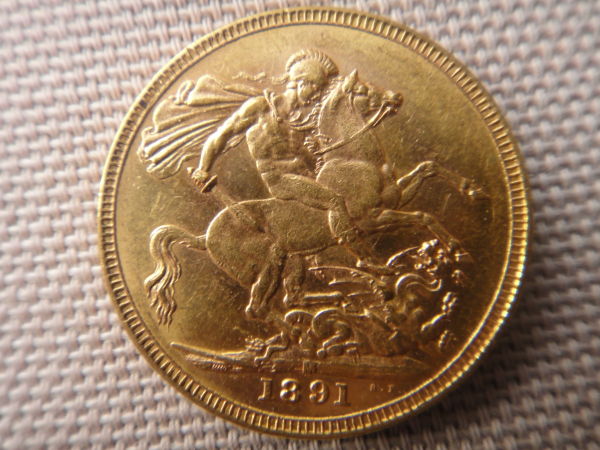 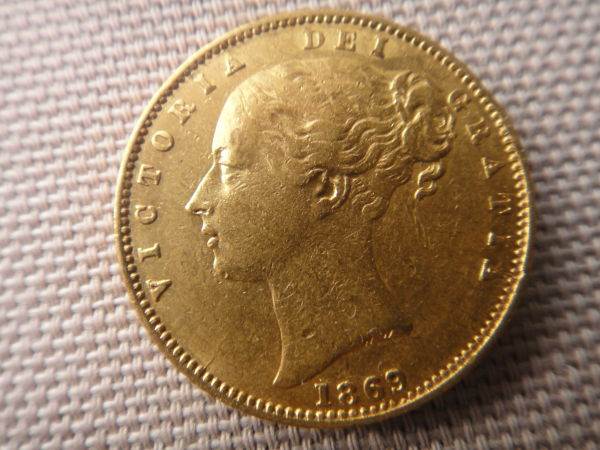 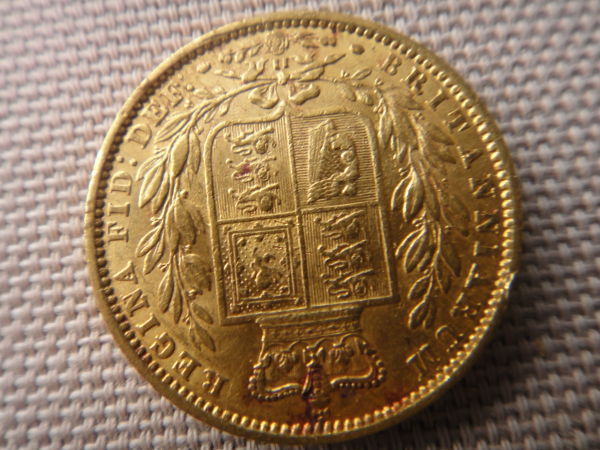 |
|
|
|
Moderator
 Australia
17000 Posts |
Your coins are 1 pound coins, also known as "sovereigns". The top one is Australian minted, from the Melbourne mint (there is a small "M" on the ground-line, below the horse's hoof and above-left of the "9" in the date). The other one is London mint. Australian sovereigns from the 1800s are generally pricier than London ones. The tiny numeral "11" below the wreath of the shield is the die number; die numbers don't significantly affect the value. This page shows a pricelist for sovereigns, in British pounds. Note the pricelist dates from 2008, when the bullion value (value based on the price of gold alone) for a sovereign was £120; Gold has gone up in value since then, with bullion value now at £240 (US$380). On that basis, and assuming any numismatic premium has remained constant, I'd rate your 1891-M at about £270 (US$430) and the 1869 at about £260 (US$410). Don't say "infinitely" when you mean "very"; otherwise, you'll have no word left when you want to talk about something really infinite. - C. S. Lewis
|
|
Pillar of the Community
United Kingdom
709 Posts |
The crowned head is known as the "jubilee" head, introduced for Queen Victoria's jubilee in 1887.
One book I have gives a mintage of 6,441,322 for your 1869 sovereign.
|
|
Pillar of the Community
United Kingdom
2624 Posts |
The second coin's portrait is known as a "bun head" and the reverse is a "shield back"...the other reverse is St George and the Dragon which is the standard back produced to this day.
In general jewellers try to buy such coins for bullion prices but offer more for the bunhead and shield back varieties since they are not numismatists and just assume that the age and difference in design makes them more marketable to their customers. Very often if they end up with more coins than mounts they melt this kind of thing without giving much thought to things such as mint marks or year.
Yours look to be nice examples, very often coins of this type are used in jewellery and get significantly damaged, worn or get soldered to something. Gold being soft I think your's have probably been put away somewhere to retain good details (the shieldbacks reverse looks extremely fine)
|
|
New Member
 United States
6 Posts |
thank you for such great information all! you guys are such gifts! :worship:
davidUK, indeed, mum and dad got the coins and put them away in velvet lined boxes. the thought had been to have a pendant made for each of us, by simply sitting the coins in a bezel so both sides are visible and nothing gets damaged. but they never did. Dad loved collecting British/colonial coins, and I think he went more by aesthetic instinct than some great knowledge of historical rarity, but occasionally it worked out well. :)
i photographed them in super macro, so you can see some of the small dings/scratches on the bun head/jubilee head, but to the naked eye, they look pristine and shiny when held. they're actually very beautiful in person.
so, given that these were minted in fairly large numbers, they're easy to come by should one want to buy them at some point - is that a fair conclusion? albeit judging by David's post it seems unblemished pieces might be harder to come by?
thank you all!
|
|
Pillar of the Community
United Kingdom
2624 Posts |
I find it amazing that they are as obtainable as they are...
These coins were in circulation pre-first world war, then they were withdrawn and used for the war effort (pressumably melted) Thought many were minted I would think that the rate for survival wasn't so high but yet they don't have a huge premium over their gold content... which I think must indicate that there are enough to meet general demand.
Collectors always want coins in the best condition possible, you have two nice coins. If you sold them you could probably replace them easily enough for some similar coins but we all know how that works. I sold about 8 of these coins when I found myself unemployed a couple of years back, I regret it because I will never be able to replace them for the kind of money I paid for them (£40 per coin bought when gold was at its lowest value, I had soverigns with each of the monarchs portraits) I probably will never get around to replacing them.
Sometimes you must do what you must do to survive, but if you have any choice in the matter I would hold onto these, they will always have some value.
|
|
New Member
United States
6 Posts |
thank you David! unfortunately, we're facing a paucity of choices here. I retain my hesitation (and identify wholly with your regret), but I'm afraid I might have to auction them here on CCF, or on ebay, and attempt to get the highest value I can get. thank you for your invaluable advice, information, guidance. |
|
New Member
United States
12 Posts |
That image on the obverse of your 1891 sovereign is unmistakable. It is very striking and strong. I'm not sure if every coin collector considers this coin his unicorn but I do.
|
|
Pillar of the Community
United Kingdom
1351 Posts |
On ebay you will get at least £275 each maybe a bit more for the bun head.Worth keeping for future generations.I sold all my sovereigns bar 1 but kept my guineas......nice coins. |
|
New Member
United States
6 Posts |
Thank you Adirondack and Peter!
|
|
Pillar of the Community
Canada
1046 Posts |
Hi is there any resource that may tell the population of a particular die used on the 1869
we have a die number 6
and often wondered how many may have been struck
thanks
dermot
|
| |
Replies: 10 / Views: 5,854 |
|










 Posted 08/27/2012 10:34 am


