| Author |
 Replies: 15 / Views: 5,530 Replies: 15 / Views: 5,530 |
|
|
New Member
United States
7 Posts |
Hi, A friend asked me about this coin, but since I don't collect modern coins I couldn't help much in terms of authenticity. Perhaps you folks could? It was found in a basement of an old house. From what I've briefly read, 8 reale coins of Zacatecas were often counterfeited and circulated along with the originals, and also the metal wasn't very pure even at the official mint. I don't know how true that is. Attached are the sloppy images (I'm using my phone, so I apologize). Some strange corrosion and I definitely see bits of copper and even what appears to be rust. Soft features might point to casting, but edge seems OK in hand. My first guess is a contemporary counterfeit. Any help is appreciated. Best, Nick Attribution: 1821 Spanish 8 Reales, Zacatecas mint, Ferdinand VII, c. 38.5mm. No weight. Z with small "A" on reverse point to Zacatecas. Possibly a contemporary counterfeit. 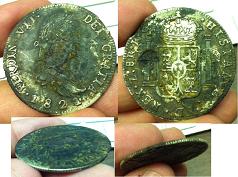 |
|
|
|
Pillar of the Community
United States
1801 Posts |
Welcome Molinari to the world of Spanish Colonial 8 Reales. If you could post larger individual photos of the same pictures above so we can enlarge them and see the details on the coin, there are several people here on the Forum that I am sure will render opinions on your coin.
Of course as you pointed out, signs of copper and/or rust are never a good sign on these coins.
|
|
New Member
 United States
7 Posts |
Obverse, best I could do under 100kb. 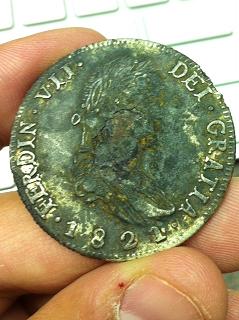 |
|
New Member
United States
7 Posts |
Reverse 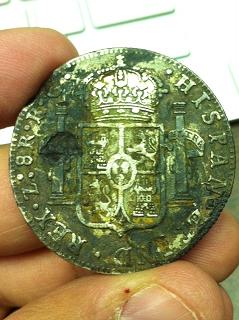 |
|
New Member
United States
7 Posts |
Side 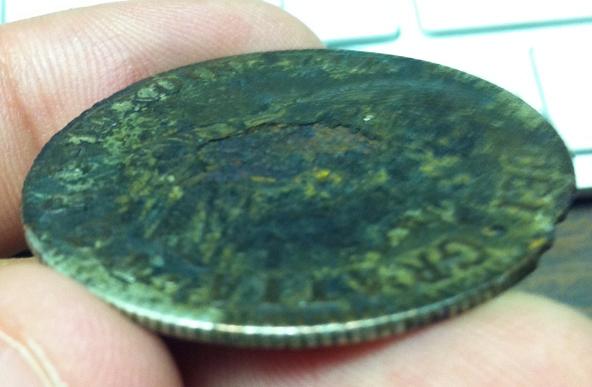 |
|
New Member
United States
7 Posts |
Edge 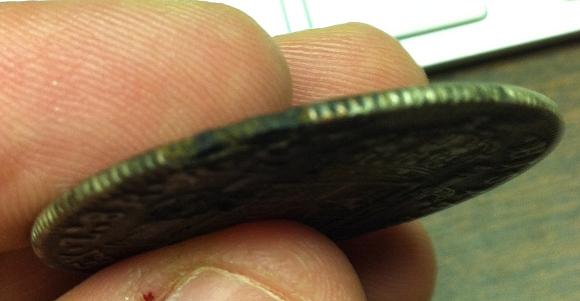 |
|
Pillar of the Community
France
1591 Posts |
According to the edge, this coin is not genuine (the edge for those has a square / circle pattern)
|
|
Pillar of the Community
Czech Republic
803 Posts |
It's definitely a counterfeit. Looks like it was plated at some point - you can see plating peeling on the bust in your "side" picture.
|
|
Pillar of the Community
United States
1088 Posts |
I would go with fake or counterfeit as well. There is too much incorrect about the coin to be real. Sorry
|
|
New Member
United States
7 Posts |
To be clear, is it a contemporary counterfeit (circulated in the 1820s, but not from the official mint) or a modern forgery (made to fool today's collectors)?
Thanks!
Nick
|
|
Pillar of the Community
United States
5362 Posts |
As previously indicated the coin is a Numismatic Forgery (Class 3 counterfeit). This means it was made AFTER 1940 for a Numismatic Market not for circulation. This is a non-silver white metal cast coin with a ring applied reeded edge. This coin was first reported about 1990 (per my records) but I believe it to be older based on the technology used to make it. There are some examples with an older rolled edge that has one overlap in the reeds. The deep bifurcation of the lettering is a distinctive feature of this example and can be used for identification. No originals have letters with such a deep set split. They are also NOTORIOUSLY light in weight being as light as 14 grams and are rarely plated in any form. If this coins was in fact plated it might be a "double fraud". This would imply that a later individual plated a counterfeit knowing what it was in an attempt to get it to sell. These re-plated counterfeits exist in all of the categories except Class 2. Either way it is Exceptionally common and essentially a worthless fake in this condition. There are other modern fakes around that are much better than this one. 1821 is one of the most commonly forged date of the entire portrait series and of the Provincial mints - Zs RG is the most common. I own three different modern varieties of the 1821 Zs RG and there are currently 25 Class 1 Contemporary Circulating Counterfeit varieties of this one date (1821). Here is a representative copy of what you have in better shape. 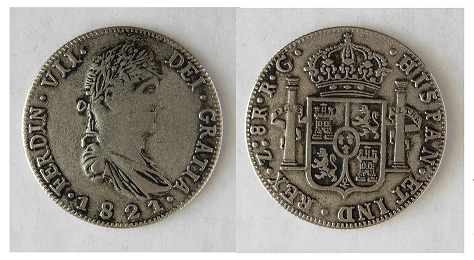 |
|
New Member
United States
7 Posts |
Thanks so much for the detailed response. I will inform my friend of the news!
|
|
Pillar of the Community
Hong Kong
1270 Posts |
I don't think this is a contemporary counterfeit. The thickness of the coin is so thin so I guess the coin is seriously underweighted. Riddell book stated this coin as a debased piece but the weight of the coin is close to the standard.
I don't understand why this piece 1821 Zs RG is the one most commonly forged by the counterfeiters but not the other dates. Can anyone know the answer?
|
|
Pillar of the Community
United States
1761 Posts |
Bob - too bad the book is still about a year away from final publication at the ANS - obviously people even as far away as Hong Kong will benefit from its publication - TODAY.
|
|
Pillar of the Community
United States
5362 Posts |
John - I agree it is needed and that the Class 3 counterfeits (Numismatic Forgeries made after 1940) need to be shown. I just hope ANS agrees it makes it longer.
But doing the book in haste might be worse that not doing it at all. We first need as close to total credibility which comes with checking facts and rechecking them again. New data can pop up at any time to modify long held beliefs.
Henry - The answer of why a forger would pick 1821 is quite obvious if you understand the psychology of forgery in general from the forgers perspective.
To be successful "a forgery needs to pass only once" is the conventional wisdom, but to a serious forger that is totally wrong. To be really successful it should NEVER be spotted. That way he can continue to introduce the fakes slowly until someone discovers the fraud or he dies of natural causes. The best forgeries are the ones we do not know about.
How do you do that? Or how do you increase the odds of success?
First don't be greedy or slipshod. Operate without detection. Do NOT flood a market. Blend in.
You can do it by making something no-one looks at too closely. Something common that is the same color and design of the most common similar coin in circulation. You make it in a lower mid grade - not collectible - not bright and shiny. You make a copy dated a few years ago from a common mint.
So among forgers, it is a given that you pick a common coin seen everywhere. That is why there are so few counterfeits of rare coins that are contemporary. 99.9% of counterfeits of rare coins are Class 3 Numismatic Forgeries - they are NOT COUNTERFEITS.
Forgery and Counterfeiting are really not identical tasks. Forgery relies on a superior appearance - an exact match. It is where a consummate artist works. But counterfeiting is the blue collar cousin of the forger.
The 1821 Zs RG is one of the MOST common 8Rs made during the War era. That period of time is critical because there was little mint stability and variation in design was tolerated. So a copy of an 1821 Zacatecas coin will fit in far easier than a copy of an 1805. The counterfeiter can be less precise and get by fine making an 1821 where his errors in style might quickly disclose an 1805.
Also the coins wear - silver looses 3% plus per 10 years of circulation. So a forger working in 1825 picks the LAST common date available. That is 1821 also.
There are other far more specific reasons for why 1821 Zs was copied the most but you should get the idea.
|
|
Valued Member
Germany
194 Posts |
Swamperbob, may I dare to ask for the other reasons why the 1821 Zacatecas has been counterfeited so excessively?
My assumption was that the Mo mint coins were too uniform (good quality) and the other Mexican mints too bad qualitywise, also Zacatecas did have a considerable production, so the coin was not rare. But these are the reasons you already mentioned.
|
| |
Replies: 15 / Views: 5,530 |
|






 Posted 09/05/2012 12:17 pm





