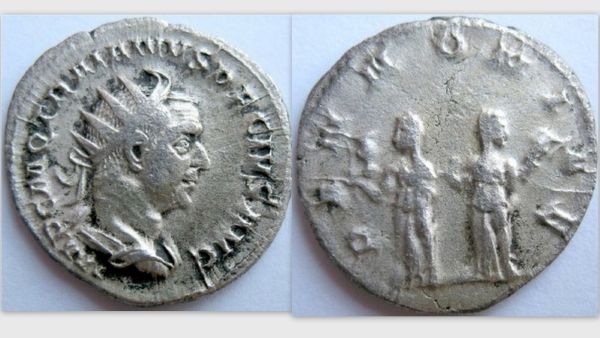
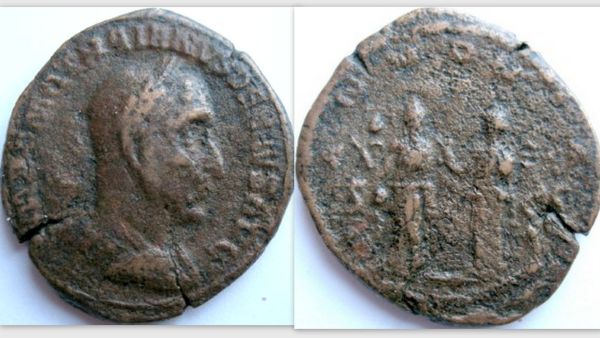
I'm unsure if I can present another set, but I will and if the moderator chooses, he can take this one down.
My second set is a set of four coins to represent the "year of the four emperors". AD 69 was a year in which four emperors ruled in a remarkable succession. These four emperors were Galba, Otho, Vitellius, and Vespasian.
The suicide of emperor Nero, in 68, was followed by a brief period of civil war, the first Roman civil war since Mark Antony's death in 30 BC. Between June 68 and December 69, Rome witnessed the successive rise and fall of Galba, Otho and Vitellius until the final accession of Vespasian, first ruler of the Flavian Dynasty, in July 69. This period of civil war has become emblematic of the cyclic political disturbances in the history of the Roman Empire. The military and political anarchy created by this civil war had serious repercussions, such as the outbreak of the Batavian rebellion.
In June 68, the Praetorian Guard prefect, Nymphidius Sabinus, as part of a plot to become emperor himself, incited his men to transfer their loyalty from Nero to Galba. Nero was suddenly powerless and the Senate was able to declare him an enemy of the state. He fled the city and committed suicide. Galba was recognized as emperor and welcomed into the city at the head of a single legion, VII Galbiana, later known as VII Gemina
Galba, AR Denarius RIC 234, struck at Rome, Oct/Nov 68 AD:
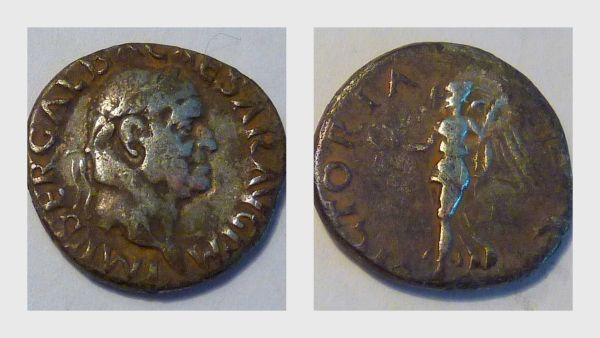
OBV: IMP SER GALBA CAESAR AVG PM - Laureate head right
REV: VICTORIA P R - Victory standing left on globe, holding wreath and palm
3.2g, 18mm
Galba did not remain popular for long. On his march to Rome, he either destroyed or took enormous fines from towns that did not accept him immediately. In Rome, Galba cancelled all the reforms of Nero, including benefits for many important persons. Like his predecessor, Galba had a fear of conspirators and executed many senators and equites without trial. The Praetorian Guard were not happy either. After his safe arrival in Rome, Galba refused to pay them the rewards that the prefect Nymphidius had promised them in the new emperor's name. Moreover, in the start of the civil year of 69 on January 1, the legions of Germania Inferior refused to swear allegiance and obedience to Galba. On the following day, the legions acclaimed Vitellius, their governor, as emperor.
Otho, AR Denarius RIC I 17, struck at Rome, Jan/Feb 69 AD:
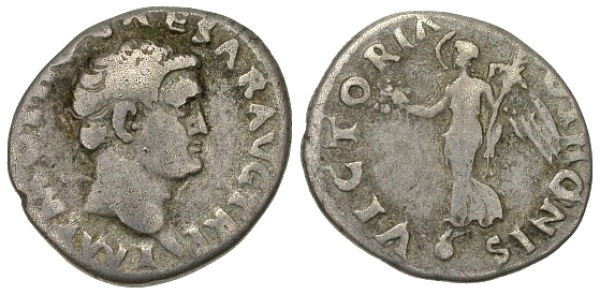
OBV: IMP M OTHO CAESAR AVG TR P, bare head right
REV: VICTORIA OTHONIS, Victory standing left on globe, wreath extended in right, palm frond in left
3.179g, 18.7mm
Otho was recognised as emperor by the Senate that same day. The new emperor was saluted with relief. Although ambitious and greedy, Otho did not have a record for tyranny or cruelty and was expected to be a fair emperor; however, trouble in the form of Vitellius was marching down on Italy from Germany.
Vitellius had behind him the finest legions of the empire, composed of veterans of the Germanic Wars, such as I Germanica and XXI Rapax. These would prove to be his best arguments in his bid for power. Otho was not keen to begin another civil war and sent emissaries to propose a peace and convey his offer to marry Vitellius' daughter. It was too late to reason; Vitellius' generals had half of his army heading to Italy. After a series of minor victories, Otho was defeated in the Battle of Bedriacum. Rather than flee and attempt a counter-attack, Otho decided to put an end to the anarchy and committed suicide. He had been emperor for a little more than three months.
Vitellius, AR Denarius RIC 109, struck at Rome, Apr/Dec 69 AD:
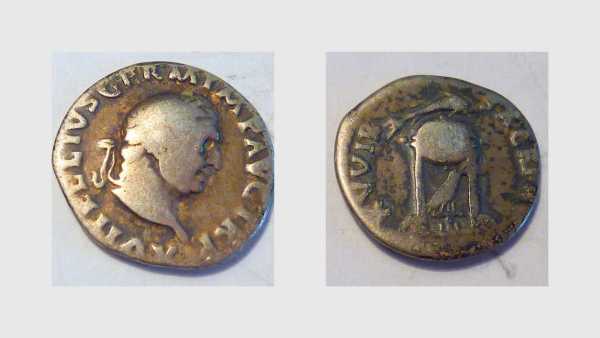
OBV: A VITELLIVS GERM IMP AVG TRP - Laureate head right
REV: XV VIR SACR FAC - Tripod, dolphin above and raven below
2.9g, 19mm
The legions stationed in the African province of Egypt and the Middle East provinces of Iudaea (Judea/Palestine) and Syria had acclaimed Vespasian as emperor. Vespasian had been given a special command in Judaea by Nero in 67 with the task of putting down the Great Jewish Revolt. He gained the support of the governor of Syria, Gaius Licinius Mucianus. A strong force drawn from the Judaean and Syrian legions marched on Rome under the command of Mucianus. Vespasian himself traveled to Alexandria where he had been acclaimed Emperor on July 1, thereby gaining control of the vital grain supplies from Egypt. Vespasian's son Titus remained in Judaea to deal with the Jewish rebellion. Before the eastern legions could reach Rome, the Danubian legions of the provinces of Raetia and Moesia also acclaimed Vespasian as Emperor in August, and led by Marcus Antonius Primus invaded Italy. In October, the forces led by Primus won a crushing victory over Vitellius' army at the Second Battle of Bedriacum.
Vespasian, AR Denarius RIC 546, struck at Rome, 73 AD
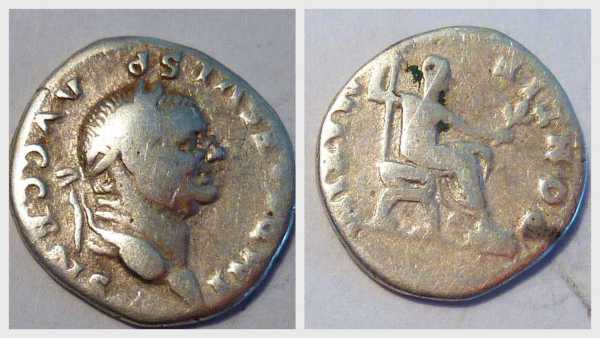
OBV: IMP CAES VESP AVG CENS, laureate head right
REV: PONTIF MAXIM, Vespasian seated right, holding scepter & branch
3.1g, 19mm










 Posted 10/15/2012 10:06 am


 a few times at coins posted in the past that I would have liked more info on.