| Author |
 Replies: 35 / Views: 13,602 Replies: 35 / Views: 13,602 |
|
|
|
Pillar of the Community
Australia
7096 Posts |
It is an absolute shame that the old bloke didn't have access to the Internet in the early days or a network of collectors that are assembled here on CCF and other sites to advise and warn him before he got stiffed with the fakes  |
|
Pillar of the Community
United States
1962 Posts |
A Riddell bust (proper or Mex branch mint?), or a Cap & Ray?
Scary beause this is two different malfunctions... In your case, it's lack of knowledge (I could see "perhaps" a well-made contemporary counterfeit passing as a crude legit issue to someone who doesn't know a certain series well... but you'd expect better from paid pros).... Whereas with that dog pillar 8R in the 63 holder, you don't need to know pillars at all to know thats a complete bogus grade.
I picked up a PCGS cob last year... attributed to the complete wrong mint (not even close, should NOT have been confused). Hae actually seen multiple instances of that (from both companies)... And remember that "Royal" (REPLICA!) cob in the PCGS holder discussed last year?
|
|
Pillar of the Community
2087 Posts |
Quote:
It is an absolute shame that the old bloke didn't have access to the Internet in the early days or a network of collectors that are assembled here on CCF and other sites to advise and warn him before he got stiffed with the fakes Its a horrific story! I buy coins from dealers all over the world. One noticeable difference between the German speaking Coin dealing world and the rest is pretty impressive Many of the well established dealers offer life time guarantees meaning that should ever the coin prove to be a fake the company will take it back at the original purchase price. Of course if this happened after 10-20 years it would mean a loss but not so large as the one in this story. For me though this "life time" guarentee enforces a different attitude to sales and attribution/identification of coins. Effectively it makes dealers stand behind their products. The First time I purchased from an Auction in USA ( I think it was Bowers) I was most uncomfortable with all the disclaimers in the terms and conditions. In comparison to my mainland European buying it made me feel very exposed and really made me doubt the company's expertise. Of course in the US that "Life Time" Guarantee service has been taken over by the TPG companies....and the risk has passed from the dealer to the TPG. I for one have more confidence when the dealer has to bear the Risk. Of course nothing beats buyers research. |
|
Valued Member
United States
98 Posts |
That had to be painful telling him his $25,000 Morgan was worth little more than bullion value. I guess in a way it's good that his family wasn't interested in collecting. Would have been harder to face being duped like he was if someone else was 'invested' in his collection.
|
|
Pillar of the Community
Hong Kong
1270 Posts |
Quote:
In addition an 1898 S barber in brass and 1911 white metal strike both made for circulation. Weight of this coin: 10.38 gr. 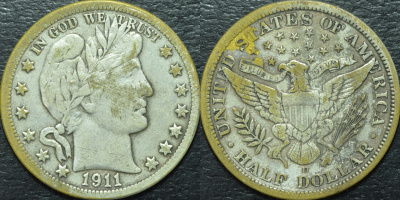 Bob, is this one you had seen? I bought it from an US seller on ebay about 2-3 years ago. I have another 1911 half dol., looks ok but found a bit debased by S.G. |
|
Pillar of the Community
 United States
5362 Posts |
The Barber half dollar is a counterfeit - debased is inaccurate as a description. These coins have a very thin plating which can be removed in a bath of mercury which is exactly how the silver is reclaimed at a processing plant. On a coin like this there is only a few cents worth of silver. It is a circulating contemporary counterfeit that has a collector value of about $15 -$30 depending on the collector. They are illegal to possess in the US even if they are marked COPY they are still illegal. But I know a few collectors who ignore that law. Debased usually refers to a coin above 20% silver - below that is billion. Coins below 40% silver carry a penalty to reclaim. That is why you still find so many of the 10% silver pesos in junk boxes. |
|
Pillar of the Community
United States
5362 Posts |
austrokiwiQuote: Of course in the US that "Life Time" Guarantee service has been taken over by the TPG companies....and the risk has passed from the dealer to the TPG I have discovered that the TPG does NOT assume the risk in all cases. When a coin in a slab is verified as a counterfeit or if there is another problem that requires a refund, the TPG contacts the last seller and works their way back until they recover the money from someone they can bully. The TPG's rarely pay out of their own pocket for their errors. The problem with this method becomes apparent when you run a business. If a dealer submits a coin the TPG makes a presumption that the coin is Genuine and Unaltered. They certify the grade and confirm the other two facts. The guarantee is still by the dealer. Therefore when someone makes a claim for a coin that was doctored (cleaned) and then submitted for grading by the PREVIOUS owner of the shop - say 8 years ago, guess whose door the TPG knocks on. The current owner and they are expected to pay the TPG for the error. It happened at the place where I help part time. It resulted in one payment and an immediate name change. That is why the guarantee is only so so. A second example: NGC holders a coin for a private collector who dies. Subsequently the executor places the coin with a reputable Auction House for sale. The coin sells to another collector for $1,000. A few months later the coin is recognized as a worthless forgery. NGC is contacted about a refund. But the owner that had the coin certified is dead. So does NGC pay - heck no they threaten the Auction House? and want them to make good for the $1,000. The private collector wants to stay anonymous and not to cause problems for the Auction House that sold it last so he withdraws the claim. NGC revokes the certification for the coin but does not have possession of the coin. Then the coin is re-sold. There is NO GUARANTEE at all. If the next buyer tries to get the guarantee paid - he gets NOTHING. Moral - always check the certification number to see if it is actually VALID. A slab is really not much of a guarantee at all.
|
|
Pillar of the Community
2087 Posts |
Swamperbob that is intriguing: it expands my understanding of all those disclaimers I commented on.
I certainly buy in a different environment. I am still bemused by a Salzburg Auction house. I send in an email bid for some coins I want: I forget about it and about a week after the auction the invoice, for the coins I was successful with, arrives with the coins. I appreciate the trust but am amazed in this day and age that such trust still exists.
Edited by austrokiwi
02/16/2013 02:22 am
|
|
Pillar of the Community
United States
5362 Posts |
That is a lot of trust.
I don't often find counterfeits on the European auction sites at what I feel are reasonable prices. They seem far higher. Even on common stuff.
|
|
Pillar of the Community
United Kingdom
2932 Posts |
I too, have had big German auction houses send me coins I won on auctions - along with an invoice to be paid. I agree with Austrokiwi - there does seem to be a lot of trust there - though they do "sort of" know me which helps I guess.
|
|
Pillar of the Community
2087 Posts |
Quote:
I don't often find counterfeits on the European auction sites at what I feel are reasonable prices. They seem far higher. Even on common stuff. My coffee hasn't cut in this morning: Your saying that when you see counterfeits for sale in Europe that they are much more expensive than in the US? I was thinking about the TPGs more. If I was a US dealer, every time I sent a coin into a TPG I would send with it a standard letter stating that The coin is being sent for grading and Authentication. That way if at a later date the TPG comes knocking "saying you sold a fake" pay up! I would reply " You were asked to authenticate the coin you authenticated it you pay. Swamperbob I guess you will now tell me they have that covered in their terms and conditions! |
|
Pillar of the Community
United States
1796 Posts |
Quote:The TPG's rarely pay out of their own pocket for their errors. Isn't that the truth. PCGS and NGC also have such a broad definition of "clerical errors" (which they say are exceptions) that they could use it to deny their guarantee for nearly anything. There is a seller on ebay who is consistently trying to sell a large date 1970 Lincoln Cent whose NGC holder says is a small date. No matter how many times they're contacted, they won't pull their listing, claiming that since it's certified that whoever says otherwise is wrong. This same person, from what I understand, tried to redeem the guarantee earlier and NGC wouldn't make good on it. They said it's obviously a large date, so that must be a clerical error, and sorry they won't disburse anything for it. However, if someone pays the fees to have it re-holdered they'd "fix it"... :-) |
|
Pillar of the Community
United States
5362 Posts |
austrokiwi The TPG's cover the issue of a "special" request which is what you propose by EXCLUDING all claims for services except as stated in their own boilerplate agreement. Remember a clerk reads your letter and no matter what you try to get them to do - they do only what their agreement claims to do - which is NOTHING. They give a "subjective" opinion on the grade of the coin BUT qualify that by saying that in the long run it is only an OPINION. You basically pay up front for NOTHING except for aggravation later.
|
|
New Member
United States
28 Posts |
thanks for posting swamperbob... indeed very bad...
but I am surprised with NGC grading aspect.. if the counterfeit coin was ever graded from NGC, how come NGC didn't detect that its a counterfeit. Aren't there experts in NGC who can detect this... How are these coins ended up in a slab?
|
|
Pillar of the Community
United States
5362 Posts |
There is no doubt at all that the NGC actually encapsulated the counterfeit coin I discussed. They simply lacked the expertise to do the job well. Although I had never seen a coin of the specific type in the holder I was able to detect it was a forgery by the way it was made and a simple impossible physical aspect I saw on the coin's surface. The current owner of the shop where I help out part time with authentications applied to NGC for employment a few years ago. But after visiting and interviewing he rejected the job offer. His impression was that they were interested only in fast turn around times and competence with grading US coins focusing on the MS grades. He felt that it was underpaid and high pressure. He did not like the prospects. |
| |
Replies: 35 / Views: 13,602 |








 First Page


 Posted 02/15/2013 02:15 am


