| Author |
 Replies: 19 / Views: 5,138 Replies: 19 / Views: 5,138 |
|
Pillar of the Community
Canada
541 Posts |
ANCIENT BRITISH COINS by C RUDD,E.COTTAM,PdeJERSEY,JSILLS published in 2010 by Chris Rudd This is a large hardcover book which is coffee table size and has 243 legal size pages with black and white illustrations and photographs. Known as the ABC book. This book is well put together and worth every penny of its 100.00 plus price. It primarily deals with the British Celtic coins and their identification and rarity. It is not a price catalogue but contains descriptions and history of over 3000 British Celtic coin varieties along with their level of rarity. I've found it easy to use and very complete with details and excellent photographs The ABC book, as it is known, is written in the easy to understand folksy style of Chris Rudd who is a long time collector and reputable dealer of Celtic Coins in the Uk since the 1950s It is filled with useful tidbits of info on locations of the major coin finding areas in the Uk along with detailed history of all the major tribal groups and their illustrious but relatively unknown leaders who put their names on their coinage.. ....It is laid out using several types of indexes along with Rudds unique numbering system which gives a number for each type of coin from 1 to 3000.....It covers the main period of Tribal coinage in Britain from 150 BC to AD 45 after which the Roman invasion curtailed the production of local coins and replaced it completely with Roman coins.If you are a new collector or an established collector this is a one stop book for UK Celtic coins. 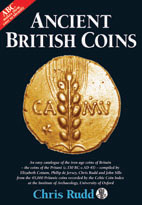 |
|
|
|
Pillar of the Community
United Kingdom
2838 Posts |
 to the forum CASSIDY77, great to have someone with some Celtic knowledge here. This is not an area I know anything about sadly, maybe you can get me interested. I'll keep an eye out for the book, thanks for the tip. |
|
Pillar of the Community
 Canada
541 Posts |
@bobbyhelmet..thanks for the welcome....as a fellow Brit you may be surprised to find out that right under your nose is the most interesting coin collectors universe gradually unfolding its reality thanks to the advent of metal detector technology.There have been major finds over the past 20 years which have clarified all sorts of mysteries when it came to understanding Celtic History in iron age Britain at the time of the Julias Caesar/Claudian invasion ....The coin varieties have been well documented and enough new coinage has been discovered by the metdets that a collector can still acquire a rare piece for less than 200 pounds in silver and less than 1000 pounds in gold. When I say rare I mean truly rare....Celtic coins have their own scale of rarity which is rather more stringent than most types of coins..For instance a Celtic coin that is considered very common means that more than 200 pieces exist!Common means 51-100 pieces are recorded::: Scarce means that 51-100 are recorded::R/rare means 31-50:: RR/very rare is 16-30::RRR/extremely rare is 6-15 and RRRR/excessively rare is 1-5!!....This grading system is based on the recorded info by the UKFD or UK finds dept in conjuction with the National treasure Act rules which requires reporting all finds by Metdets...Naturally these figures arent accurate so you have to use them with discretion in determining rarity of Uk coin finds...The metdets have been finding Celtic silver coins easily because they are generally very small units often not more than 10mm wide and previously almost impossible to locate...Also the gold pieces in the quarter stater size are tiny and without technology they cant be seen easily.....However the designs on these coins are magnificent and catalogued so you can build a set from each of the 12 or so tribes that produced coins in Britian between 150BC and 45 AD . The collector universe is starting to wake up to this coinage and the prices are on the increase yearly but the rarity of this set of coins is still in the truly rare category so while expensive these coins are being more and more valued. There are few collectors as most ancient collectors still prefer the more affordable and vast population of Roman and Greek coinage. In my view the designs on the Celtic coins are more interesting and artistic and original...Like the Celtic people themselves they are often a mystery unto themselves and leave much to the imagination. You seldom find a human portrait but there are lots of magical symbols, horses,dragons,and the initials of their kings inscribed on their flans. I hope this inspires more collectors to acquire Celtic coinage for their ancient collections....here is a gold coin in my collection it is small ..about 10mm and is from the Cantii tribe date 50BC UK Celtic 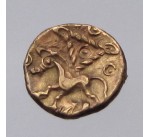 |
|
Pillar of the Community
Canada
541 Posts |
Correction to Cantiaci tribal coin imaged above...FYI this gold coin above is similar to one I have and is listed in the ABC book as number 198 and is a variety of this type considered rare. its value is approx 500BP and its official name is the Corded Triangle type of Late Weald Gold staters...weight approx 1.30 grams and size is 12mm This picture was borrowed from a UK coin dealers listing. At foirst I thought it was the one I own but realized my coin has an added detail of a square net underneath the horse. This type of gold stater is smooth on the other side with no design. For a coin that is only 12 mm it shows how detailed the designs can get on Celtic coins which appears to be in the 10-14mm size range. The full stater sized coins are larger up to 15-18mm like the one gold CUNO Corn ear stater featured on the front cover of the ABC book.... |
|
Moderator
 United States
23731 Posts |
Looks like a very interesting book.
|
|
Valued Member
United Kingdom
449 Posts |
Cassidy, would there be any chance you could look up a coin for me? It is a Sego sphinx bronze unit.
|
|
Pillar of the Community
Canada
541 Posts |
Sego sphinx bronze unit::listed as ABC453 coin of the Cantiaci. Sego is thought to be a younger son of Tascciovanus..5-15 AD ruler of Kent..this is all theoretical..the coin itself is considered Very Rare RR also identified as VA1855;:::BMC 1690:::Obverse identical to Tasciovanus Bull ABC2682 which is RRRR excessively rare Geometric pattern forming 8 pointed star around central pellet in ring Sphinx 1..uncertain legend [SEGO?} in front ABC has pictures but I'm not camera http://www.celticcoins.ca/vanarsdel...I&van=1855-1this link shows number 940293 as being a sego type listed as a trinovantes coin hope this helps..maybe ill get a photo uploaded later |
|
Pillar of the Community
Canada
541 Posts |
listed as a Catuvellauni design type [not trinovantes}
ABC 2682
This info is all in the ABC Book and is easy to reference
when I get my camera set up I will photgraph it and post it
Did you aquire one? One has been found as recently as july 2012 by metdet in UK [of course!]
|
|
Valued Member
United Kingdom
300 Posts |
Hi Cassidy , here are my Celtic finds , all found in my county , can you guess which part of the uk I live ? ( no cheating ) 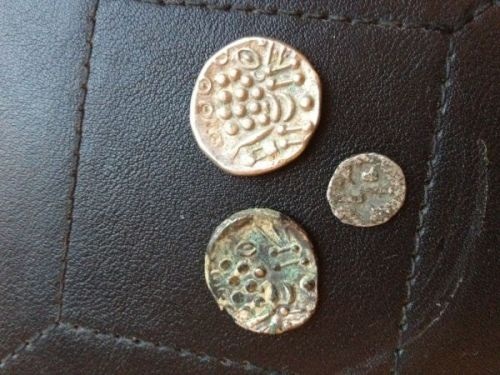 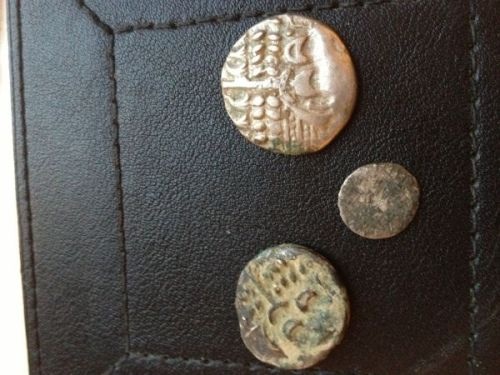 |
|
Pillar of the Community
Canada
541 Posts |
cranborne chase gold stater DUROTRIGES 58-50 BC The Durotriges were one of the Celtic tribes living in Britain prior to the Roman invasion. The tribe lived in modern Dorset, south Wiltshire, south Somerset and Devon east of the River Axe. After the Roman conquest, their main civitates, or settlement-centred administrative units, were Durnovaria (modern Dorchester, "the probable original capital") and Lindinis (modern Ilchester, "whose former, unknown status was thereby enhanced"[1]). Their territory was bordered to the west by the Dumnonii; and to the east by the Belgae. Maiden Castle, Dorset was in the territory of the Durotriges Durotriges were more a tribal confederation than a tribe.[2] They were one of the groups that issued coinage before the Roman conquest, part of the cultural "periphery", as Barry Cunliffe characterised them, round the "core group" of Britons in the south. These coins were rather simple and had no inscriptions, and thus no names of coin-issuers can be known, let alone evidence about monarchs or rulers. Nevertheless, the Durotriges presented a settled society, based in the farming of lands  surrounded and controlled by strong hill forts that were still in use in 43 AD. Maiden Castle is a preserved example of one of these hill forts. The Celtic tribes of Southern Britain showing the Durotriges and their neighbours. The area of the Durotriges is identified in part by coin finds:[4] few Durotrigan coins are found in the "core" area, where they were apparently unacceptable and were reminted. To their north and east were the Belgae, beyond the Avon and its tributary Wylye: "the ancient division is today reflected in the county division between Wiltshire and Somerset."[5] Their main outlet for the trade across the Channel, strong in the first half of the 1st century BC, when the potter's wheel was introduced, then drying up in the decades before the advent of the Romans, was at Hengistbury Head. Numismatic evidence shows progressive debasing of the coinage, suggesting economic retrenchment accompanying the increased cultural isolation. Analysis of the body of Durotrigan ceramics suggests to Cunliffe that the production was increasingly centralised, at Poole Harbour (Cunliffe 2005:183). Burial of Durotriges was by inhumation, with a last ritual meal provided even under exiguous circumstances, as in the eight burials at Maiden Castle, carried out immediately after the Roman attack. Not surprisingly, the Durotriges resisted Roman invasion in AD 43, and the historian Suetonius records some fights between the tribe and the second legion Augusta, then commanded by Vespasian. By 70 AD, the tribe was already Romanised and securely included in the Roman province of Britannia. In the tribe's area, the Romans explored some quarries and supported a local pottery industry. what me cheat? maybe I could accompany you someday on mt next trip to the uk..id love to go along coin hunting...never done it before! |
|
Pillar of the Community
Canada
541 Posts |
slight correction
These coins are easy to id from the ABC book but it is a bit tricky because many of the Gold staters in other groups ie the corieltauvi have very similar patterns. The cranbourne stater pictured is ABC 2157 listed as S common
i think it may be silver and not gold
the smaller coin appears to be ABC 2160 called the Spread Tail stater..either silver or Billon listed as S common
common reads as more than 200....which for most coin issues would be exceedingly rare...thats the beauty of Celtic coinage ..its undervalued because of demand
the smallest coin is hard to see but I dont think its Durotrigan
|
|
Valued Member
United Kingdom
449 Posts |
Thank you for all the information. I think the one you found on the metal detecting forum was the one I bought  |
|
Valued Member
United Kingdom
300 Posts |
Well done , it is a billion one I think , you can see bronze coming through on parts of it .
The smaller one is Durotriges silver quarter stater , 3 men in a boat type ( not the starfish one )
Well done :)
|
|
Pillar of the Community
Canada
541 Posts |
@monkeybean.....well I'm glad I passed the test..I also have 2 types of the the "3 men in a boat " acquired through Silbury Coins and Forum coins respectively
it is the Gold 1/4 stater type ..small and thick ABC 2205 Duro Boat Gold listed as Scarce
and I have the silver 1/4 stater which is probably like yours listed as ABC 2217 called Duro Thunderbolt ...very common
by the way your personal finds are remarkable as Celtic coins are very much the small minority of metdet coins found in the UK and many metdets never find one mostly due to the fact they were only produced for 150 years and are found in an exclusive area of the UK called the Celtic coin finding area which is also outlined in the ABC book. and FYI... There is a whole 1/2 page devoted to the Cranborne chase silver stater which enlarges the coin and examines every detail of the design on pg 113..... I believe it is one of the earliest and influential designs of the Celtic Uk coin era. congrats on your finds.....
|
|
Pillar of the Community
Canada
541 Posts |
@coinage 123...may I enquire how much the Sego Sphinx piece cost you? I will have to enroll in that Metdet forum because it could be a good source of fresh coinage. did you know that for me to buy coins from the uk requires the seller to apply for a treasure export permit? I'm not sure how much it would cost to get such a permit but I know that many dealers and sellers dont bother.....unless they are going by the book.
|
|
Valued Member
United Kingdom
449 Posts |
Of course, I spotted it on ebay as I recognised it from the detecting forum. It cost me £20 overall which I don't think was too bad. I will upload some pictures if you like. Edited by Coinage123
02/21/2013 6:18 pm
|
| |
Replies: 19 / Views: 5,138 |










 Posted 02/20/2013 10:17 pm


