Coin Community Family of Web Sites Join Thousands of Coin, Bullion, & Money Collectors
Specializing in Modern Numismatics Join Thousands of Coin, Bullion, & Money Collectors Royal Estate Auctions - $1 Coin Auctions300,000 items to help build your collection! Royal Canadian Mint products, Canadian, Polish, American, and world coins and banknotes. Coin, Banknote and Medal Collectors's Online Mall Vancouvers #1 Coin and Paper Money Dealer


Username:
Password:
Save Password
Forgot your Password?


This page may contain links that result in small commissions to keep this free site up and running.

Welcome Guest! Registering and/or logging in will remove the anchor (bottom) ads. It's Free!

1789 8 Reales

To participate in the forum you must log in or register.
Author Previous TopicReplies: 171 / Views: 32,397Next Topic
Page: of 12
Pillar of the Community
wonghinghi's Avatar
Hong Kong
1270 Posts
 Posted 11/22/2013  10:15 am  Show Profile   Bookmark this reply Add wonghinghi to your friends list Get a Link to this Reply
1789-8-Reales

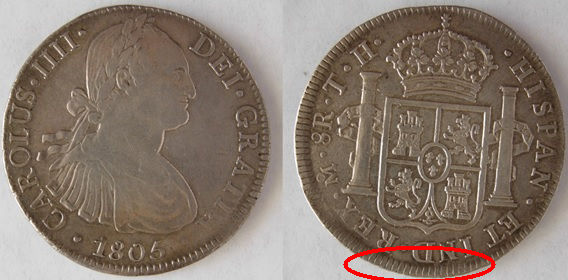
Swamperbob, your second coin is very well struck but it is definitely a modern forgery. The low S.G. implies it is made of low silver and high copper. The lustre is at reddish bias. XRF measured a 91% Ag result is wrong due to the presence of L. Beck effect, that is, there is a silver surface enrichment of Ag-Cu alloy. L. Beck effect makes XRF not reliable! I tried three coins that I think the Ag content are falsely elevated.
Pillar of the Community
wonghinghi's Avatar
Hong Kong
1270 Posts
 Posted 11/22/2013  10:20 am  Show Profile   Bookmark this reply Add wonghinghi to your friends list Get a Link to this Reply
Sorry, I miss to tell the direction of the dentils shown in the red circle is wrong, not concentric.
Pillar of the Community
colonialjohn's Avatar
United States
1757 Posts
 Posted 11/22/2013  9:30 pm  Show Profile   Bookmark this reply Add colonialjohn to your friends list Get a Link to this Reply
Hong Kong - I know you sent me coins for analyses but for sure sometimes XRF results need to be understood on several counts:

1- It could be a Sheffield or silver plated coin yielding Ag surface results >90%.
2- It could be in some areas if enough XRF results were performed would show elevated Cu results particualry the areas where Sheffields start to lose their plating - near the area between the denticles and rim and the edge (third side).
3- It could be a situation where Ag results vary from 75-95% if enough XRF spot analyses were performed on the surface.

As I told Bob even with a $250,000 dollar EDAX XRF device used for this ANS CC8R book on 100's of coins this analysis is a first indicator of a coin being a Class 1 counterfeit, a regal (i.e., legitimate issue) of the period or something else ... its complex ... what area of contemporary counterfeit collecting is not? ... even today many people believe the Machins Mills Coppers were made in Newburgh, NY. There is no strong proof other than direct die sharing of the 1787/1788 issues with some Colonial State Coppers of Vermonts & Connecticuts ... we just assume Newburgh, NY since there Colonial linked and unlikely British imports and we have no other LOGICAL place to indicate their origin ... so we place them in the U.S. Red Book and today its FACT ... contemporaries ALWAYS have a little grey (mystery) to their true origins ... we can only make strong and weak assumptions to their true attributions ... are the Machins that are not dated 1787/1788 possibly of some other origin like British imports? Yes I am aware that most (not all) issues not of 1787/1788 have some feaatures to this core group of 1787/1788. Are the Class 2 CC8R's predominantly all made in China? Are the Canadian Blackmsiths of all Wood varieties (1-46) Canadian? ... UNLIKELY. One good thing in the book with the CC8R Sheffields is that there is strong WRITTEN evidence linking them to Birmingham, England ... wait for the book <BG>.

John Lorenzo
United States

Edited by colonialjohn
11/22/2013 9:33 pm
Pillar of the Community
swamperbob's Avatar
United States
5362 Posts
 Posted 11/22/2013  9:44 pm  Show Profile   Bookmark this reply Add swamperbob to your friends list Get a Link to this Reply
austrokiwi In response to my statement:


Quote:

But to say that question is not becoming critical in Europe as well is burying ones head in the sand.


You asked me:


Quote:
What I wrote was in America the first question asked is is it genuine. Where do you get the idea from that, that I said it is not important in Europe. Please revisit my post and read it as it was written.


So I did just that because what I believed I read was that questions of forgery were not uppermost in the minds of European collectors apparently because they do the job of authentication themselves and because the market is more "mature".

That self reliance is commendable, provided the individuals involved are aware of all the types of forgeries that exist and the newest clues to forgery detection that are being developed by serious US and world collectors are employed.

This was the portion of your statement that I was referring to:


Quote:
Yes in Europe that question is asked but its not the first question!


I am stating that authenticity must come first in this market because of CHINA. Appearance alone is no longer a "guarantee" because forgeries have become better AND because certain types of forgeries made some time ago have been forgotten.

My response was meant to indicate that you now need to make that question FIRST and not place it somewhere down the line on the European radar.

So I was indicating that a review of the European approach (which I take it relies on subjective factors based on personal expertise) needs to be revised to also include the approach that couples simple scientific tests like Specific Gravity and complex tests like XRF along with familiarity based on personal experience.

My primary concern and belief is that Science can never be trumped by "expertise" whether that expertise is based on a college degree or 50 years of personal experience. I believe all avenues need to be explored before we can make a claim that any coin is MOST LIKELY GENUINE.

******************************************************

Henry Your last post is composite and contains several different issues, so I will quote your post and then look at the pieces of what you say.


Quote:
Swamperbob, your second coin is very well struck but it is definitely a modern forgery. The low S.G. implies it is made of low silver and high copper. The lustre is at reddish bias. XRF measured a 91% Ag result is wrong due to the presence of L. Beck effect, that is, there is a silver surface enrichment of Ag-Cu alloy. L. Beck effect makes XRF not reliable! I tried three coins that I think the Ag content are falsely elevated.


Your first comment is essentially correct. The second coin dated 1805 is the coin given to me in 1960 which the forger himself said was made in the 1920s for use as money in China. This was not a coin made to fool numismatists - it was made to circulate alongside genuine examples. It is a Class 2 Silver Restrike.

The second comment is completely incorrect. The FIRST coin is the one that has the very low Specific Gravity proving it is a Contemporary Counterfeit. I am sorry but I purposely reversed the SGs so that only appearance would be in play.

The second coin has the correct SG and the XRF test done lacks gold and silver at the appropriate level. It was made with silver that had to be refined after 1878 because the silver is simply TOO PURE to have been made in 1789.

Your third comment that the luster is incorrect may be true because I purposely cleaned the surface of the 1805 coin before XRF testing to remove all surface environmental contaminants. I did this only because I knew the coin was a Class 2 forgery and I figured it was of low value and cleaning (NOT ACID ETCHING) could be done without effecting the value or tests. I cleaned it as is suggested by forensic scientists who test Museum artifacts. Nothing in the cleaning removed any metal.

The final section of your question raises other questions. You say:


Quote:
XRF measured a 91% Ag result is wrong due to the presence of L. Beck effect, that is, there is a silver surface enrichment of Ag-Cu alloy. L. Beck effect makes XRF not reliable! I tried three coins that I think the Ag content are falsely elevated


First of all, once again the 91% range was very approximate and not actual results. I was indicating that both coins had silver surface levels that matched most genuine coins that have been tested.

I am very familiar with the work of L. Beck that you report. I have a copy of one published version on my desktop. But as you must know if you have read it - the report was intended for testing of silver/copper artifacts recovered in an Archeological context - ancient Roman coins were used. These are normally dug artifacts not coins that have passed hand to hand for only 200-250 years. If you read more on the topic, you will find that the complete reasons for the effect of surface enrichment is due to several factors which MUST be taken into account when evaluating the XRF tests. A coin of 200-250 years age is NOT as effected by the "Beck" effect as you are implying. Our tests of numerous period counterfeits bear on this subject and show that the effect is there BUT is LESS PRONOUNCED than is seen on ANCIENT coins. The 91% range which I stated for both coins is stated on the low side.

Here are the results for the 1791 for just the larger components. Surface in field - 91.8% silver, 6.4% copper, 1.1% gold and 0.19% lead. That leaves about 1/2% MISSING. Two things are notable. NO platinum meaning Mexican silver is unlikely and there are other components that were not disclosed in the test. Each component also has a range so that I have never seen a test result of exactly 100.00%. They can in some cases add up to more than 100% and should always be treated relatively to one another.

The conclusion you reach that the Beck effect makes XRF unreliable is anything but correct. That statement is totally wrong. The Beck effect is viewed and allowed for in our tests and it fully replicates in relation to GENUINE coins tested. The effect can therefore be adjusted out of the results within reason. It is the differentials in anticipated results that prove the forgery.

The 1791 coin, the Contemporary Counterfeit, was sold at several high end auctions and was always authenticated as real by experts. I have fooled self appointed "experts" at ANA shows with that specific coin. People most familiar with the details of the correct design of the Portrait 8R will immediately recognize it as a forgery without any tests as I did. I bought it in competition with people who believed it was real and paid a significant sum (full retail) precisely because I could recognize what the "experts" had missed. It is a counterfeit that is much rarer than any genuine 1791 8R actually is.

This coin (the 1791) actually has a very small break in the Sheffield plate only visible in person or a high resolution photo but the metal alloy UNDERNEATH the surface is VERY high in Copper - based on the color visible in a microscope.
The under-plate alloy was not tested using XRF because the break had not yet been discovered.

This 1791 coin has an oddity not seen on very many period forgeries. The silver ribbon applied to the edge (to cover the copper core) is VISIBLE clearly on both sides of the coin. The application method for the ribbon is both crude and early. It is also very consistent with the Birmingham style of forgeries. It was made using a full punch set created by individual engraving. These are NOT post 1830 punches. They are not made employing duplication techniques like galvanism.

My final conclusion is that this coin may actually be one of the actual counterfeits struck in England with the assistance of the English government for the war effort against Spain in 1796. It fits the model of what such a forgery should look like.

So my exercise was really intended to demonstrate that appearance can be deceiving especially for individuals who are only generally familiar with the appearance of old coins that are a very specific type.


Valued Member
Germany
194 Posts
 Posted 11/22/2013  10:50 pm  Show Profile   Bookmark this reply Add dosmundos to your friends list Get a Link to this Reply
Wow! I guess I just wrecked both my eyes and my brain reading through the whole thread!

What I see - not only here, but in some other forums and discussions as well -, is that more and more people are becoming aware of this XRF testing technology. However, there is a lot of confusion about what exactly XRF can show and prove, and what not. Also, it appears that there are very different machines out there which deliver very different results, some of which might not be suited for Counterfeit Detection and thus cause more confusion than anything else.

I guess that buyers of scrap metal and the "oro" and "plata" dealers on Mexican street corners make good use of such machines, but will not have the money (and the need) to buy the high end, scientific ones. If you take your coin to them, they can tell you whether it is made of good silver, but they won't be able to catch the trace elements that would discern old silver from modern silver. So, XRF is a somewhat different counterfeit detecting method than a loupe or your classic ring test, I would say.

Hopefully, the technology will become a little more accessible to us enginerical analpabets in the near future!

As for the Class I and Class II counterfeits, I guess people (including coin dealers) will have to understand that the GNL book will not simply declare most 8 Reales to be worthless counterfeits.

Nowadays, there are three types of coins. The good ones, the (obvious) contemporary counterfeits, and the bad, bad modern forgeries. Bad, because they are worthless.

In the future, the "good ones" might be divided into "original good ones" and "later unofficial restrikes that are still good and valuable collectible coins". And most likely, despite all of Swamperbob's efforts, we will never be able to completely and undoubtedly establish for each and every coin whether it is an "original good one" or a restrike anyway. So it remains to be seen whether it will have any effect on the "market" part of numismatics (which, let's be honest, is of interest to even the least materialistic collector).

But the strong prices for some of the coins of the Ringo collection in the last Ponterio (sorry: Stacks-Bowers) sale tell me that there is a future for at least high-quality contemporary counterfeits / unofficial restrikes as well.

If a Maria-Theresia-Thaler made in the 1930s shows a counterstamp from the 19th century, it's a worthless forgery (unless it finds a place in the auction catalog of a certain Austrian firm, it appears). If a 1795 Mo 8 reales was most probably produced in the 1830s and anywhere but in Mexico, it is still an old coin that served as money, circulated, most likely travelled around the world and has considerable numismatic (and monetary) worth.
Pillar of the Community
swamperbob's Avatar
United States
5362 Posts
 Posted 11/23/2013  12:43 am  Show Profile   Bookmark this reply Add swamperbob to your friends list Get a Link to this Reply
Dosmundos

You certainly have grasped the topic. You have also reached the nearly the same conclusions that I draw after 600 pages and about 50 years of study.

There are actually 5 categories of Portrait 8R coins in my view.

The Class 1 are the typical off metal counterfeits made to circulate as money that we consider rare and highly collectible. My 1791 is an example of that class. These NEVER exceed 70% silver by SG test. Dates vary but they circulated. They are real counterfeits by everyone's definition.

The Class 2 are the "silver" counterfeits - the restrikes made without official approval and which range from 80-93% silver by Specific Gravity testing. These are the type everyone today seems to have forgotten and which were made between 1830 and 1930 for trade purposes which I am trying to get recognized. My 1805 coin falls in this class.

The Class 3 coins are the Numismatic Forgeries. These were made for Numismatic Fraud at any time (usually recently) but some are known to be nearly 100 years old. Most are worthless junk but some are very interesting if only of low value. They include purpose made cast and struck varieties of all metal types and range from No silver at all to 999 fine silver by SG test.

Class 4 are altered coins, copies, replicas and coin-like objects of all types. This is the most interesting category and could be sub-divided almost without end. There are Lima originals revised to read Mo so they could be sold to China at a premium (a sub-variety of Class 2 almost). There are also Replicas with the word COPY removed or Tourist replicas sold to suckers at flea markets worldwide. There are VERY rare dates made from originals that fool high end auction houses - even in Europe. There are colorful anodized aluminum copies made for Mardi gras and alterations done for unknown political or satirical purposes which date to the 1820s and as Hobo coins dating to who knows when. There are bowl bottoms cast from "counterfeit" hosts. Also included are buttons made from genuine coins and buttons made to look like coins. There are two headed buttons and two tailed buttons. There are advertising coins and Unusual coins that look like 8Rs but with weird legends. There are even religious amulets that the owners thought protected them from bullets by magic. This is the eclectic part of collecting portrait 8R coins. It is a subject I have been fascinated with for decades.

Class 5 are the genuine coins - which I do not include in the book and for which I hold little interest or enthusiasm.

The Ringo sale with prices approaching $500 each certainly showed those willing to listen (like ebay) that there is a genuine market for some counterfeits. The key is knowing how to recognize the good and chuck the bad. I also hope that this first introduction to the GNL numbering system will prove useful.

You were also right to place the "value" issues near the end. When I first heard about the silver restrikes I was fascinated. My appreciation of the class as very distinctive and historically important took over 30 years to develop. These restrikes exist and in very large numbers measured in the millions.

I wonder if I was the first to realize that there are more Charles IIII 8Rs in existence today than all of the First Republican Cap and Ray Mexican types even though they had comparable original mintages? Has that never struck anyone other than me as odd?

I am trying to answer that question - still after 53 years of asking WHY?
Pillar of the Community
swamperbob's Avatar
United States
5362 Posts
 Posted 11/23/2013  02:39 am  Show Profile   Bookmark this reply Add swamperbob to your friends list Get a Link to this Reply
I was wondering if anyone else agrees with me that this coin HAS to be a counterfeit of some sort?

1789-8-Reales

1789-8-Reales
Pillar of the Community
colonialjohn's Avatar
United States
1757 Posts
 Posted 11/23/2013  1:50 pm  Show Profile   Bookmark this reply Add colonialjohn to your friends list Get a Link to this Reply
Realize Dos Mundos whether its a $10,000 XRF machine or a $250,000 XRF machine the results should STILL be adequate and trustworthy. Its CHOOSING the proper assay metals for analysis - such as - minimally: Ag, Cu, Fe, Sn (tin) Pb, Au and Pt. This is a new learning frontier beyond appearance, S.G. and the good old ring test. Test yourself - at this year's NY International Show auctions - just by appearance see which Portrait slabbed 8R's in high circulated conditions (VF-AU) are probable Sheffields. There are always a couple being sold ...

John Lorenzo
United States
Pillar of the Community
swamperbob's Avatar
United States
5362 Posts
 Posted 11/23/2013  2:42 pm  Show Profile   Bookmark this reply Add swamperbob to your friends list Get a Link to this Reply
John - I have seen the hand held small XRF field units used by junk dealers - those are not much use because they are usually pre-set for industrial metals - they are not set to do what is really needed.

*********************************************

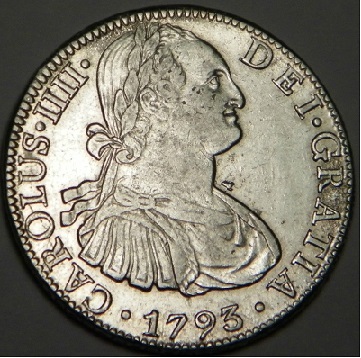
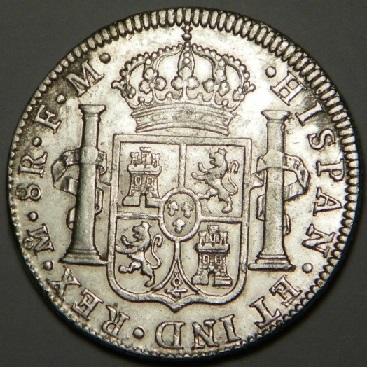
Regarding the 1793 8R I posted - perhaps the edge will tell the story.

1789-8-Reales

This is actually an auction posted on ebay. The face dies have 2 strong markers of forgery. But they are two that are usually right. The edge is definitely all wrong.

Here is the link:
http://www.ebay.com/itm/Milled-Span...121219464427

Now a few follow-up questions:

What do you think would be the seller's response if I were to contact him and tell him the coin is NOT GENUINE?

The coin is a $145 buy-it-now - do you think the price is OK knowing what it actually is?

What do you think would happen if this one was reported to ebay as a counterfeit?

Who thinks the coin would certify as long as the weight is above 26.8 grams?
Pillar of the Community
swamperbob's Avatar
United States
5362 Posts
 Posted 11/23/2013  4:50 pm  Show Profile   Bookmark this reply Add swamperbob to your friends list Get a Link to this Reply
The following is a mental exercise meant to focus on some odd statistics that exist with relation to the numbers of Mexican dollars (8Rs) in the market today.

I think many of you are aware that I scan every auction on ebay that contains the word Mexico and Reales every day. I also search a few other parameters as well. Those who wonder if I ever get out are also correct - I don't.

The 24 hour period ending at Midnight on 11/22 ((9PM ebay - California time) set a new record. My base search returned a total of 5,673 active auctions using those words (normal is lower). In the 24 hours 1,660 new items were posted matching my criteria a large 1 day total.

But the interesting fact to me was that the percentage of counterfeit 8Rs posted in one day was the highest in the entire period I have maintained statistics.

That sounds really bad - but here are the actual numbers.
These are daily posts only.

Total new items 1660
Total Portrait 8Rs 48 A slightly above average number
Class 1 coins 6 Highest individual day this year
Class 2 coins 9 Highest individual day this year
Class 3 coins 2 About average

That is 35.42 % of the total of all Portrait 8Rs posted were clearly not genuine using my criteria. That is the highest percentage I have seen this year.

To compare that with the average for this year:

Total new items per day 973
Total Portrait 8Rs/day 36.841 (no shipwreck coins)
Class 1 coins/day 0.544
Class 2 coins/day 1.545
Class 3 coins/day 1.586

This average matches well on a percentage with past years. The shipwreck coins (mostly el Cazador) average 13.5 coins per day. They are not included in the figures above.

As I pointed out earlier in this thread, there is a stark contrast when these numbers are compared with the Cap and Ray coins produced from 1823-1857 (the era when the US imported silver from Mexico for use in coinage). Anyone who knows 8Rs realizes that simply huge numbers of 8Rs were made in this era which is why prices for typical circulated examples remain very low.

But here is what occurs on ebay.

Total Cap and Ray 8Rs/day 1823 to 1857
Raw coins/day 5.343
Graded coins/day 0.828
All Cap and Ray 8Rs 6.171
Class 1 coins/day 0.069
Class 2 coins/day By present definition ZERO
Class 3 coins/day 0.455

To complete the data of interest the post 1857 coins:

Total Cap and Ray 8Rs/day 1858 to 1897
Raw coins/day 28.521
Graded coins/day 2.655
All Cap and Ray 8Rs 31.176
Class 1 coins/day 0.069
Class 2 coins/day By present definition ZERO
Class 3 coins/day 0.352

To me these statistics make a strong statement and raise critical questions for collectors of Portrait 8Rs. There are 6 times as many Portrait 8Rs as there are early Cap and Ray types. The Portrait coins average 3 1/2 per day counterfeits versus 1 for the Cap and Rays.

Given that Mexican mint production is fairly well known and stable on an annual basis at least to the 1840s - WHY HAVE so many Portrait 8Rs survived compared especially to the earliest Republican issues when mintages were HIGHEST?

The presumption here is that ebay is a non-biased and representative sampling of the 8R coins that are in existence. I do not want to get bogged down in the statistical approach used here - just the facts on a macro level.

Filters to keep in mind.

Confirmed Class 2 coins to date are predominantly from the Mexico City mint and are dated between 1785 and 1810 using the Charles III, Charles IV and the Fantasy portrait of Ferdinand only. They were therefore representative of a 25 years period. All but three of the 81 confirmed examples are actually dated 1789 to 1810.

The data posted side by side makes the case:

Total coins per day

Portrait 8Rs 36.84 : Early C&R 6.17 : Late C&R 31.17
Issue period 48 years 34 years 39 years

The cap and ray types show a clear tendency for later dates to survive at a higher rate.

Why do Portraits appear as often as all the C&R types combined? Why are they so much more common than early Cap and Ray coins?

Theories? I can think of a few;

1. The Portraits were all hoarded by the Chinese.
2. There were far more Portrait coins made then C&R coins.
3. Both types were still used as currency until 1935.
4. There was an influx of added portraits not reflected in the official numbers.


Comments?
Pillar of the Community
jfransch's Avatar
United States
1801 Posts
 Posted 11/23/2013  10:50 pm  Show Profile   Bookmark this reply Add jfransch to your friends list Get a Link to this Reply
I propose a 5th theory
ebay is not representative of the true market for Spanish American Coins. At USMexNA in October I would say the cap and rays outnumbered portraits easily 5 to 1. On the current Mexican Coin Company website, there are 44 Mo portraits offered and 118 cap and rays, 3 to 1. At the coin shop I visit, who is a recognized major dealer in Spanish Colonial, he has cases and trays of Cap and Ray coins and only a spattering of Portraits. I personally think the abundance on ebay is an abnormality and often I see the same Portraits listed again and again so unless you are tracking that, the number is deceptive.
Pillar of the Community
wonghinghi's Avatar
Hong Kong
1270 Posts
 Posted 11/23/2013  11:23 pm  Show Profile   Bookmark this reply Add wonghinghi to your friends list Get a Link to this Reply
Swamperbob:


Quote:
The Portrait coins average 3 1/2 per day counterfeits versus 1 for the Cap and Rays.


  • this fact may or may not be true because the identification of a counterfeit from the scans on ebay needs some sorts of expertises especially for those class 2 CC. I don't think this is an easy job. Some coins you need to do an XRF analysis in confirming it is an class 2 or not, so the ratio of portrait coin to C&R (3 1/2 to 1)might alter tremendously. That is, ACCURACY TO MAKE OUT A COUNTERFIET DETERMINES THE ACCURACY OF THE RATIO.


Quote:
Why do Portraits appear as often as all the C&R types combined? Why are they so much more common than early Cap and Ray coins?


  • theory 4 is more likely. If the statistical data obtained above is accurate, I agree the presence of unofficial strikes is a strong reason to explain the fact.


Pillar of the Community
swamperbob's Avatar
United States
5362 Posts
 Posted 11/24/2013  12:01 am  Show Profile   Bookmark this reply Add swamperbob to your friends list Get a Link to this Reply
jfransch That is a potentially valid 5th theory.

Would it be best to say as you do, that -

Ebay is not representative of the true market for Spanish American Coins.

Or would you say that it is not reflective of the availability (inventory) of these coins, and potentially it does reflect the true market? Big inventories might just imply a weak market.

The Mexican Cap and Ray coins dated after 1857 are as rare as hens teeth in NE shop inventories. I worked there for 26 years with several different dealers. The late 8Rs have to be imported because they never walk into the shop. Demand is always very low. Portraits on the other hand are routinely seen over the counter and sell much faster. In the NE area I presumed that the colonial collector interests was the driver skewing the numbers toward Portraits and away from later types specifically late Cap and Rays. Here in NC things have not changed much. In the shop I authenticate for perhaps a dozen Cap and rays come in PER YEAR but there are 4 to 5 times more portraits. The portraits also sell better.

In my stats for ebay I am doing my best to eliminate duplicate postings of the same coin day after day. This also occurs with the Cap and Ray types. I think on average the re-posts that are contaminating the totals are fairly close for both types are similar and they do not effect the big picture significantly.

One thing I definitely have noticed is that the numbers of individual coins posted per day varies WILDLY which is why a long term view is, in my opinion, superior to just a few days data. I accumulate daily, weekly, monthly and yearly stats in each category and the ranges are spectacular. For instance - this year the day with the highest number of Cap and Ray postings was 104 and the lowest only 6. Last year the high was 197 and the low 1. So any one day view might give you a wrong picture of things.

Just so everyone knows, my year for stats begins on July 1st. That is because I started keeping statistics in mid-June 5 years ago and now I just can't stop. It has become a daily obsession.

So snapshots are definitely not accurate in my opinion.

The only bias I have seen on ebay seems to be that it tracks along and slightly behind the spot silver market. The ebay postings are typically higher when silver is moving near the peak and lowest near valleys and in periods of stagnancy. The trends within each grouping are similar.

The biggest effect in ebay stats is when they have the free postings days - everything goes nuts. That is when the cheapie coins dilute the numbers and garbage appears. There is a noticeable up-tick in numbers of bullion coins at these times and that of course favors the late Cap and Ray junk silver that is chopped to death and the polished Portrait junk.

My concern here is the seemingly huge disparity between the number of Portrait coins and the early cap and ray coins and why that exists in a place like ebay. If stuff ain't sellin' on ebay the number of posts drops.

So at least in my view a disproportionate number of portraits are trading when contrasted with the early Cap and Ray coins.

You are postulating that the Cap and Rays coins are actually far more common but is that the pre-1857 or post 1857 issues? The ebay numbers show that there are far more late Cap and Rays than early.

But should there be as many common date Portraits?

I would expect that the Charles IV and Ferdinand VII portraits in particular should be on a par with the early Republican Cap and Rays in terms of raw numbers.

But they are not and they are out of line by roughly 5-1.

If the reason was either market or inventory I can not see why ebay (a wide coverage market) shows this 5-1 spike. 2 to 1 maybe due to popularity BUT is 5 to one really reflective of inventories? or of markets.

Every time an early Cap and Ray is posted it sells (unless the start price is horrific). That is where I bid most and they do sell well.

Certainly the annual production in the 34 years of the early republic were not just 1/5th of the production during the 48 years of the Portrait production. Here I include Charles III but a case could be made that these years are actually quite scarce.

So here are the 5.5 year totals for ebay. This is total posts by type for 1971 days included in my study up to yesterday. You can see from the numbers why my wife thinks I am obsessed. I do ebay every day on vacation and even when I was hospitalized I never missed a day.

Portrait 8Rs (no shipwreck) 49,762 25.25/day
Cap and Ray early 10,566 5.36/day
Cap and Ray late 58,172 29.52/day

You may be right that on some venues and in some geographic areas there is a preferential bias toward one type or the other. In the shows I visit in NC and the east (I still hit Boston or Philadelphia every once in a while) the Portraits always seem to me to be more plentiful than Cap and Ray types.

I am planning on being at the FUN show in January so I am going to pay a lot more attention there.

Has anyone completed a production study with totals covering 1772 to 1897?
Pillar of the Community
swamperbob's Avatar
United States
5362 Posts
 Posted 11/24/2013  12:39 am  Show Profile   Bookmark this reply Add swamperbob to your friends list Get a Link to this Reply
Henry I am not sure of what your comments mean.

Identification of counterfeits using only pictures is obviously possible. I am trying to show others how it is done.

I list only Class 2 coins I am sure of because I have tested the variety. So yes, it is obvious that the ratio is going TO INCREASE not decrease as new varieties like the Keyhole/porthole type come to light.

I have never believed it was going to be possible to identify every single Class 2 coin. But we can not stop hunting for them and a very cautious buyer can avoid coins with fewer and fewer visible clues as they choose.

Valued Member
moneditis's Avatar
Spain
110 Posts
 Posted 11/24/2013  09:17 am  Show Profile   Bookmark this reply Add moneditis to your friends list Get a Link to this Reply
Hi everybody from Spain

First of all, please, have in mind I am not an english/american mother tongue speaking person.

Very, very interesting threath/topic. As you can imagine, here we deal with a lot 8Rs bust/portrait and columnarios.
I would say columnarios are more countefeited than portraits...but I can not show any statistics...just my perception. Curiously, two days ago in a numismatic meeting I was "having a close look" to different 8Rs and would say more 8Rs are available than, well, one month ago, but christmas are arriving as well.
Later I will be posting photographs of 8Rs Mexico before 1785 and one 1782 Potosí. Potosi is an interesting ceca (mint).

Thank you all

*** Edited by Staff - Please Review the rules that you agreed to when you registered. ***
Edited by moneditis
11/24/2013 10:01 am
  Previous TopicReplies: 171 / Views: 32,397Next Topic
Page: of 12

To participate in the forum you must log in or register.


Disclaimer: While a tremendous amount of effort goes into ensuring the accuracy of the information contained in this site, Coin Community assumes no liability for errors. Copyright 2005 - 2026 Coin Community Family- all rights reserved worldwide. Use of any images or content on this website without prior written permission of Coin Community or the original lender is strictly prohibited.
Contact Us  |  Advertise Here  |  Privacy Policy / Terms of Use

Coin Community Forum © 2005 - 2026 Coin Community Forums
It took 0.48 seconds to rattle this change. Forums