| Author |
 Replies: 171 / Views: 32,935 Replies: 171 / Views: 32,935 |
|
|
|
Pillar of the Community
United States
5362 Posts |
You didn't read the post because I listed two coins slabbed by NGC. There are many others as well.
But you would ignore any facts anyway because your opinion is right.
These are not mistakes the second one was a loss of - $1,300 is not a mistake if you are an authenticator. It is a lack of expertise.
The XRF tests do prove if a coin is fake. They can also prove a coin COULD be real. So my statement you quote is correct.
|
|
Pillar of the Community
United States
5362 Posts |
I see the XRF results - they are done to 100 ppm level.
At that accuracy level both Gold and Platinum as a minimum should have been present. All Mexican refined silver processed before the 1870s has gold in it.
Also several other trace elements.
I have never seen a test this clean indicating no light metals or organics except for recently produced forgeries.
John is part of the discussion by default because he ran all the tests in the book and his the a co-author.
|
|
Pillar of the Community
Austria
566 Posts |
Wow, already 42 postings :)  I might qualify for this year's secret santa holiday exchange! Edited by coinworldtv
11/20/2013 9:40 pm
|
|
Pillar of the Community
Austria
566 Posts |
Swamperbob, now seriously: Quote:
I have never seen a test this clean indicating no light metals or organics except for recently produced forgeries. Do you believe, that this coin might be a recent forgery? This would be indeed shocking, but I would not even nearly consider it. Edited by coinworldtv
11/20/2013 9:55 pm
|
|
Pillar of the Community
Austria
566 Posts |
If you ask me that XRF machine has failed the test not the coin!
|
|
Pillar of the Community
United States
5362 Posts |
If the XRF test results are correct the coin was made AFTER 1870 at the earliest. I have two coins that I wonder if you believe are genuine or not. Both coin show surface silver concentrations in the 91% range using XRF primary alloy is copper in both cases about 8%. One has a Specific Gravity of 10.31 and the other 9.97. What do you think of this one? It has been tested with XRF. The weight is 26.95 grams. Is it genuine? 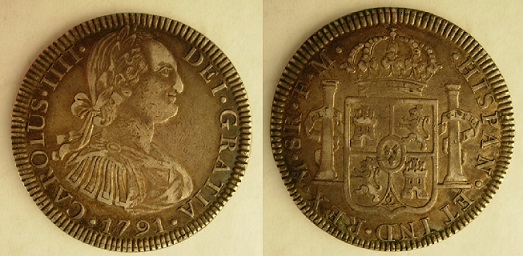 Or this one also tested with XRF is it genuine? weight is 26.9 grams. 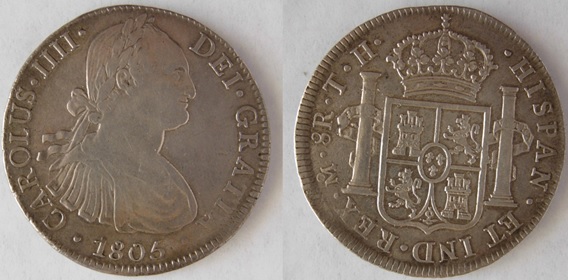 |
|
Pillar of the Community
United States
1761 Posts |
I have to admit all you guys are starting to give me a headache <big grin>. I think Felip was being truthful and you need to realize Bob there are all levels of XRF devices and the collector on what elements are important or not important. He obviosuly is not using an EDAX Orbis at the $250,000 level but probably some hand held device or possibly he was unaware of the importance of Au & Pt (most likely the cause but this print out looks like from a hand held $10,000-$25,000 device. The values he reported for Ag, Pb & Cu all looked pretty good - however as P.T. Craddock pointed out of the British Museum in his Forgery book Au & Pt are critical signature elements for 18th/19thC silver - to the point if these are not present or say <0.01% I would expect the piece to be modern with little argument - otherwise based on my analysis of several hundred specimens. HOWEVER - in Felip's analysis he did not analyze these elements. So UNTIL he does the jury is STILL OUT. If he comes back and the Au & Pt is between 0.1-1.0 or greater (maybe to 1.5%) or slightly less (~0.08% or so) we do indeed have a PUZZLE here? But again XRF is just one test. Again there may not be any real differences between Class 1 & 2 with Au & Pt ... but we expect values <0.01% if Modern (say 1900-after). I took P.T. Craddock's teaching and confirmed it nicely with no real Pt & Au differences outside this range (0.1-1.0%) in the Mexican Numismatic Association Cast/Struck 8R Chihuahua paper. The metals I analyze in this paper should be your assay metals. All other metals outside this suite I feel could be background contamination from other sources. I am currently working at Kearfott a company which has a SEM/EDS but not of the modern quality at EDAX so I can on a lesser frequenecy still do Material Analysis but ONLY through a co-worker in the lab. Felip at this point should redo this ASSAY and ADD Pt & Au (add Fe if also inclined) into his previous assay test. Lets then see the results ... we can then move forward or end this discussion based on these two (three) elements and there quantitative values. I hope ... again ... if you contact me privately I can send you the Chihuahua paper from the latest issue of the MNA organization.
John Lorenzo
United States
Edited by colonialjohn
11/21/2013 01:08 am
|
|
Pillar of the Community
United States
5362 Posts |
Hi John. You say Quote:
So UNTIL he does the jury is STILL OUT. If he comes back and the Au & Pt is between 0.1-1.0 or greater (maybe to 1.5%) or slightly less (~0.08% or so) we do indeed have a PUZZLE here? The issue goes well past XRF alone. The other scientific methods which include SG and the geometry of the edger are both violated by this coin. I fear your quote above will be interpreted as support for his position that science including XRF can be ignored in favor of opinions that the coin looks good therefore it is. I completely agree with you that an XRF test (done accurately with a decent instrument like you used) is a definitive test for the age of the silver, If a valid test shows no Au or PT it proves beyond any doubt that the coin is a very recent forgery (1878 if US origin silver or 1900 for Mexico origin depending on the date that the cyanide process was introduced at the refinery). Au and Pt in the alloy proves only that old silver was used. The correct ratio is seen on numerous Class 1 contemporary counterfeits made with Sheffield silver plate. I agree the test apparatus used was inadequate. That was obvious from the print out - the results added up to 100% which our tests have never done and no trace contaminants were noted at all. There are always missing non-metallic traces or light metals that do not appear like Aluminum. But in addition to XRF - I have SG results on three coins made using the same reverse die punches that produce low SGs. The coin posted by Henry which also matches the coinworldtv coin by die type also shows a low SG 10.195. That is 810-840 fine silver - that is a Class 2 coin by definition. My coins fall into the 80-85% range as well. So 4 of 5 coins with known SG are deficient, This looks like a Class 2 type made between 1830 and 1840 and not much later. Tests done by British authorities show higher silver contents in the restrikes by the 1840s. Since there are no Genuine Portrait 8Rs made at the Mexico City mint that test 81-84% fine silver (proven by mint reports from the period - US, GB and China). SG then becomes a definitive scientific test for forgery. In addition the use of a correct edger based on geometry requires 2 overlaps that are opposite one another and of the same length. The specimen photographed by Henry has an identical JOIN of two adjacent circles instead of an overlap in design and the laps are on Henry's coin are NOT exactly opposite one another - they are 5 degrees off. What we have been arguing over is the validity of tests based on science - physics for the SG and XRF and geometry for the edger. Failure to meet any of the definitive scientific tests proves that the coin is a counterfeit. I do not want Filip latching onto your first statement and making the interpret that the case is actually still in doubt. I have zero doubt about the status of this coin in Class 2. |
|
Pillar of the Community
United States
1761 Posts |
Bob - I agree with what you said but remember with XRF analysis normally the machine MUST be pre-calibrated for all the metals you want to analyze and the instrument detection limits. This instrument may have been set to read all metals >1% and/or just calibrated for his three metals Ag, Pb & Cu. Of course no 8 Reales could JUST contain these THREE metals. It is a Class 2 by definition with everything in this post based on OUR criteria but give him a chance to report the metals < 1% or calibrate for the JPL 8R Chihuahua assay list which in my opinion is COMPLETE for 18th & 19thC silver coins.
John Lorenzo
United States
|
|
Pillar of the Community
United States
1761 Posts |
Just one last thought remember the L. Beck paper that with time and proper environmental conditions silver coins WILL show elevated Ag levels due to copper leaching and silver migration between the inner/outer cores. We have seen many examples of Class 1 & Class 2 with Ag levels above 92%. But this is coin dependent. I was doing some other research at EDAX and for a 1964 Kennedy half (only one example) no Ag migration occured after the coin was cut in half and the inner/outer core SEM/EDS results were recorded. Still one coin but it appears this L. Beck silver enrichment research takes TIME on a silver coin as with these early 8 Reales. JPL |
|
Pillar of the Community
Hong Kong
1270 Posts |
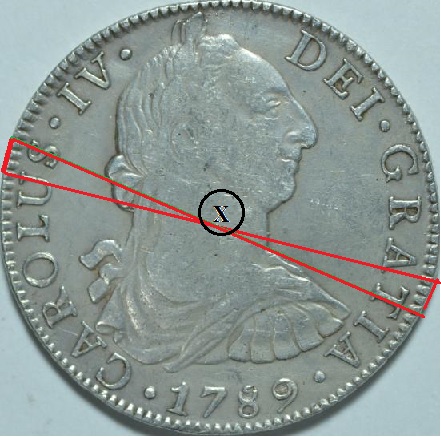 Thank you swamperbob, your good observation that the two edge joints are really not in good 180 degree opposite when I examine it on hands. I think this is the most persuasive evidence to let me believe this is not an original. But do you think it is a class 2 CC? I check all my American 8Rs with two edge overlaps are really in 180 degree opposite. Same scenario happens to my MTT also. So I think the deviation of the two edge overlaps is a hint to a counterfeit. What would you expect the results if this coin is sent to Filip for XRF analysis under the same instrument? Filip, do you accept it? Too late tonight, I will post my second 1789 8R tomorrow. |
|
Pillar of the Community
United States
5362 Posts |
No answer yet on the two coins I posted? No one cares to risk a guess?
Henry - Regarding the edge being out of alignment - I personally do see that as proof of the coin being a Class 2 counterfeit - but a very early one made before the Schroffs in China started using SG testing. Your SG results of the Keyhole/porthole window variety 10.195 essentially match the three I have which tested in the 80-85% range.
This early type of Class 2 silver restrikes were only made briefly between 1830 and 1836 or thereabouts. SG was first demonstrated to the Chinese by the British in 1835.
Thereafter the assay went up to nearer correct. \\I see little if any difference in actual value between the earliest silver restrikes and genuine issues. Rarity is comparable.
|
|
Pillar of the Community
United States
689 Posts |
Swamperbob, please show the third side of the 8Rs you asked about.
|
|
Pillar of the Community
United States
5362 Posts |
The pictures I have are all I have right now at home and the coins are in the Bank. But for purposes here you may presume BOTH have decent looking circle and rectangle edges that have overlaps of equal length at 180 degrees. I recall one does for sure and for the other one I am fairly sure it does but have not seen the coin for at least a year.
This is an exercise in die design - all you need are the two pictures.
Edited by swamperbob
11/21/2013 9:40 pm
|
|
Pillar of the Community
2087 Posts |
Quote:
But to say that question is not becoming critical in Europe as well is burying ones head in the sand. Swamper Bob. What I wrote was in America the first question asked is is it genuine. Where do you get the idea from that, that I said it is not important in Europe. Please revisit my post and read it as it was written. |
| |
Replies: 171 / Views: 32,935 |








 First Page
 Previous Page


 Posted 11/20/2013 9:37 pm


