Again lots to reply to. I have a day off from
ebay and I am taking a break from re-checking the Ringo collection and inserting them in the book.
Austrokiwi Thank you for pointing out the cultural differences. I can accept that the difference is present but I can not accept that because of a cultural difference that "expert opinions" are regarded as superior to scientific data. I may be American but science is science. I also know that many of the cutting edge studies using XRF testing on ancient coins are coming from European scholars. It is great that online translation now makes some of that material accessible to me. I do not denigrate learning at all. I know there can be professional disputes on unsettled scientific methods. But XRF reliability is a settled area of fact. It is used in forensic testing of antiquities on both sides of the pond. Coins are just tiny metal objects that can be verified using techniques tested and proven by museum authenticators like Craddock.
My objection is the constant harking back to "I need more proof before I will believe that" when it comes to the settled areas of forensic and materials science. Some facts are considered proven and we work from those onward. We do not at every turn go back and re0-invent the wheel,
You are 100% correct about American Numismatics being dumbed down. Who did that? Collectors or dealers the likes of Littleton Coin who substitute hype for factual data? The US is a consumer driven culture with scam artists on every corner. That is why is it genuine is a prime concern. But to say that question is not becoming critical in Europe as well is burying ones head in the sand.
wonghinghi I do not understand where you got the idea that I believe that all counterfeiters used ONLY one die edgers. It is simply one of many different ways counterfeiters edged their coins. It is however one of the easy ones to pick out because it leaves very clear tangible evidence behind. Some counterfeiters did use two die edgers EXACTLY like the mint edger. Those can only be spotted if they cut the dies incorrectly. That is also why some counterfeits may never be discovered. But that does not mean we should stop the hunt for fakes. I have many examples of errors on the edge happening. Including one that used too many circles. Some forgers who had no edger hand cut edges. There are many other methods that were used. I have said that many times on this forum.
But if a forger did use a one die edger or any other incorrect method the coin is a fake. Knowing exactly what a real edge looks like and how it was applied is essential to becoming an expert in the authenticity of Portrait 8Rs.
A two die edger is actually an easy device to manufacture but two matched dies are needed. A one die edger, especially a round die is easier to make and use but yields far different looking results.
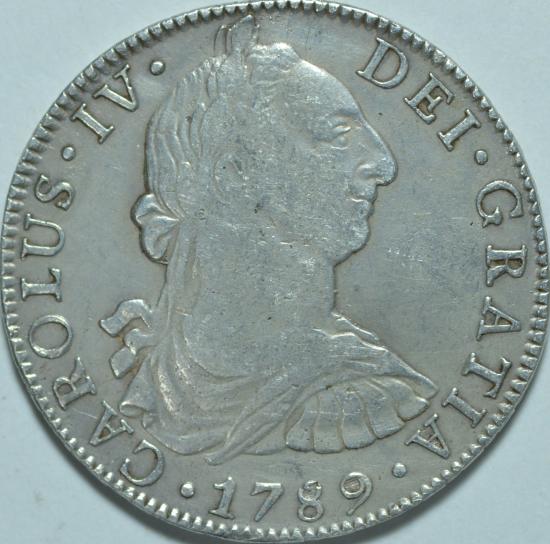
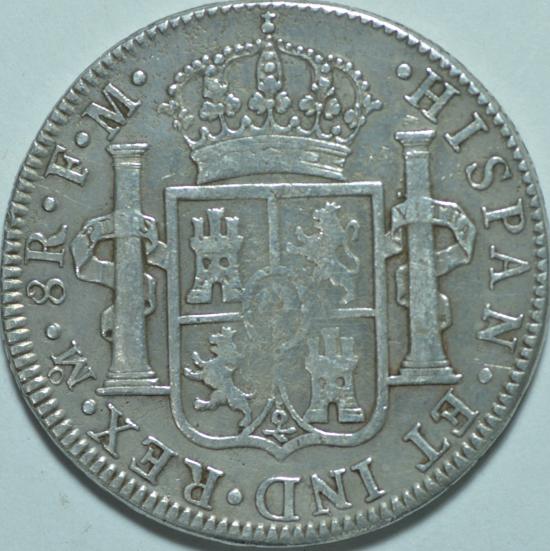
Henry - regarding your 1789 coin. Are you showing it in the belief it is Counterfeit or Genuine?
It is in my opinion a counterfeit for two reasons. First the SG of 10.195 is far too low to be considered real. In my table, I would call the coin 84% silver +/- 1%. If that is an accurate reading (not plus or minus 9%) - the coin can not be GENUINE.
There is no proof at all in mint records of Mexico City or the US mint that Mexico City ever produced such defective coins - even during the War years. If these coins were that defective they would have not been adopted by the Schroffs of China as Standards against which all other world coins were measured. The same thing applies to the US which used the Mexican Portrait dollar as our standard. All tests that I have located from the period 1780 to 1850 show the same thing the value of Mexico City coins does not deviate by more than 1-2% per coin and average 100 coin test lots show virtually NO deviation between the coins produced and standard. A deviation of 15% or more is absolute PROOF of a counterfeit. These tests were all performed as fire assays and a deviation of under 1% was easily detected.
No one uses fire assay now because it destroys the coin. That is why XRF is such a great tool. You get results more accurate than the assay of 1790 without harming the coin.
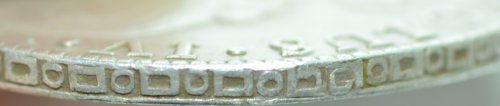
Second the coin has two overlaps one as you say in the 3rd photo between the you and S of Carolus and the second on the seventh photo between the A and T of Gratia. They do not appear from the photos to be the same length. That could also prove forgery. The laps must be of identical length.
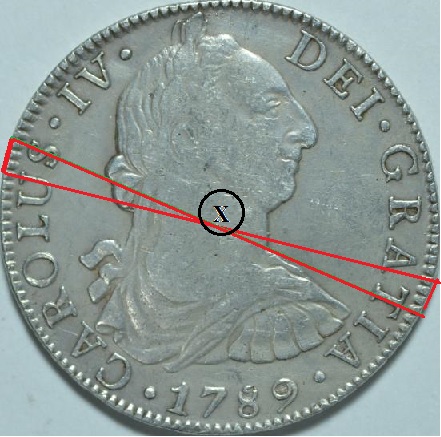
These laps are also definitely not 180 degrees apart. They are closer to 170 and 190 degrees in length a shift of about 5 degrees. They are about 1-3 elements off depending on the length of the first lap. If the first location is correct then the second lap should be on the OTHER side of the A toward the R and not on the side of the A nearest the T. The geometry of the two bar edger does not allow what we see here to happen. One side can NOT be physically longer than the other. That is IMPOSSIBLE. Rolling a round object (even one that is NOT exactly circular) between two parallel straight lines will result in each side traveling PRECISELY the same distance. Precise down to far less than one segment of the edge as I see here.
 westwood arms
 None of the TPGs use XRF testing in the way researchers like John Lorenzo uses it. He and I are collectors of counterfeits of all types and genuine coins we tend to avoid. I believe that getting the coin certified by NGC or PCGS will just result in another slabbed forgery. They do NOT XRF coins -only medals and their tests record the top three components only to the nearest 1%. They charge about $70 per test.
You might want to contact a materials testing lab. There should be many on the west coast. Any location where high tech is located they have such labs.
The existence of slabbed forgeries is ABSOLUTELY A PROVEN FACT. Here is one I have handy - NCS National Conservation Services is a wholly owned branch of NGC. They guarantee that the following coin is "Authentic". The picture speaks for itself - the coin is a blatant fake. I bought it on
ebay less than a year ago.
No number of expert opinions can change the fact that this is simply a crude counterfeit. I own this one and several that are not slabbed made from the same dies and NONE are 90% silver. XRF tests or even SG would have proven that.
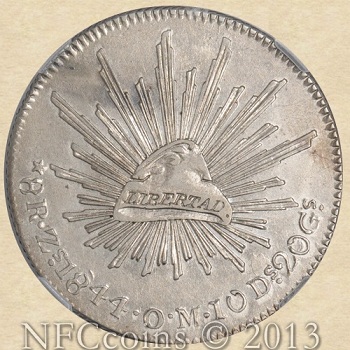
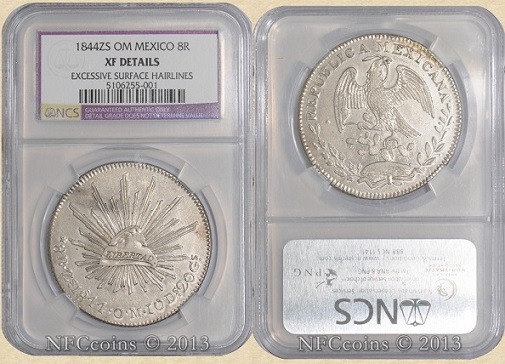
To anticipate the next question - I did in fact contact NGC and got a photo from them of the coin that they actually certified and it is the SAME coin. They want the coin back. I of course refuse to do that unless I accompany the coin.
There is another thread posted here with a Modern Chinese fake that was slabbed as one of the best known examples of an 1840 Portuguese India Rupia by NGC. That coin had been viewed by experts in Europe and the US - it was slabbed in 2007 but it too is a FAKE only a modern one.
https://goccf.com/t/92144&whichpage=2So don't tell me that expert opinions are better than the forensic science used by authenticators. It is very insulting. I have worked part time for over 20 years as an authenticator.
Henry I just noticed that you expressed the following opinion about XRF.
Quote:
About XRF, I don't think XRF can solve all the problems about the authenticity of coins. Apart from the accuracy of the analysis, there is always a grey area of how high or how low an element should be that would lead to another argument, such as when the measured Au level is 0.1% or 1.5%, the interpretation is very different. Another suspicion might be induced.
I agree that experts could dispute minor variations in test results but here the XRF tests SHOW NO GOLD OR PLATINUM at all. It can not be explained by all the gold hiding in the center, Alloys and even most solutions reach a state of equilibrium when liquid which results in uniform distribution of elemental particles somewhat evenly throughout. The complete loss of 100% of the gold and platinum at the surface is NOT POSSIBLE. Why proven metallurgical fact. This is not a minor deviation. It can not be explained away by surface enrichment. It can only be dismissed by someone who does not understand the test and the history of metal refining.
It is only very recently that 99.999 fine ANYTHING can be created even in a laboratory. This is especially true in commercial manufacturing such as a mint facility. Methods of refining silver have a well known and VERY long History. The different methods when applied to the same ore yield different end results. All silver ore in Mexico is CONTAMINATED with gold. That is a well known fact found in books going back 200 years or more. Not opinions being expressed but the results of tests by chemists. In 1789 all of the gold could NOT be removed from the silver in a commercially viable operation. It was possible to make 99% fine silver but the rest of the metal in the ingots was Gold and Platinum with some very rare trace elements like Iridium as well. Pure silver was IMPOSSIBLE to create with the Patio Process and Cupellation. Those are simple scientific and historic facts.
These scientific facts can not be ignored because we want to sell coins and not lose money on what we already own.
This raises my last comment. Filip wonders if I harbor a prejudice against coin dealers. The answer is NO. I have worked as a dealer for years part time and as an authenticator for coin dealers in several states. I studied the auhentication business in the 1970s from a master of the Art in Boston. I also learned the art of forgery directly from people involved in that business. I harbor no prejudice against dealers who sell honestly. I have no prejudice against dealers who will listen to scientific fact.
I do however question the motivation of anyone who has a closed mind to science and accepts opinions as facts. Like I said earlier 95 dealers out of 100 or 999,999 out of a million can say that in their opinion a counterfeit coin is genuine - but if the coin is actually a counterfeit their opinion does not change the coin magically into a real one.
There are some things XRF is good for - one is the elimination of fake silver coins using silver refined by modern techniques. That is apparently what we have here.








 First Page
 Previous Page


 Posted 11/20/2013 10:57 am