Just a few minor corrections of fact and some less than minor personal observations on this topic.
The counter stamping of an 8 Reales with the oval stamp, octagonal stamp or the full Boulton dies RAISED the circulating value of the 8R above both face and intrinsic value of the silver it contained. It did not authorize the Spanish coins themselves or authenticate them. It made those coins tokens with a value in excess of the silver content. It was done to keep silver in circulation so that business had a medium in which transactions could be conducted. It gave rise to token coinages after 1810 where the value was set by fiat far above metallic content.
*****************************************************
The idea that there was a constant flow of captured Spanish 8Rs into England as a result of the war is also a misunderstanding of history. There were Spanish treasure ships that were captured by British armed naval forces from time to time. However, that was far from a regular everyday occurrence. The Bank of England bought the incoming captured 8Rs which immediately went to their vaults to back paper pound notes which were despised. The supplies of 8Rs were finally released for re-coining at an increased value only when the Bank was put under relentless pressure.
*****************************************************
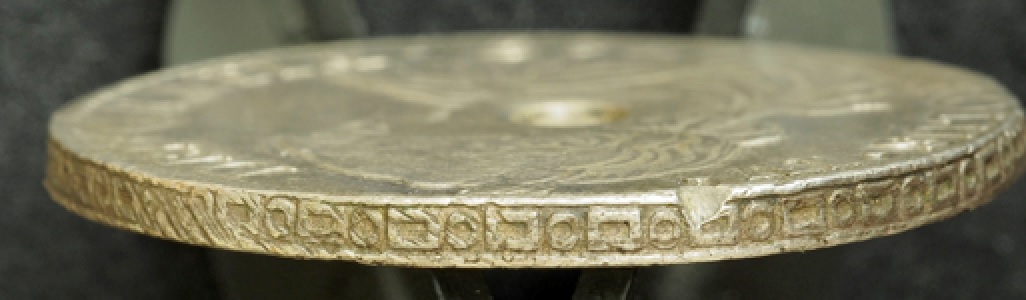
The 1790 coin we are looking at here is
almost without any doubt a coin made AFTER 1796 and likely after 1830 based on the edging apparatus used to make the coin and the punches used to make the dies themselves. The fact that the CERTAINTY IS NOT ABSOLUTE precludes removal of the item under
ebay rules.
The single die edger indicates to me a non-Mexican origin and a date anytime after 1796 is possible.
There are, however, two reasons that indicate the coin was not part of the original group of counterfeits made in 1796.
First: The coin is silver apparently over 80% fine and that is NOT typical of the 1796 varieties. The coins I own with the weird windows (Keyhole and porthole is my name) show SG's near perfect. The weights are also within tolerance given wear. That is not disputed and is the ultimate reason that I hold out a dim possibility that they might be genuine. XRF would be virtually indisputable if something like Cadmium or Yttrium were found.
Second: The way the dies were made is actually TOO GOOD, too precise to be from the original 1796 emission - from Birmingham. They were good but NOT THAT good. Having examined hundreds of coins made during the original emission this 1790 is too close to the original design to have been made before 1830. There is a precision in the way the fonts and small design elements are copied that is simply never seen in the early Sheffield coins. NEVER. It is also why so many professionals are reluctant to view these coins as anything but genuine.
So could this coin have been made in 1796 as part of the Birmingham involvement in the War effort against Spain and Napoleon. Technically it is very unlikely, and there was absolutely NO reason for a silver restrike to have been made that early. It would be contra-indicated by the facts of the time.
The plausible case for the stamp being applied in 1830 or later is however logical and the only answer I can come up with for a high grade silver restrike. If this was a base metal copy the answer might be different.
By 1830 in England and France, electro-galvanic replication of die elements was in fact possible. It is a known fact that in 1839 the US mint was aware of a procedure in place in France which was capable of exactly duplicating dies. Boulton before his death was working on a similar project. This procedure was NOT available in the US. It was done by copying each letter (or die element - like a Lion or a Castle) onto a punch that would be used to make new dies that would theoretically be a match to the originals provided the die sinker could duplicate layout and spacing.
So the issue reduced to the basics is really why is the stamp there at all? Was there a reason to apply it in 1830 or 1840? The simple answer is of course NO. By that point in time the emergency coins were demonetized and most of the remaining examples including the counterfeits were already shipped to Canada.
There is no reason for the stamp to have been placed there in 1830, 1840 or any later point in time later than that with the single exception of making it a collector coin.
It is a well documented fact that numerous coins were countermarked AFTER the original emergency period to serve as collector items. This is why today there are Ecus from France, Dollars from the US and minor coins from all over the world with Oval and Octagonal stamps. None of those are Genuine. Many were made with original privy stamps but none were actually made for circulation.
This coin may have been made in 1840 and it may have traveled to China but maybe not. But one thing that did not happen (my opinion) was that the coin was not in existence to be countermarked in 1797 simply because of the combination of edge application and planchet composition.
Now could the coin be a circulating silver restrike made in 1830 that was counterstamped in 2000? What would preclude that possibility? Nothing at all except a well made punch.
There are well made punches in use right now. Mr. Melgar of Spain apparently has one. How many others are there?
That is the best explanation of the coin I can give - but that is NOT enough to terminate the auction under
ebay rules. I voted to retain the auction and I advised the manager why.
*******************************************************
The next issue is the factual basis for the existence of silver counterfeits.
Is this all an urban legend?
Professional dealers and graders likely hope it is. But as pointed out earlier the Micro-O
Morgan dollars show it is possible. The micro-O has ZERO attestation in the original records. No one knows when or where they were made. They were bought and sold as rarities at high prices and they were graded by TPGs until 2005 or so.
Is there more documentation for the existence of a far more common far less valuable 8 Reales?
YES.
In the book the proof I lay out covers dozens of pages. But the simplified story is as follows.
The Chinese inland merchants demanded payment in silver and ONLY silver. The only coin they would accept after 1809 was the Carolus Dollar from Mexico City.
In 1830 in the period prior to the first opium war in China - the premium paid by Chinese merchants for
high grade examples of Charles III and Charles IIII 8 Reales reached 20% over the coin's intrinsic silver value. This came about because China did not import items from the western world but the western world wanted tea and silk. The one-way demand created a $30,000,000 trade deficit. That is 30 MILLION DOLLARS in 1830 when a day's wage was under $1. So every year 30 million dollar coins were shipped to China to pay for the trade deficit.
As you can imagine world supplies of un-worn un-chopped 8Rs dried up fast.
Where in 1830 do you get NEW Mexican silver Portrait dollars? At this point in time, US Dollars did not exist (the China premium in 1803 was 4%). The new Mexican Eagle dollars from Mexico City traded at face value but all other dollars were treated with a NEGATIVE multiplier at 1-4% UNDER intrinsic silver value. The Chinese would not accept them for any more than that. Silver had to be shipped to China every year and shipping was NOT free.
The coins needed were specifically Mexican dollars with the Fatman, Bustman, Human Head or Devil's head coins with wide hair ribbons. They paid 20% OVER silver value.
Now put yourself in the position of a monetary trader. You can buy a dollar in London and ship it to China for 2.5 cents per coin. England could make a silver dollar for about 3 cents per coin plus metal. So It was possible to buy raw silver make an 8R and ship it to China for Five and one
Half Cents over silver and in turn you receive $1.20 in trade value - a tidy profit of 14.5%. Huge for 1830-40.
The trade deficit was actually large enough to cause England to establish an opium trade with China. The English through BEIC shipped opium from India to China and sold it in Canton. The Chinese government tried to stop these shipments and they outlawed opium. So the English government attacked China. The English won the "war" easily of course - swords against Redcoats and Junks against Ships of the line. It was not a fair fight. The peace treaty stipulated that the Opium trade would continue unmolested and it fixed prices in favor of England.
Regarding the factual basis for the creation of silver restrikes for the China trade it was mentioned in the US House of Representatives in published records for 1835 the same year that it was also documented in the English Parliament. Both of those records establish the commencement date as no later than 1830.
There are numerous other published documents from the entire century that point to this "semi-secret" trade.
The factual nature of this production is or will be beyond any dispute. The details have yet to be fully discovered but once a thousand eyes are reading records - instead of just my old eyes - it should develop rapidly. That is my hope.
The remaining issue is how to tell the silver restrikes from the genuine coins. My book is a first stab at that methodology. It needs work of course but it is a starting point and much more research needs to be done.
*****************************************************
Regarding the distinction between Counterfeits types we all know there are TWO main divisions (Three in the case of 8Rs, MTTs and Ducats). The coins made in China last week I refer to as Numismatic Forgeries. I prefer Forgeries over Counterfeits because these were made to defraud collectors (numismatists) and not to circulate. I could not agree more that they are NOT THE SAME as the Contemporaneous Circulating Counterfeits. I only wish we could re-educate everyone to accept that primary distinction.
Coins or bills made for Monetary use in circulation whether regal or non-regal - whether genuine or counterfeit ARE COLLECTABLE HISTORIC ITEMS. The fact that most of the older types are also NO LONGER LEGAL TENDER (with the exception of
US coins in the US) means they are no longer illegal in and of themselves.
US coins that are not genuine are still illegal to own or sell.
So Counterfeits simply stated can be legal.
In the US, the mint act of 1873, which took us off the bi-metallic standard also officially DEMONETIZED all world silver (not gold) coins. This same statute SPECIFICALLY EXEMPTED the manufacture of such world silver coins from any prosecution under counterfeiting laws.
That last provision of the 1873 law is critical to my case about the US government supporting overtly or covertly the manufacture of 8Rs in the US. The US knew that it was going into the business of making silver Mexican 8Rs and didn't want that activity to be criminal. The law was changed to do just that. It was no coincidence that this law followed shortly after the failed attempt to make 8Rs in California using Comstock silver. I have recovered a series of letters from a legal file that indicates in 1893 that a case of counterfeiting was overturned on that basis. The shipment of counterfeit coin was going from Massachusetts to China by way of San Francisco.
This is a complex subject involving international monetary interests and the silver barons of the US. History of US involvement needs to be re-written just as the objective of the Opium Wars in China needs to be understood. These actions were undertaken for the same reasons. The UK and the US were both solving a balance of payments deficit.
In this case a few million coins a year are a good trade for two wars and the creation of generations of opium addicts.
History in most western countries is a whitewashed re-telling of a story that hides the true motivations of the west when dealing with China.
For the past 12 months in my daily reports to
ebay regarding coins that violate the existing regulations, I have tried to get the managers used to Numismatic forgery and Contemporary Circulating Counterfeit as terms. Right now BOTH are prohibited. But that rule needs to change. Otherwise auctions like the one that just happened at Stacks will never happen on
ebay. Otherwise the honest dealers will be penalized while the ones resorting to fraud will prosper.
Numismatic Forgery is based on FRAUD and the objects themselves are illegal copies based on Consumer Protection Law in the US. THESE ARE NOT ACTUALLY COUNTERFEITS and counterfeiting statutes do not apply. The Contemporary Circulating Counterfeits WERE originally made under penalty of counterfeiting law but that crime has been nullified by the demonetization of the items. The only thing needed to make a Contemporatry Circulating Counterfeit Coin or Bill legal is a CORRECT description of the item so that fraud by deception does not take place.
Counterfeiting law applies ONLY to the making, distribution, sale and uttering of current, circulating money or items of monetary value without authorization by an entity having the power to issue money. A counterfeit of a British Pound coin, a US Anthony Dollar or a Euro are all covered by US Counterfeiting law and all are absolutely ILLEGAL to possess or sell in the US.
Counterfeiting simply is the wrong charge to make when a seller describes a contemporary circulating item as genuine. The error is not that he has posted a counterfeit but that he has improperly described a non-monetary historic item. He is committing Fraud - he/she is not engaged in counterfeiting.
That is the distinction I am working at constantly to get
ebay to UNDERSTAND the difference.
AS a way of helping - I would ask the members of this Forum that NO ONE REPORTS any Contemporary Circulating Counterfeits. They should NOT be reported.
I have 5 years of studies of
ebay data and there are many types that normally get by but which under the existing rules - should not:
Fourees - These are counterfeits of ancient coins made thousands of years ago. Fourees are a violation of
ebay rules. But one made last week is FRAUD.
Evasion Half Pence - These were imported to and sometimes made in the US - they are not genuine coins but evaded prosecution under English law. These were never counterfeit but they are prohibited under the
ebay rules as used.
Non-Regal issues - Also colonial US in nature these exact copies of English and Irish Halfpence were counterfeit when made but have not been legal money for 200 years. They are prohibited by
ebay but traded openly by collectors.
Non-Regal Spanish and Spanish American Silver coins. These are the coins documented in Riddell's Monograph (1845) and more recently in the works of ANS writers like Kleeberg, Lorenzo, Ringo and myself. These are all prohibited even if properly described.
Restrikes of all sorts are PROHIBITED by
ebay whether Novodels from Russia, Bashlow restrikes of Confederate cents or
Half Cent US mint restrikes. Remember
ebay uses words NOT concepts.
Copies and Replicas are all prohibited as are Fantasy issues.
I know that is one huge NUTSHELL, but that in a nutshell are my thoughts.
The book is nearly 600 pages long.








 First Page
 Previous Page


 Posted 11/13/2013 10:07 pm