Coin Community Family of Web Sites Join Thousands of Coin, Bullion, & Money Collectors
Vancouvers #1 Coin and Paper Money Dealer Coin, Banknote and Medal Collectors's Online Mall Join Thousands of Coin, Bullion, & Money Collectors 300,000 items to help build your collection! Specializing in Modern Numismatics Royal Estate Auctions - $1 Coin AuctionsRoyal Canadian Mint products, Canadian, Polish, American, and world coins and banknotes.


Username:
Password:
Save Password
Forgot your Password?


This page may contain links that result in small commissions to keep this free site up and running.

Welcome Guest! Registering and/or logging in will remove the anchor (bottom) ads. It's Free!

1789 8 Reales

To participate in the forum you must log in or register.
Author Previous TopicReplies: 171 / Views: 32,374Next Topic
Page: of 12
Pillar of the Community
MathieuMa's Avatar
France
1591 Posts
 Posted 11/15/2013  10:42 am  Show Profile   Bookmark this reply Add MathieuMa to your friends list Get a Link to this Reply
coinworldtv : I don't think coinworldtv said the counterstamp was made in 2000 - he said nothing with those could ever been proved :)
It's the problem with counterstamps, unless a wrong die is used (poorly made copies - YII and Fo7 ones are a good example) or wrong techniques to apply them is used ( strange things on the other side, way too much pressure, and so on) ... you can't figure out what's correct or not.
With coin, at least you have something : the metal composition which can be checked and compared. (in addition to the two above ways)

I'll just add something regarding adjustment marks : they were done on the visible sides of the coin, not on the edge.
The edge is here do deter copies, and to be sure the coin has not been shaved.
And technically, it's much more complicated to adjust a coin on the rim (it's circular there, not flat).

I long to see Bob's answer, you are adding interesting points here :)
I like history, but I love when science can get the facts out - they are made to be used together in our hobby.

PS : you forgot to elaborate on question 2 :D
PPS : the miage you are sending don't appear properly :/ You can use http://imageshack.us/ for example, or https://picasaweb.google.com (right click on the picture in the album, and paste the url here). There is also an image uploader below the text input box here.
Edited by MathieuMa
11/15/2013 10:47 am
Pillar of the Community
jfransch's Avatar
United States
1801 Posts
 Posted 11/15/2013  1:45 pm  Show Profile   Bookmark this reply Add jfransch to your friends list Get a Link to this Reply
Everyone....great thread and great discussion (now I need a nap after re reading it all)
What dates have you seen the keyhole/porthole windows appear on and does anyone here have a coin showing one of those dates, the keyhole punch and a correct edge with opposing overlaps with or without the diagonal marks(be they signs of a single edger or adjustment marks)? I will raid my SDB tonight and see what I can find.
Pillar of the Community
swamperbob's Avatar
United States
5362 Posts
 Posted 11/15/2013  6:42 pm  Show Profile   Bookmark this reply Add swamperbob to your friends list Get a Link to this Reply
Filip - I agree that scientific and historical facts are the critical elements in this discussion - so I will answer your challenge in the same manner with facts.

Your first challenge is:

Quote:
Object: Mexican 8 Reales Coin, dated 1789, counterstamped with a perfect 1795 British oval counterstamp (there is no clue of this countermark being new, except your theory which is here challenged).


Scientifically it is impossible to determine when a stamp is applied to a coin. Either of us could be correct. But I would point to the fact that the coin's surfaces do not show a 200 year old patina and ask WHY?

Scientifically - the perfection of the stamp is open to opinion and debate. I believe the stamp has been accurately duplicated so that the appearance is no longer an absolute guarantee.

So I think we can conclude that any date is possible. I did not say my theory was built on a premise of the stamp being applied in 2000 just that it could have been.

Then you move on to the edge markings. You say:
Quote:
Reason: Unusual rim markings

Assumption: The coin was made with a single die edger, which produced the rim-markings.


The assumption is proven by the numerous examples of contemporary counterfeits that happen to have the same strange edge markings which occur only on half of the edge. I call my Theory about the one die edger a testable Scientific Hypothesis it is not merely an assumption as if there were no supporting scientific facts.

So lets test my hypothesis (theory) versus your theory that the irregular diagonal edge marks are due to adjustment filing.

I think an impartial observer would conclude that BOTH your view and mine are at the same level. Both are theories that need to be tested.

So lets test them with your definition of ADJUSTMENT Marks:


Quote:
1) Adjustment marks definition: File marks, inflicted on a planchet before striking, to bring weight down to mint standard. They do not constitute impairment to a coin. After blanks were cut out from strip, but before they were sent to press for stamping, they were weighed; lightweight ones were returned to the Melter and Refiner's division, normal ones went to the press (being cleaned and given upset rims in the meantime), heavy ones went to the adjusters, who were women armed with files and wearing leather aprons. Weighing and adjusting sometimes had to be repeated several times. Every few hours the contents of the adjusters' aprons went back to the Melter and Refiners.


I agree 100% with your definition of adjusting with one correction - it was blanks and not planchets that were adjusted. That is a common technical error.

But now lets see how that definition fits both of our theories (assumptions).

In the definition is a very critical point:


Quote:
After blanks were cut out from strip, but before they were sent to press for stamping


That proves that adjustment happened BEFORE the blanks moved along in the process. It makes complete sense. Why in the days of all manual labor would anyone stamp an underweight blank and have those man hours wasted. The same theory applies to adjustments made after the strike. The whole point of milling (edging) coins was to prevent filing and clipping. If the mint filed the coins after the strike how would a merchant distinguish between mint filing of the edge and Joe Schmo filing the edge to steal silver? The only logical answer is they wouldn't but is there proof?


Once the blanks were weighed there were three possible results.

1. Light weight blanks were recycled
2. Normal ones went into a box to await the next step in the process
3. Heavy ones were adjusted by filing right then and there.

So far we can agree - I think.

The blanks in step 3 were filed one or more times and then those blanks went in the same bin as the normal blanks. Remember the blanks were subject to a count which was checked and rechecked to preclude theft at each step.

What was the next step?

Your definition says:


Quote:
normal ones went to the press (being cleaned and given upset rims in the meantime),


That would be the same route taken AFTER adjusting. The pick-up was done together in batches going to the same place. The cleaning tanks. Then the annealing furnace then the pressroom.

After cleaning the adjusted blanks (now the correct weight) went to the same place as the normal weight blanks. They were annealed (softened) and then they were edged on a manual two flat bar edging mill. This turned the blanks into planchets by adding the edge design and upsetting the rim for striking.

So the correct order is established as:

Adjustment
Cleaning
Annealing
Edging
Cleaning
Annealing
Striking

So on a factual basis how do the edge "adjustment" marks according to your theory occur ON TOP of the edge design?

Answer - they can not. Therefore the edge marks can not be adjustment marks and your theory is disproven.

The simple fact is that edging and stamping were NOT done at the same time.

The adjustment marks for weight were made on the Blank after it was punched and before it was sent to the coining room for edging.

So your entire theory (assumption) based on edge adjustment filing is proven incorrect.

Then you state:

So here are the questions again and the alternative answers:


Quote:
Question 1: What are the rim markings?

Answer: These are weight adjusting marks 1).
=========================================

Reason: Machine made markings (from a single die edger) would be more alike, but what we see on various specimens is kind of random.

Simple Question: Why should somebody adjust coins before (or after) their striking?

Answer: The high alloy of the planchets was too high, possibly a mistake of mint/melt.


So your conclusion #1 is disproven - the edge markings are on top of the edge design they are NOT related to adjustment.

You then make an assumption of your own:


Quote:
Reason: Machine made markings (from a single die edger) would be more alike, but what we see on various specimens is kind of random.


You assume that the one die edger leaves regular markings from the griping strip, but is that necessarily correct? In some cases (more sophisticated copies there are regular grip marks or no grip marks at all. On one case I have seen there is a crisscrossed pattern like knurling. In an era of hand made machinery, before flat stock could be knurled, all the operator needed was a rough surface that allowed a blank to roll along against the die. So I would suggest as a possibility that they abraded the opposite surface with a FILE leaving the random marks, some deep some shallow, that also look like adjustment file marks.

In Mexico Adjustment did not happen after the coin was struck - it is not mentioned in any written sources. All scratches that occur OVER the deigns on the face or edge dies are classified as post strike damage.

I have never stated that the punch was or was NOT MADE in 2000 or any other date the Privvy punch could have been applied anytime. The fact it is correct proves NOTHING.

Fact a perfect duplicate punch matching the 1795 privy stamp could be fabricated and applied today.

Also a fact an old 1795 punch could have been applied in 1850 to a silver retrike made in Birmingham.

Both are possible and not precluded by your line of argument.

The Keyhole windows issue like the cracked doorway, or off center windows, or the tiny windows, or the broken lintels or a number of other anomalies could link forgeries.

The ONLY way to prove any of these coins are GENUINE is through scientific testing which is costly.

Remember I did not come out with this line of argument using ONLY an old man's story. The coin he gave me in 1960 has been tested scientifically with XRF and it is made of silver that could NOT have come from Mexico because the gold and platinum have been removed from the silver.

You can chose to discount the facts as a mere story.

My book was written to get collectors to open their eyes and to start addressing the possibility just like the MTT - there May actually be more RESTRIKES of the 8R in existence today than genuine coins made in the period from 1772 to 1811. How many MTTs made before 1811 trade as cheaply as an 1809 8R?

Both were trade coins made for the purpose of exporting silver in bulk. In both cases the numbers were large for the time. But the 8Rs went to China. What happened to them in China? Gwanzou a noted Chinese economics authority of the 19th century stated that 85% of the Portrait 8 Reales imported into China before about 1850 were IMMEDIATELY MELTED AND WERE MADE INTO SAYCEE INGOTS. This practice did not stop until AFTER the Opium Wars.

So think about the fact that high grade 8Rs imported into China between 1830 and 1850 at a rate of 30 MILIION coins a year had a high premium value in China but in 85% of the cases were immediately melted in Saycee ingots. So how many of the GENUINE coins made in Mexico survived the melting pot?

I have MANY theories still in testing that might shock the average collector. I do not go forward and normally discuss a theory until I have thought - re-thought tested and retested every facet of the process.

I do not believe that all restrikes will ever be able to be identified. In fact only copies made after about 1878 can be distinguished by XRF at this time.

I am hopeful that more coins will be tested and that the non=Mexican coins will eventually be able to be distinguished to an earlier date. But overall I really am hopeful that someday the actual rarity of genuine 8Rs can be established as fact and that the restrikes can be identified for what they are.

We have all been Ostriches too long.

Remember one thing - if 85% of the coins you see are restrikes - then only the GENUINE coins will look "wrong".
Pillar of the Community
coinworldtv's Avatar
Austria
566 Posts
 Posted 11/15/2013  8:31 pm  Show Profile   Bookmark this reply Add coinworldtv to your friends list Get a Link to this Reply
Well, with one coin tested there is indeed nothing prooven yet.

Still, I do not believe in perfect forgeries and not even in perfect counterstamps.

The re-using of old countermark dies is known, but these tools have not survived until today.

All the newly made counterstamps are easily detected (even with blind eyes :).
Pillar of the Community
MathieuMa's Avatar
France
1591 Posts
 Posted 11/15/2013  8:39 pm  Show Profile   Bookmark this reply Add MathieuMa to your friends list Get a Link to this Reply
More than one coin were tested actually - a lot of them have been tested (some of which will be published on that upcoming book).
A perfect coin without the proper alloy (no gold / platinium) means it was made once that technique was available.
Those do exist, are tested : this is a fact.

Regarding perfect counterstamps, I don't agree : even Stack or Cayon get fooled and list them - they sometime end being auctioned, but most of the time they are removed prior to the auction.
I suppose you are aware of the work from Juan Melgar ? If you have a facebook account, come on that group and have a look at the picture gallery (there is a section for Melgar) : https://www.facebook.com/groups/monedafalsa - you can also see some of them in this topic : https://goccf.com/t/122568
Pillar of the Community
coinworldtv's Avatar
Austria
566 Posts
 Posted 11/15/2013  8:50 pm  Show Profile   Bookmark this reply Add coinworldtv to your friends list Get a Link to this Reply
Yes, these are the countermarks which a professional should blindly detect, but I do not see anything near perfect here.

All of them are crude immitations, also the fake coin shown in the detail section of this thread.
Pillar of the Community
coinworldtv's Avatar
Austria
566 Posts
 Posted 11/15/2013  9:08 pm  Show Profile   Bookmark this reply Add coinworldtv to your friends list Get a Link to this Reply
All in all, I am looking forward to see THE Book, no matter if it is 600 or 800 pages.

I hope that it will include following newly added information from this sentence:


Quote:
So I would suggest as a possibility that they abraded the opposite surface with a FILE leaving the random marks, some deep some shallow, that also look like adjustment file marks."


This will be the place where I will put a smile in order to remember this amusing conversation.
Pillar of the Community
swamperbob's Avatar
United States
5362 Posts
 Posted 11/15/2013  9:20 pm  Show Profile   Bookmark this reply Add swamperbob to your friends list Get a Link to this Reply
I did not mean to imply only one coin had been XRF tested to establish the category of Silver Counterfeit made from 1830 to 1930. We have tested between 200 and 300 8 R coins at last count. We have also tested several hundred other coins including genuine coins and other denominations. There has also been extensive testing done on Davignon Half Dollars also reported in Riddell's book on Contemporaries. The parameters for the classes of forgery are well documented to this point. What I have not tested yet are examples of this particular window version.

But there are visual clues that go along with this counterfeit type. There are 20 clues in all that are listed in the book. No coin has all 20 visual clues but when several occur together the XRF tests have proven the forgery in over 70% of the cases. The more clue point to forgery the more likely it is a fake. The other 30% that do not XRF test as fakes still may be counterfeit silver restrikes because the silver was extracted using silver amalgam processes ONLY and the trace elements could be right.

There is NO KNOWN SCIENTIFIC test yet developed that can prove beyond any doubt that a coin is genuine. The tests all prove forgery.

Your coin has 8 out of the 20 markers of a Silver restrike - the edge diagonals are ONLY 1 clue. The typical silver restrike has 4-6 and the maximum number so far is 13. Based on a statistical look at the data I would bet that there is more than a 95% certainty that you coin falls into the counterfeit type made between 1830 and 1930.

So while each specific type must be tested. Odds favor your coin being a Silver restrike by a VERY wide margin.

In any event as a class the Silver Forgeries absolutely exist and the proof is substantial.

This windows variety was only discovered within the past 12 months and first came to my attention AFTER the book was finished.

The 95 - 5 probability of forgery allowed me to indicate to ebay that the auction is NOT beyond all doubt a counterfeit so it should continue.

Pillar of the Community
colonialjohn's Avatar
United States
1757 Posts
 Posted 11/16/2013  2:49 pm  Show Profile   Bookmark this reply Add colonialjohn to your friends list Get a Link to this Reply
Unfortunately I no longer work at EDAX so analyzing these deformed castle porthole 8R's would be interesting in terms of their Ag,Pt & Au levels. My final paper was on the Cast/Overstrike-Cast War of Independence Chihuahua 8R's in the recent Mexican Numismatic Association Journal. It really demonstrates how Platinum (Pt) and Gold (Au) (normally > 0.1% and less than 1%) must be in the alloy composition to be of this period (i.e., 1811-1822).
As time moves forward into the 20thC for silver alloy pieces we see Pt & Au decreasing with better refining methods for all silver coins like morgans and 8R's. Moving forward this could be a good indicator for authenticity to a particular period as also noted previously by P.T. Craddock of England. One of the most important points I picked up in analyzing CC8R's was how so few were actually of a real german silver composition. All the Ringo pieces termed as german silver I suspect are of another alloy composition (i.e., not Cu/Zn/high Ni). Remember in the beginning of the book project Bob how all those different colored CC8R coins you sent were all basically debased silver pieces in which the high Cu &/or Zn levels just were behaving differently to the environment <BG>. I also picked up two of Ringo pieces which were termed white metal and one was termed a cast white metal. These are actually in my opinion high tin (i.e. >90%) alloys and were struck. There appearance appears as cast white metal but when the weight is low (mostly at ~22-24g range sometimes lower; I own one at 15.6 grams!) it really points to a high tin (>90%) composition.
Bob - I am not sure if there are any real differences between Pt & Au levels between Class 1 and Class 2. Certainly between Class 1 & 2 and the 20thC modern pieces when looking strictly at silver debased alloy composition pieces only.

John Lorenzo
United States
Pillar of the Community
MathieuMa's Avatar
France
1591 Posts
 Posted 11/16/2013  6:58 pm  Show Profile   Bookmark this reply Add MathieuMa to your friends list Get a Link to this Reply
colonialjohn : was your work published there yet ? I don't remember seeing it there.
Pillar of the Community
swamperbob's Avatar
United States
5362 Posts
 Posted 11/16/2013  7:27 pm  Show Profile   Bookmark this reply Add swamperbob to your friends list Get a Link to this Reply
Hi John,

You of course know that I agree with your assessment 100%. The XRF test results that Prove forgery are limited to Restrikes in silver made with silver refined after about 1878. That is when the Scottish process of cyanide reduction proved to be able to refine silver to 99.99%. So XRF separates the truly Modern (post 1878) restrikes from the earlier pre-1878 strikes. The use of the 20 points of comparison that I set up in the Class 2 section of the book is the best identifier that I have come up with to ID restrikes in silver made between 1830 and 1878. I only wish Mike Ringo had lived long enough for me to fully understand his approach and for him to fully understand mine. Filling in for him on the book project has been a challenge.

In the Stacks sale appears one of the Silver Class 2 restrikes based on the punch types used. I have one in my collection which I bought after the book was put to bed. Item 10478 is a silver restrike. Stacks attributor put a ? after the metal but if it is like mine it will have an SG at 10.3. Mikes coin weighs under 25 grams and that may have been why he noted it as a counterfeit. I classify it based on the die punch comparison.

But today I got a note from the facebook group started by Sedwick) among others https://www.facebook.com/groups/mon...032857563558

The coin discussed there is another Class 2 Silver Restrike posted by Filip. This coin matches both Mike Ringo's coin and mine on the basis of an elemental punch comparison. The coinworldtv coin also has 7 of 20 points of comparison using my scale.

But to head off any further discussion at this time and to stop the challenges to theories that are not yet fully understood I would like to point out what I did in the other forum.


Quote:
This is one of the coins that is now and has for 100 plus years been attributed as genuine. Many identical examples will be found in PCGS and NGC slabs attributed as genuine. It is only the issues raised in my book which is NOT yet published that will call this into question. It is at this point in time UNFAIR to Filip {I would add to any other professional dealer as well] to say that the coin is NOT GENUINE. This issue is also a key reason why editing of my book has been such a drawn out process. At every step I have run into opposition from the established professional community {and I absolutely expect MUCH MORE]. It is ground breaking work that could be killed before it even gets out for a fair hearing. I see the Silver Restrikes as just as Genuine as any other 8R. But I also see the prices for the 8R being held down because the actual rarity of true original issues struck prior to 1830 is being terribly overstated. The book is a first step only into the correction of that long standing issue. For more see the Coin Community Forum.


So please until we get the book out there - until people can see and read the whole case laid out in a straight forward manner - do not throw BRICKS of accusation about the classification of coins.

DO NOT REPORT class 2 silver restrikes as counterfeits to ebay. I have already explained to ebay manager the nature of my work and the fact that Class 2 silver restrikes should not be considered Counterfeit in the same way that Class 3 Chinese fakes are. ebay will not take action to stop these auctions at this time. It is premature and could damage my ability to get a fair hearing on the topic.
Pillar of the Community
coinworldtv's Avatar
Austria
566 Posts
 Posted 11/16/2013  8:54 pm  Show Profile   Bookmark this reply Add coinworldtv to your friends list Get a Link to this Reply
Dear Swamperbob,

i do accept your apology, but you should be honest to yourself and to the public.


Quote:
This is one of the coins that is now and has for 100 plus years been attributed as genuine. Many identical examples will be found in PCGS and NGC slabs attributed as genuine. It is only the issues raised in my book which is NOT yet published that will call this into question.


This type of coins (the above mentioned class 2 type) is still considered as authentic by NGC, PCGS, and most professional numismatists. As you say most professionals do not agree with you.

I hereby declare that I also DO NOT AGREE with your opinion.

In my opinion there might be a class2, but not a restrike it is a characteristic appearance of a coin (this includes all its physical and material features).

You might convince here a few people, but in order to have success (i mean not the number of sales, but the acceptance of your book by professional numismatist) you need to stop the general assumption, that everybody is wrong (and 85% of the 8R coins are actually restrikes).

And please do not make my fully sound countermark bad, you do not have any reason for that. This is a perfect countermark. This is not a crude forgery, that is the real thing. Your comment that if the countermark was contemproary a 200 year old patina should be there is ridiculous and shows, that you simply do not have anything else to put against it.

You see, even the manager at ebay is getting worried, that you vote on the sale of a "RESTRIKE?". It is you against yourself here. You need to work on that. You are not using the right words, you are a bit self-opinionated and answer questions with tons of informations of non related or at least far-fetched (the micro-o dollar can not be compared to a spanish 8 reales piece).

I mean all of this in a positive way and I am happy that you do all the research. Even if you are wrong on the 8 reales issue (and I think, that you are), your work might contribute to some other (maybe not shocking) valuable addition to numismatics and to the identification of forgeries.

Best regards
Filip (coinworldtv)
Pillar of the Community
swamperbob's Avatar
United States
5362 Posts
 Posted 11/17/2013  01:12 am  Show Profile   Bookmark this reply Add swamperbob to your friends list Get a Link to this Reply
I of course accept your comments as completely sincere - however, as sincere as you may be - you have NOT seen the evidence I have gathered yet and you are already positive you are right and I am wrong. That in fact I should:


Quote:
be honest to yourself and to the public.


The scientific method which I have employed here and all my adult life says that you make hypotheses and then TEST them. You discard hypotheses that do not match the facts. And then you form a new hypothesis for testing and move forward.

You also say that I should:


Quote:
you need to stop the general assumption, that everybody is wrong


By preempting the facts with an opinion, even a majority opinion, - it is you and not me that is taking a decidedly non-scientific approach. Verifiable facts are verifiable facts. Opinion is only opinion. Do you have any facts?

All the opinions in the world are REFUTED by one solid proven fact.

My arguments are all based on or supported by facts.

For the last 100 years, people have been deluded by opinion. But for over 100 years prior to that time these coins were called COUNTERFEIT. That was in the era before these coins became collectable and were treated only as money. I see this as no coincidence (but that is a different topic).

These coins were called COUNTERFEITS by the founder of the British Numismatic Society in the 1830s.

They were called COUNTERFEIT by the US mint assayers in the 1830s and 1840s.

They were called COUNTERFEIT by the English mint assayers in the 1830s and 1840s.

In 1913 Spink and Sons published an Article that said they were COUNTERFEIT.

In 1905 the French Society of Numismatics recognized these coins were COUNTERFEIT.

In 1870 these COUNTERFEIT coins were prohibited by the Chinese Government from being imported into China.

In 1835 the United States House of Representatives published a report finding these coins were COUNTERFEIT.

Numerous books written between 1830 and 1900 document their existence and their large production numbers.

So, I take it that are you saying that all the experts and authors then were wrong and the experts since 1913 are right?

The past 100 years, has witnessed a substantial amount of scientific progress in authentication methodologies that have been systematically ignored by many people (mostly coin dealers) who were driven by purely PROFIT motives. It is the fear of harm to their business or reputation that causes them to at inconvenient times - oppose facts.

When science first determined the world was round - the vast majority of the learned experts rejected it as laughable. They too did not examine the facts before they made up their minds.

So time will judge who is right. Science will progress and silver restrikes will become accepted ONCE AGAIN for what they really are COUNTERFEITS of the 19th century.

I embrace both History and Science in my research. I categorically reject all of the "professional numismatists" who rely only on OPINIONS which result in their own coins selling for higher sums than they perhaps should.

In your last post on this forum you also say:


Quote:
And please do not make my fully sound countermark bad, you do not have any reason for that. This is a perfect countermark. This is not a crude forgery, that is the real thing. Your comment that if the countermark was contemporary a 200 year old patina should be there is ridiculous and shows, that you simply do not have anything else to put against it.


I agree that your counterstamp is not a typical crude fake. But that does not make it genuine. Just a good looking stamp.

I would ask you simply - if the coin was made after 1830 could your counterstamp be GENUINE?

The answer is YES it could. It could be a GENUINE original stamp - it just was not applied during the monetary emergency of 1796. Any stamp placed on a coin made after 1796 can not be a genuine historic artifact of 1796.

It is a well known fact that the original privy stamps were used as late as 1850 to mark coins for the new numismatic market. So it is possible that a silver restrike made between 1830 and 1850 but which was dated before 1796 COULD have been stamped with a genuine privy stamp. It is absolutely possible. It may have been made for a collector or for China. But that does not matter. The stamp application would NOT be genuine in that case even if the stamp itself was genuine.

Proving when your coin was made is essential. To have a genuine stamp applied during the Emergency of 1796 the coin had to already exist in 1796. That is a fact.

As a fact, I can state that the coin was not made using the normal methods of manufacture that were employed by the Mexico City mint in 1789. The edger used to apply the edge design was not normal. I state that as a proven fact. One die edge mills were NOT used in Mexico City. Two die edge mills do not produce the edge you show. Therefore, can any countermarked coin made incorrectly be a Genuine Emergency issue?

To prove I am wrong you need to:
Prove it.
You need to prove your coin existed in 1789.

What is your scientific test proving that date?

The remark about patina is only one point of suspicion - it is certainly NOT the only point of suspicion. To reject all of the balance of the line of argument over that one issue is hardly professional. The coin may have been cleaned in the past 200 years at any time. It may have been cleaned recently, it may have been cleaned before or after the stamp was applied. There is ZERO positive evidence.

You have stated as fact that all the George III privy stamps are gone. Did you ever verify that fact?

It sounds nice to say they no longer exist but it is NOT true. The British mint museum collection includes over 30,000 die punches and portrait master punches of all the Kings and Queens from the reign of Charles II (1660-1685) onward in "UNBROKEN succession" (to quote from the British Museum website) to the present date.

So the original "master" punches that created the privy punches still exist. How do you prove that all of the original privy stamps have also been destroyed?

How do you prove that a genuine stamp is still not in private hands being used to make new exemplars?

How do you prove that a forged stamp has not been created?

May I ask what FACTS you have put forward? In the past posts most of your facts have proven to be incorrect. I am referring to the following "facts":

1.) That filing the edge of a coin after the strike was practiced and referred to as "adjustment" by the Mexico City mint?
That is NOT a fact.

2.) That a perfect duplicate die can not be created by modern methods?
That is certainly not a fact. Ask Mark Hofmann.

3.) That the TPGs like ANACS, NGC and PCGS do not encapsulate COUNTERFEITS? {I am including them because you rely on them to prove your case.}
They absolutely do encapsulate fakes by error. I own several examples as do most of my counterfeit collector friends.

4.) That the George III privy stamp does not exist today? Not true at all.

5.) That the same experts you now rely on were all proven to be WRONG about the micro-O dollar for decades?

You may not like that example because it does not fit your preconceived ideas about the TPGs but it happened. You can not deny that fact.

It may not be a convenient fact for your way of thinking but it did happen.

It is, in point of simple fact, a perfect example of MOST people being wrong while a few real experts knew it or suspected it all along. The reason for this ---

Majority opinion is not always right.

I am absolutely convinced after 50 years of studying and researching the topic of counterfeit 8 Reales that I am right and I have in my book the facts that support my contention. It is my life's work.

Every single fact that you have put forward - I have systematically and scientifically refuted. You are now expressing opinions NOT facts. No facts that I have expressed have been disproven by any your statements.

So all we can really agree on is that we hold different opinions. One of us is right and one wrong. My position is based on facts and yours are based on .......?

The facts will decide this question ultimately.

The fact that I CHOOSE not to, at this point, condemn all silver retrikes as Counterfeits on ebay is my way of avoiding a red herring line of argument.

I am not doing so because I believe these coins are GENUINE, I believe contemporary circulating counterfeits should all be allowed on ebay without the present restrictions. The coins I believe should be stopped are the Numismatic Forgeries coming from China and coins that are sold using fraudulent descriptions.

I take my position with ebay because the Silver Restrikes (counterfeits if you prefer) are:

1.) Legal to own and collect. The ebay regulation is wrong.

2.) Legal to sell anywhere if properly described so that potential fraud is not involved.

3.) Not genuine coins made in the year shown on the coin. They were monetary items - they were used as currency. They are Contemporary Circulating Counterfeits made of Silver.

So lets agree to let the facts speak for themselves. I am always ready to listen to facts and if necessary to modify my theories to accord with new information.

I will revise any part of the book found to be in error (factual) at any point up to publication.

For anyone interested here is a picture of a broken Charles II master portrait punch. The broken section could be added to each die easier than it was to cut an entire NEW punch.
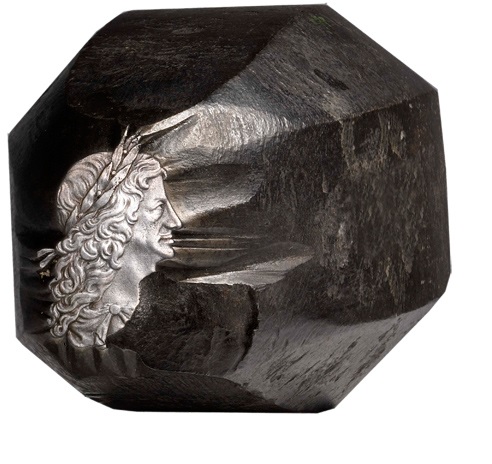

1789-8-Reales
Edited by swamperbob
11/17/2013 01:20 am
Pillar of the Community
MathieuMa's Avatar
France
1591 Posts
 Posted 11/17/2013  06:50 am  Show Profile   Bookmark this reply Add MathieuMa to your friends list Get a Link to this Reply
Thanks for all those clarifications Swamperbob.

I was going to say that there are two kinds of collectors in our field : those interested in history, accuracy - and those doing business.

If some of my coins are modern fakes, I hate it (because I gave money to some crooks).
If some of them are ancient counterfeits, well I don't like it as that's not what I collect, but I'm still glad to know it and - after all - own a piece of history from this period.
That's all what collecting coin is about : history. At least to me. (I never said value never matters, it's just a side effect of history)
Pillar of the Community
coinworldtv's Avatar
Austria
566 Posts
 Posted 11/17/2013  10:32 am  Show Profile   Bookmark this reply Add coinworldtv to your friends list Get a Link to this Reply
Dear Swamperbob,

you are again repeating your theory from your book (which is being continously reveised) and then using it as if it was a law (accepted as accurate and adopted), which it is not yet the case as nobody except you has had a look on it. The snippets I see here and there seem and too far-fetched and not consistent.


Quote:
For anyone interested here is a picture of a broken Charles II master portrait punch. The broken section could be added to each die easier than it was to cut an entire NEW punch.



I bet, that it would be easier for mankind to step on mars than to step on the sun, but still I do not see any of both happening in our century :)
Edited by coinworldtv
11/17/2013 10:55 am
  Previous TopicReplies: 171 / Views: 32,374Next Topic
Page: of 12

To participate in the forum you must log in or register.


Disclaimer: While a tremendous amount of effort goes into ensuring the accuracy of the information contained in this site, Coin Community assumes no liability for errors. Copyright 2005 - 2026 Coin Community Family- all rights reserved worldwide. Use of any images or content on this website without prior written permission of Coin Community or the original lender is strictly prohibited.
Contact Us  |  Advertise Here  |  Privacy Policy / Terms of Use

Coin Community Forum © 2005 - 2026 Coin Community Forums
It took 0.56 seconds to rattle this change. Forums

