Starting in April 1937, the Delaware Tercentenary Commission issued a series of six
Bulletins that provided updates to the activities of the Commission, presented developing details of the planned celebration, discussed the official participation of the United States (Federal Government) and Sweden and announced various souvenir items as they became available.
As would be expected, the commemorative half-dollar authorized by Congress in 1936 for the 1938 Tercentenary was a topic discussed in several of the
Bulletins. I thought it might be of interest to some to have the chance to read these "official" communications about the coin as presented by the Commission.
Read More: Commems CollectionBulletin No. 1 - April 1937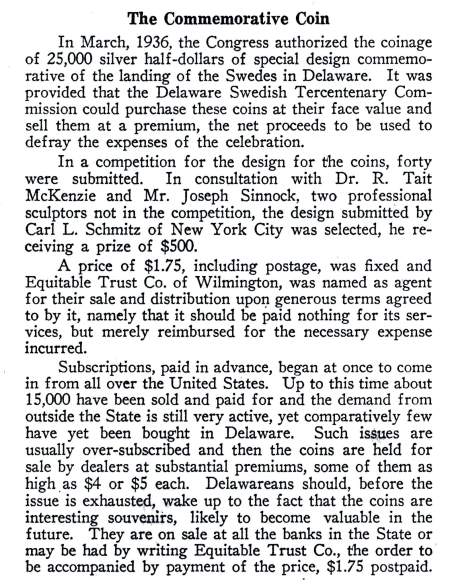
As described in the above, the sponsoring organization for the commemorative half-dollar was the Delaware Swedish Tercentenary Commission (DSTC), not the Delaware Tercentenary Commission (DTC). The DSTC was the first Tercentenary Commission to be authorized by the State of Delaware (in 1935). Its mission was to begin the planning for the 1938 celebration, including how to raise the necessary funds. Getting Congress to authorize a commemorative coin was one of the Commission's primary fund raising objectives - it achieved the goal in March 1936. The DSTC delivered its "Final Report" to the Delaware General Assembly in January 1937. In February, the Delaware Tercentenary Commission was created to complete the planning and execution of the 300th anniversary celebration.
Bulletin No. 2 - June 1937No discussion of the commemorative half-dollar was included, but the
Distribution of Coin committee was listed for the first time as one of several under "Special Committees." George Dougherty was listed as Chairman, with George A. Elliott, Jr. and Rodman Ward included as members.
Bulletin No. 3 - October 1937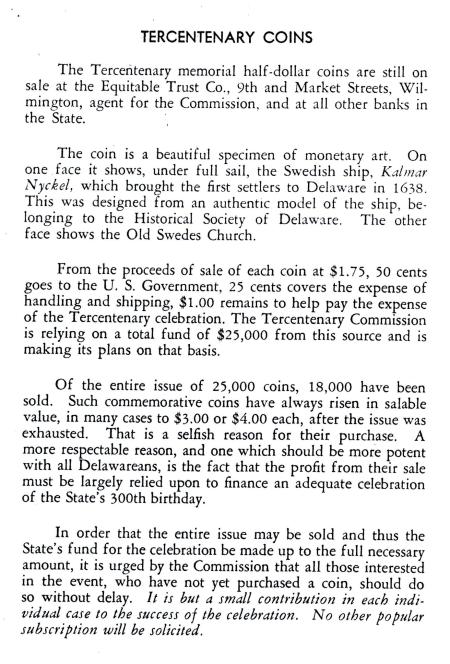
Based on this update, approximately 3,000 coins had been sold over the six months between April 1937 and October 1937. Considering the rapid sell-out of other US commemorative coins just a year or so before, the Delaware's sales seem indicative of the fact that the peak of the "commemorative boom" had definitely past. Upon initial inspection, I found it interesting to read in this
Bulletin that the Commission lowered its projections for the future value of their coin. In the April 1937
Bulletin (above), you likely noticed a secondary market projection of $4.00 to $5.00 per coin, but here, in October 1937, the forecast was lowered to $3.00 to $4.00 each. Another sign of the cooling market for commemoratives!
Bulletin No. 4 - March 1938No major discussion of the half-dollar, just inclusion in a general discussion about the Commission's souvenirs for the celebration. It was noted that about 20,000 of the coins had been sold to date, a figure that indicated sales of approximately 2,000 coins between October 1937 and March 1938 (about five months). Considering that about 4,000 of the 25,000 coins struck were returned to the Mint for melting, it would appear that the last few months leading up to the June 1938 anniversary celebration generated the sale of only about 1,000 additional coins.
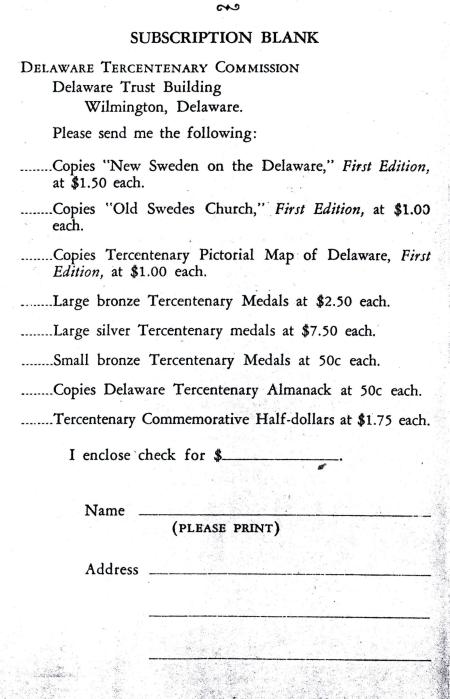
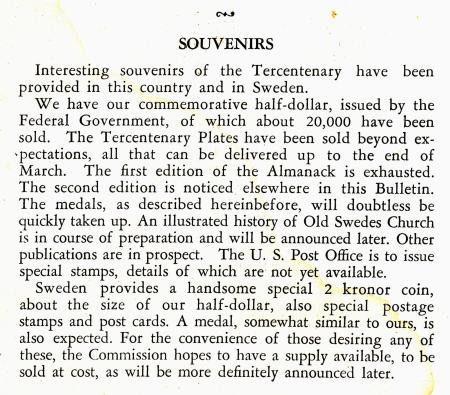 Bulletin No. 5 - May 1938
No updates regarding sales of the commemorative half-dollar, its only mention was inclusion on a "Subscription Blank" on the back panel of the
Bulletin. You'll also note on the form the Commission's commemorative medals and several of the publications it also sponsored/sold.
 Bulletin No. 6 - June 1938
The final
Bulletin issue focused on the schedule of events for the celebration and did not discuss any of the available souvenirs. Local banks continued to sell the coins for a time after the June 27, 1938 anniversary date but post-celebration sales do not appear to have been very strong.
I always find these contemporary, first-hand accounts of classic US commemorative coins an interesting read. Hopefully, you do as well!
1936 Delaware Tercentenary Half-Dollar - Obverse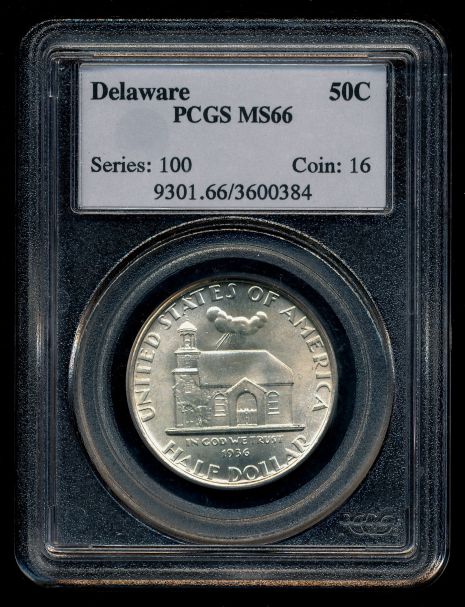 1936 Delaware Tercentenary Half-Dollar - Reverse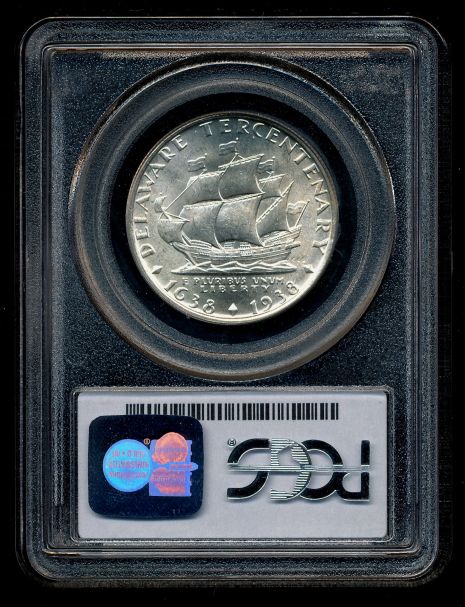







 Posted 07/01/2013 12:48 pm





