| Author |
 Replies: 9 / Views: 1,110 Replies: 9 / Views: 1,110 |
|
|
Valued Member
United States
122 Posts |
|
|
|
|
Bedrock of the Community
United States
62064 Posts |
Note the overall size of the devices? Does the area in question; reduce the size of the devices or enlarge them. Remember if the anomaly reduces the size of the devices, it is Machine Doubling. If the area in question is flat, shelf like; then it is Machine Doubling. Hub doubling enlarges the devices and show a rounding affect. So what do you think you are seeing in your images? |
|
Valued Member
 United States
122 Posts |
Looking at my pics it looks like Hub Doubling on "In God" but the R in Liberty looks more flat and shelf like where the othe letters look like HD ?
I was comparing my pics to the ones on varietyvista.
|
|
Pillar of the Community
United States
2624 Posts |
The top curve of the "GO" both show reduction of the device, no separation and no notching. It is MD.
|
|
Bedrock of the Community
United States
62064 Posts |
Here is an example of hub doubling. Note that the devices are formed twice on the die from the hubbing? 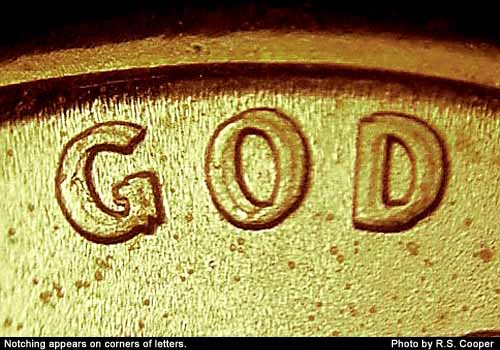 You see the notching in the corners, but note how much wider the devices are on this coin? Compared with your coin, the devices are actually reduced when you see the flat shelf like area. Like stepping down off a curb. This Machine Doubling is caused from a normal die, but with the slightest movement of the dies, it damages the devices. Making the shelf like look of Machine Doubling. Here is another example of Machine Doubling: 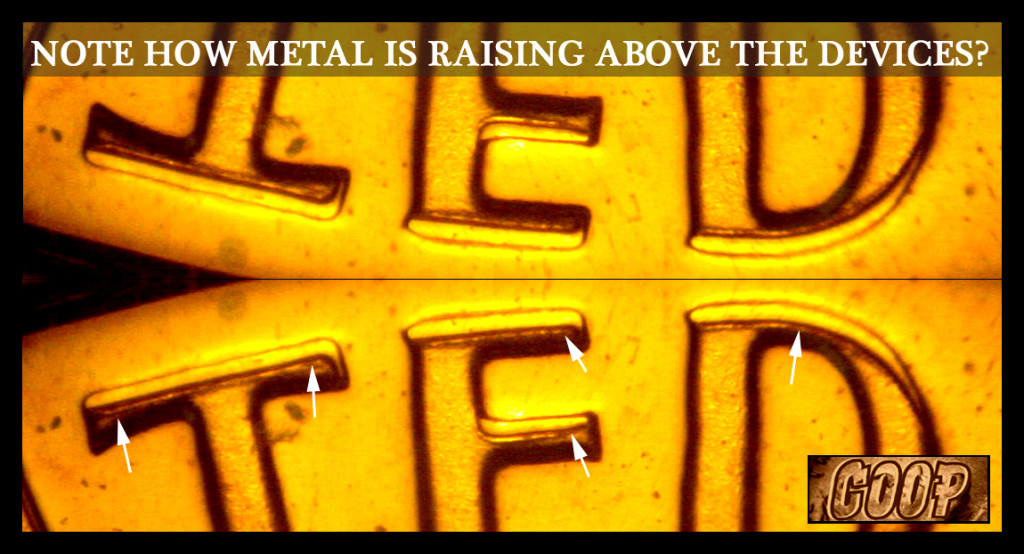 Note how the metal on the devices are pushed from the die movment. When looking at the tops of the devices, you can see the reduction and the flat shelf like appearance. The metal is so disturbed it is raising. I made a mirror image to show it better on the image above it. |
|
Valued Member
United States
122 Posts |
THANK YOU COOP for the above example... Things are starting to make a little more sense... As they say "Do you see the light ?"   Coop or anyone could you show me on this pic (If it is detailed enough)where exactly I would should be looking? Maybe using the arrows like Coop did in his above pic. |
|
Bedrock of the Community
United States
62064 Posts |
The Machine Doubling leaves a angled, step like, shelf look. In the areas you show a rounding, it is actually like a step on a sidewalk. The Machine Doubling damaged the devices. Sometimes at the bottom, sometimes higher up. This image might help by Jason Cuvelier:  From Coin Fishin' DVD. See if this helps. The Machine Doubling shows the step like distortion reduces the devices. The hub doubled die shows the roundness of both hubbing enlarging the devices. |
|
Valued Member
United States
122 Posts |
Things are starting to get a little more clearer now, Thank You, I usually pick up on things pretty fast but for whatever reason this is killing me...
|
|
Valued Member
United States
122 Posts |
|
|
Bedrock of the Community
United States
62064 Posts |
A lot better images. But now the glare is hiding what you want to show. You might try a curtain of typing paper. The light seems a little strong on the last image. Glare is not a good thing. I mentioned macro images about images that are taken through a scope/lens setup. Some cameras have that setup feature on the camera. But it helps to take images at a close distance. (1-2 inches from camera) But so far I'm not seeing hub doubling. Just more Machine Doubling that is more minor than you've shown before. When you find a doubled die, you will know it for sure. |
| |
Replies: 9 / Views: 1,110 |
|










 Posted 03/01/2014 12:23 pm


