Over the last couple of months, a shipwreck hunter Steve Libert has been in the news with his claim that he has located the remains of the
Griffon, Rene-Robert Cavelier, Sieur de La Salle's 17th century sailing ship that was lost in 1679 on Lake Michigan. Though Libert is confident that he has truly found the
Griffon, others are not as sure and further archaeological excavation is necessary to know one way or the other.
In any case, the story seems like a good reason to post about a commemorative silver dollar issued by the
Royal Canadian Mint back in 1979.
Upon its release, the
RCM described the subject of its annual commemorative silver dollar as follows: "the
Griffon, the first Canadian-built commercial vessel to sail the Great Lakes above Niagara Falls in 1679." While accurate, the brief description provides just the merest glimpse into the intriguing story of Le Griffon. Here's a bit more of the ship's history...
The
Griffon was built by La Salle on the banks of the Cayuga Creek on the Niagara River during the winter of 1678-79. It was built "in the wild" vs. in a purpose-built shipyard and is a testament to the skills of La Salle and his men. It is believed that the single-mast sailing ship was between 30 and 40 feet long, displaced approximately 45 tons and featured an armament of seven cannons. It was built as a merchant ship, primarily for the fur trade, but one that would be able to defend itself!
The ship embarked on its maiden voyage on August 7, 1679. It sailed through Lakes Erie and Huron and into northern Lake Michigan where it docked in the harbor at present-day Washington Island. At that point, La Salle and the majority of the ship's crew disembarked from the ship. La Salle intended to continue exploring the area while the
Griffon returned to his post on the Niagara River. The ship was loaded with over 12,000 pounds of furs collected by local traders and then departed, with minimal crew, on September 18, 1679.
The
Griffon did not complete its return voyage, however, and was never seen by La Salle again. It is unclear exactly what happened to the ship. Some believe it was lost in a storm, others say it was attacked by local First Nations people who killed the crew and burned it. La Salle believed that the captain and crew of the ship stole the furs and sunk the ship. To this day, a definitive answer still eludes historians.
The
RCM's 1979 commemorative silver dollar depicts the
Griffon on its reverse â€" or at least it depicts one possible version of the ship. The coin depicts a ship with two masts, likely based on a well-known antique woodcut of the ship (shown below). As noted above, however, current thinking is that the ship had just a single mast. The coin was designed by Walter Schluep.
17th Century Woodcut of The Griffon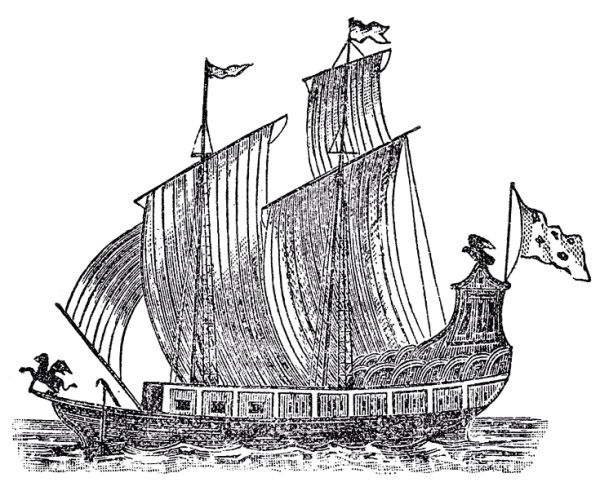 1979 RCM The Griffon Silver Dollar: Reverse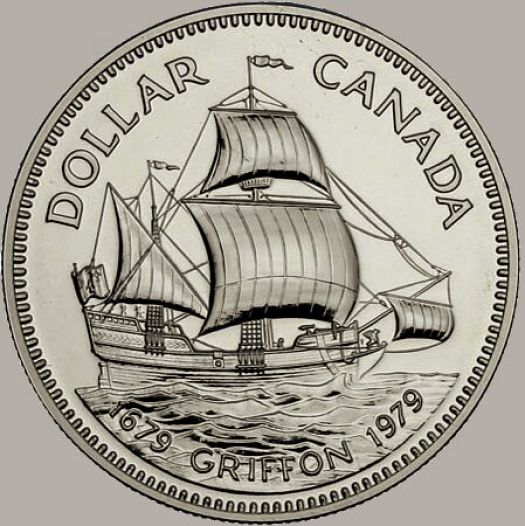





 Posted 07/28/2014 9:25 pm





