Coin Community Family of Web Sites Join Thousands of Coin, Bullion, & Money Collectors
Join Thousands of Coin, Bullion, & Money Collectors Coin, Banknote and Medal Collectors's Online Mall Royal Estate Auctions - $1 Coin AuctionsSpecializing in Modern Numismatics Royal Canadian Mint products, Canadian, Polish, American, and world coins and banknotes. Vancouvers #1 Coin and Paper Money Dealer 300,000 items to help build your collection!


Username:
Password:
Save Password
Forgot your Password?


This page may contain links that result in small commissions to keep this free site up and running.

Welcome Guest! Registering and/or logging in will remove the anchor (bottom) ads. It's Free!

Coinage As An Academic Tool: Coin Distribution Studies.

To participate in the forum you must log in or register.
Author Previous TopicReplies: 11 / Views: 1,626Next Topic  
Valued Member
MichaelS's Avatar
Netherlands
59 Posts
 Posted 08/03/2014  08:29 am Show Profile   Bookmark this topic Add MichaelS to your friends list Get a Link to this Message Number of Subscribers
Hello everybody.

Many of you are pleased to collect, trade and identify coins and gather the stories behind them - and rightfully so. Coins are indeed fascinating in their own right. I was wondering who uses numismatics to answer academic questions, perhaps not necessarily related to the coins themselves. I'd like to start off by giving a small example of my MA thesis

During my MA programme in archaeology however, I became interested in coinage and their distribution patterns as a potential proxy for activity (habitation of areas, exchange, et cetera) and site formation processes that make coins come to light (or obscure them). This I will do by using Geographical Information Systems to analyse the coins in relation to certain landscape layers (geological, topographical, hydrological, etc.), such as the paleogeographic map of the Netherlands of +- 800 AD. I am particularly interested in Carolingian coinage (roughly 750 to 950 AD) in the Netherlands. My thesis is nearly finished and I'd be glad give a superficial sneak peak at a type of analysis.

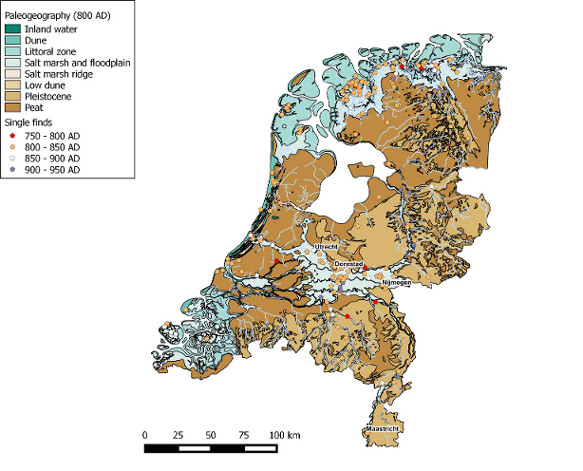
I give the example of the paleogeographic map of the Netherlands. When I started off, I had some basic hypotheses about where distribution was likely to take place.
* I expected very few coins around areas rich in peat and sand. Peat (large areas of the west and north of the Netherlands) was detrimental to farming and habitation, and those areas are assumed to have been sparsely inhabited. Sandy pleistocene cover sand regions were supposedly at least somewhat inhabited during the early Middle Ages, but sandy soil mineralised soil appears to heavily corrode coins in combination with water. Though the areas were inhabited, fewer coins are expected.
* I hypothesised a strong correlation with floodplains in riverine areas and near the coast. Both the sea and the Rhine and Meuse rivers were arteries of trade during the Carolingian era (as they were before and after). River banks were popular places for habitation. Especially Dorestad - the premier trade emporium of the Carolingian era - is expected to be rich in coins, as are areas near the sea as Frisians (very active traders) lived on artificial mounds within the bountiful salt marshes near the sea.
* Obviously, a correlation with current urban areas can be expected, as many urban areas were also populated during the middle ages. Perhaps even more importantly, this is where detectorists will readily search.

All these basic hypotheses proved to be correct, as the following picture will show.
Coinage-As-An-Academic-Tool:-Coin-Distribution-Studies.

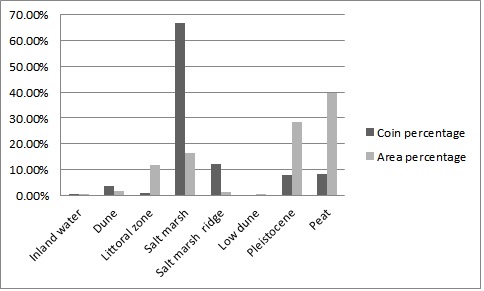
And the corresponding statistics. This shows the size of the paleogeographic areas in relation to the entire Netherlands (which should be equal to the amount of coins found in those landscapes if distribution was equal or random). It also shows the 'real' percentage of coins found in each geographical feature. You can easily sea that the riverine/sea areas have an abundant amount of coins, whereas areas rich in peat and sand do not.
Coinage-As-An-Academic-Tool:-Coin-Distribution-Studies.

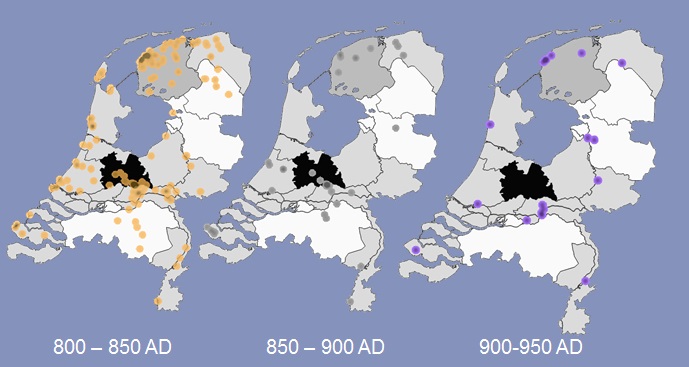
Last example is a game of 'spot the differences' with time slices of 50 years.
Coinage-As-An-Academic-Tool:-Coin-Distribution-Studies.

Easily seen in the latter two time slices is that distribution near the coastal areas almost completely ceased except for some remnants in the province of Friesland (top left province). The possible ‘trade route' or line of coins visited in Noord-Brabant (the southern middle province), or indeed any activity in Noord-Brabant ceased as well.

Especially striking is the last image complete absence of coins in Utrecht, including Dorestad - - " consequently, Tiel (slightly south of Dorestad) remained active. The last remaining vestiges of coins are mostly inland, and some interesting appearances can be seen in both Zwolle and Zutphen along the IJssel river. There are of course many reasons for these changes in distribution during these 150 years.

Hopefully this was not too boring. This is of course extremely superficial as I will not bore you with my entire thesis, but coin distribution in combination with statistical packages can be incredibly interesting for both practical reasons (where can I expect certain coins?) and theoretical (why did distribution exist and change the way it did?).

Thank you for your attention. I'd really love to hear if anybody else uses coins as a tool to ask questions in relation to societies too. This need not be distribution analysis, obviously - it's just that GIS and statistics is something I greatly enjoy in combination with archaeology. In the future I hope to apply similar methods to Anglo-Saxon, Frisian and Roman coinage. I'm a bit of a GIS geek, so if anybody needs help with making presentable maps or analyses please do not hesitate to ask.


Edited by MichaelS
08/03/2014 08:40 am
Pillar of the Community
pishpash's Avatar
United Kingdom
3626 Posts
 Posted 08/03/2014  10:06 am  Show Profile   Bookmark this reply Add pishpash to your friends list Get a Link to this Reply
It is not boring Michael, but it is a lot to take in. I am not familiar with the names of the areas in the Netherlands so the maps are a little difficult for me. I assume that the plundering of coins by detectorists that don't report the finds would have a bearing on the results?
Valued Member
MichaelS's Avatar
Netherlands
59 Posts
 Posted 08/03/2014  12:11 pm  Show Profile   Bookmark this reply Add MichaelS to your friends list Get a Link to this Reply
I can imagine that mentioning Dutch provinces are confusing. My thesis obviously introduces this much better for an international audience.

It is true that this picture only shows the coins that detectorists submitted to NUMIS, our national coin-find database. This might slighly affect the picture I presented, but I assumed that the coins that were submitted were a representative sample of the entire 'population' of coins. I have no reason to think that people in Limburg (the southernmost province) would be more lax in submitting coins than people from Utrecht or Friesland.

Thanks for your response!
Pillar of the Community
Kamnaskires's Avatar
United States
7066 Posts
 Posted 08/03/2014  1:07 pm  Show Profile   Bookmark this reply Add Kamnaskires to your friends list Get a Link to this Reply
With regard to Michael's question about "who uses numismatics to answer academic questions": In my own teaching (of college-level visual arts) I use selected series of ancient coins to support my lectures on modes of abstraction. Contrasting the portraiture on coins of the early Roman Empire to the depictions on Late Roman bronzes, or following the gradual transition from Greek-inspired realism in early Parthian coinage to the simplified, linear visual vocabulary of late Parthan coinage, serves the purpose well â€" as does contrasting Celtic depictions to their original Greek sources. In each case we discuss how the formal devices have been adjusted from the earlier coinage to create the more abstract styles. It provides useful food for thought as I move students into abstraction, and it's a good way to sneak a bit of history into a class of city kids who, for the most part, lack substantive historical knowledge or appreciation.
Pillar of the Community
United States
3444 Posts
 Posted 08/03/2014  1:07 pm  Show Profile   Bookmark this reply Add FVRIVS RVFVS to your friends list Get a Link to this Reply
I would think the periods to which finds are associated would proportional to the relative amounts of violence occurring in the area.
Areas such as those prone to being 'sacked' (Vikings perhaps ?) would have more reasons for coins to be buried away for safe keeping or even of the plunder being 'lost' in the circumstances of war (ie "you sunk my battleship !").
Areas like the Balkans seem to have become quite productive of 3rd & 4th century material when the levels of violence and pillage depopulated vast areas.
Our joy of owning an ancient coin may well mirror the pain and sorrow of people who lost everything they owned. Even their lives !
Pillar of the Community
Learn More...
Victor's Avatar
United States
905 Posts
 Posted 08/03/2014  1:40 pm  Show Profile   Check Victor's eBay Listings Bookmark this reply Add Victor to your friends list Get a Link to this Reply

Quote:
I was wondering who uses numismatics to answer academic questions


I wrote my master's thesis "Constantine the Great: The Coins Speak on bronze coinage of Constantine the Great in an attempt to demonstrate how ancient coins can be another primary source for the historian.
Moderator
Learn More...
echizento's Avatar
United States
23731 Posts
 Posted 08/03/2014  1:52 pm  Show Profile   Bookmark this reply Add echizento to your friends list Get a Link to this Reply
While I've never use coins in teaching, solely a collector. I find your thesis interesting and would enjoy reading it when it is published.
Pillar of the Community
Ben's Avatar
United Kingdom
4208 Posts
 Posted 08/03/2014  5:40 pm  Show Profile   Bookmark this reply Add Ben to your friends list Get a Link to this Reply
An interesting subject. Interesting how few find sites there are (even in total).

They are actively doing this in England with the PAS. There's a great mystery - where was Caruasius' 'C' Mint? There are several cities it could be. They hope to nail it down using distribution (and also tie the RSR and BRIT mint marks to a location) - I had a unique coin from the C mint, which I had recorded (it now sits in the British Museum and I've got a good few weeks of food at uni to remind me of it), but unfortunately its find location hadnt been noted (it had made its way into a batch which seemed to be a mix of coins from Ludlow and Norfolk).
Valued Member
MichaelS's Avatar
Netherlands
59 Posts
 Posted 08/05/2014  10:18 am  Show Profile   Bookmark this reply Add MichaelS to your friends list Get a Link to this Reply
Bob L: That sounds very interesting. I'm afraid I know very little about visual art, and I have to shamefully say it's probably the area of archaeology that I was always least interested in due to so many wishy-washy theories being applied. The way you present it sounds interesting however. Can you recommend me any good books in particular?

FVRIVS RVFVS: Good observation. I have to note that there is a difference between single finds and hoards. The finds you refer to that increase during tumultuous periods are usually hoard finds, indeed for storage and safekeeping. Part of a chapter in my thesis discusses these, and these do increase during the 840s AD - the start of heavy viking raids in the Netherlands. Single finds (my main topic) have little to do with this, and are primarily found when coins were abundant in the economy. On a more emotional note; good point. I never really stopped to realise that some if not most of our joy in ancient coins is built on the suffering of very real people. Weird to think about.

Victor: As the Constantine era is among my favourite Roman periods, I would love to have a glance at your thesis. Is it on academia.org somewhere?

echizento: I'll gladly send it when it's finished! I have to warn you though; it's sometimes statistically heavy. You'd probably best be off just reading the introduction and discussion. But we''ll see in due time.

Ben: Interesting! I just took a look at PAS as I had not heard of it. I love how the UK handles its heritage, which is one of the reasons I'd like to focus future studies on Britain.


Edited by MichaelS
08/05/2014 10:19 am
Valued Member
United States
61 Posts
 Posted 08/06/2014  9:00 pm  Show Profile   Bookmark this reply Add rasiel to your friends list Get a Link to this Reply
This is a great use of coinage. Really wonderful data there! I doubt metal detectorists are skewing the data unless you could prove that they're selectively retrieving some coins and leaving others behind. Here the most important factor is possessing a large enough data set. Once your database is populated enough that you can use it to predict dispersion patterns to within an acceptable margin of error it becomes a great tool. And it looks like this is a perfect example of such!

I would only question coming to the conclusion of regionalized depopulation, as above, without knowing with certainty that the coinage wasn't evenly distributed elsewhere. In other words, during the period 850-950 were the coins appearing in some other location uniformly or could it be perhaps that there was a drop in the output of coinage and the data set is not sufficient? If we assume that in each of the three periods there was a known constant (just that they're not appearing in THIS area) then the conclusion should be correct.

Ras
Valued Member
United States
61 Posts
 Posted 08/06/2014  9:10 pm  Show Profile   Bookmark this reply Add rasiel to your friends list Get a Link to this Reply
Ben, there may yet be some controversy about the C mint (which most assume is just Camulodunum (Colchester)) but RSR is not a mint at all. It's now known for sure to be an acronym for "Redeunt Saturnia Regna" - a key phrase in a poem by Virgil that alluded to rebirth. This was apparently Carausius' personal motto and, coincidentally, another phrase from the same poem is used on our dollar bills where the eye on top of the pyramid is!

Ras
Valued Member
MichaelS's Avatar
Netherlands
59 Posts
 Posted 08/07/2014  04:49 am  Show Profile   Bookmark this reply Add MichaelS to your friends list Get a Link to this Reply
Hi Rasiel, thanks for your wonderful feedback. Your first paragraph was very encouraging (as I do worry about data representativity), and your second paragraph made me think. Yes, there are some caveats to the conclusion, which was presented simplistically in my original post.

The interesting thing is that even with the lack of data in these later two time slices, the results here very clearly appear to be congruent with the historical sources. Dorestad (in the middle province of Utrecht) was, together with being the primary trade emporium during the Carolingian era, also one of its primary mints. Its decline and subsequent fall (attested in sources and archaeology) will therefore correspond with the drop of output you mentioned, as it may be responsible for that drop of output.

Although fewer in number than ever before, coins continue to be found in Friesland and Groningen (the northernmost provinces). Interestingly, coins are found along the IJssel (a river in the east) in near the towns of Zwolle (province of Overijssel) and Zutphen (province of Gelderland), towns that would become trade centres of some importance in the high and late Middle Ages.

After the date of 864 AD, no coins minted in Dorestad were found in West Frankish hoards, nor were any coins minted by Charles the Bald found in Frisia after 864 AD. Dorestad ceased minting in 855 AD, leading to a shortage of silver in Frisia reflected in a drop of hoards, which were thereafter included more gold coinage by Frisians and Arabic silver imports by Danes (Coupland 2006, 262). All of these, according to Coupland (2006, 262) are signs of poverty.

So your critique is very valid and something I have to take in consideration more than I did previously. That said, I am still convinced that this changing pattern of circulation is not a random happenstance of poor data, but a very real change in distribution perhaps exacerbated by poor data. It is also a shame I have no access to records of the Arabic silver imports mentioned.

Thank you again for your remarks! Since I hope to publish a shorter version of my thesis to a numismatic journal in the hopes of increasing my chances for a PhD, comments from expert numismatists are always welcome.


Edited by MichaelS
08/07/2014 04:54 am
  Previous TopicReplies: 11 / Views: 1,626Next Topic  

To participate in the forum you must log in or register.


Disclaimer: While a tremendous amount of effort goes into ensuring the accuracy of the information contained in this site, Coin Community assumes no liability for errors. Copyright 2005 - 2026 Coin Community Family- all rights reserved worldwide. Use of any images or content on this website without prior written permission of Coin Community or the original lender is strictly prohibited.
Contact Us  |  Advertise Here  |  Privacy Policy / Terms of Use

Coin Community Forum © 2005 - 2026 Coin Community Forums
It took 0.34 seconds to rattle this change. Forums
