| Author |
 Replies: 20 / Views: 2,991 Replies: 20 / Views: 2,991 |
|
Pillar of the Community
1121 Posts |
|
|
|
|
Pillar of the Community
3772 Posts |
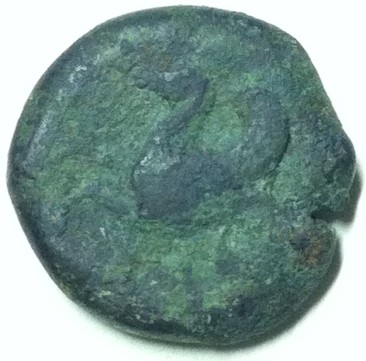
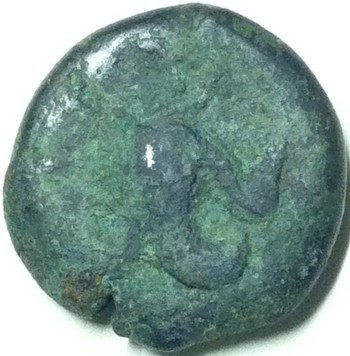
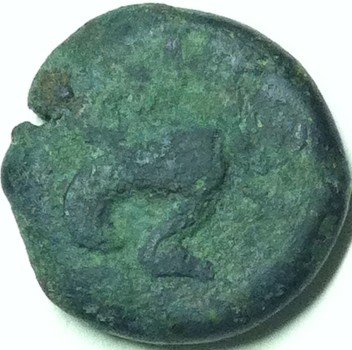
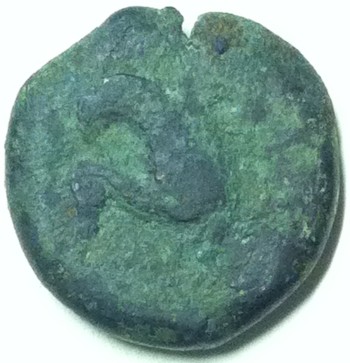
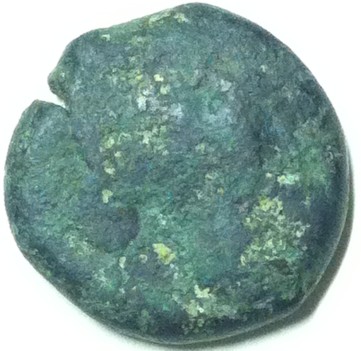
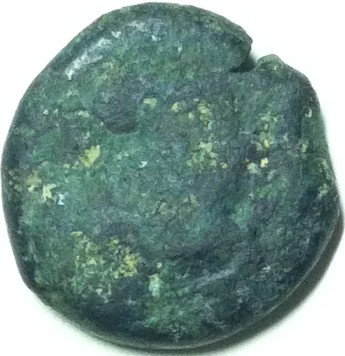
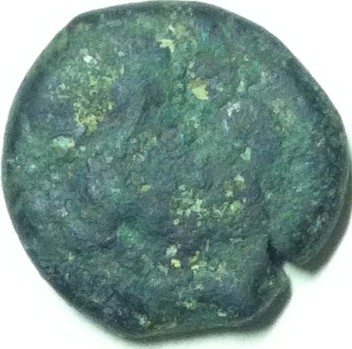
You really need to somehow ensure that more detail is visible.
Coins with Pegasus on one side (usually reverse) and the head of a god/goddess or ruler on the other can be found in several places.
Could be from some place in Greek Italy, Sicily (eg Syracuse) or the Macedonian Kingdom (to name just a few).
|
|
Pillar of the Community
 1121 Posts |
I take your comment Medieval, and after some searching I find that the greatest use of Pegasus in this pose seems to be from Corinth(ia).
Are you aware of any other area/time when the image of Pegasus was used thus?
|
|
Pillar of the Community
3772 Posts |
The easiest guide I know off to give you a quick start is "Richard Plant's Greek Coin Types and Their Identification".
(Have a copy somewhere but not on hand, still not unpacked everything from last move.)
But this gives you only a pointer where to look, in the end you need sufficient detail to properly identify the coin; and that means doing some reasonable work on the coin. In the end you want to get a very clear description or (better) an image to compare the coin to. If you are lucky you are able to pin it to an entry in a summary catalogue/book like Sear's. Otherwise you might have to go into BMC or the SNGs. There is a massive diversity of greek coins and if you want to be certain you have to spend some time for identification, especially if you have no part of an inscription.
My suggestion is to put this coin aside until you have developed some experience with identifying greek coinage. To develop that it helps to go through some reading material. What books on Greek coinage do you have (if any)?
Edited by Medieval
10/01/2014 08:17 am
|
|
Pillar of the Community
United Kingdom
3626 Posts |
I have Richard Plant's book and I can recommend it. I don't find every coin but it is a good starting point. If you plan on buying Greeks in the future, it is worth the investment.
|
|
Valued Member
United Kingdom
183 Posts |
it could be a hippocamp reverse?
HH
|
|
Pillar of the Community
1121 Posts |
Hi, Medieval, I have looked up Richard Plant's book, but before I invest $60.00 (cheapest) I would like to look into it further.
|
|
Pillar of the Community
3772 Posts |
Quote:
but before I invest $60.00 (cheapest) I would like to look into it further. You have to decide how serious you want to get about collecting Greek coin and how often you are going to buy Greek coins which are not or poorly identified/described. (*) Until you have yourself relevant reference material you might want to look what is available in accessible libraries (or what your local coinshop has on hand). The two key coinshops in Sydney where I got a lot of coins from had quite good reference material on hand, especially one of the dealers had himself a huge library and being on friendly terms lent me some (including Mitchiner, RIC and Cologne) for weeks on end. There is also a very good selection at Sydney University, spent quite a few days there leafing through BMC and various SNGs etc). (*) If you are lucky enough you have access to a coin dealer who has a bargain box of low grade but identifiable ancient coins or get auction lots which are not at all or partly identified. (Have seen quite a few attribution mistakes in auction lots as well, so always good to verify yourself.) |
|
Valued Member
United Kingdom
435 Posts |
I agree with HawkHybrid. The reverse is a Hippocamp. There are a limited number of commoner Greek types with a similar Hippocamp reverse. I suspect this one might be a coin of Solus, Sardinia, struck in the 4th century BC, similar to this one, with a young Herakles obverse. 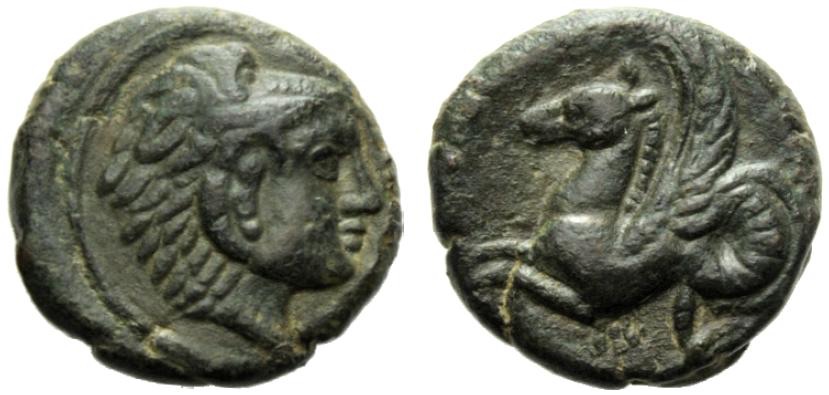 But it is difficult when the coin is so worn. If you don't know of it already, you might find the ACSearch website useful. It has a good search engine and is useful for finding types. Here is the address: acsearch.info Another possibility is a Syracuse litra with Athena obverse, but I personally think that that worn image is less likely a match for this, though the reverses appear similar. If it is the Solus type, then it is quite scarce and an interesting addition, even though worn. Edited by Valecrucis
10/02/2014 08:00 am
|
|
Pillar of the Community
1121 Posts |
Hi, Valecrucis. Welcome to the forvm. I appreciate the input, but I am afraid that the gap between the nape of the horse's neck and the wing (in your picture) is so different between the two coins, I cannot go with you on this one. If you look up Pegasus, Corinth you will find a whole bunch of coins that are a deal closer in appearance. Like . . . 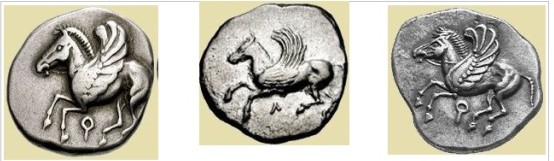 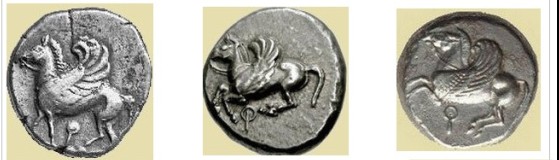 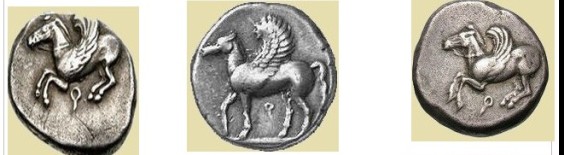 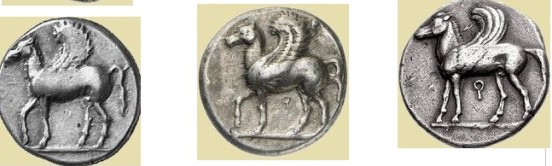 But I cannot see the 'post' in front of Pegasus in any of them that I can see on my coin. So I am lost. |
|
Pillar of the Community
United States
2480 Posts |
Topcat, I'm afraid further attribution is a hopeless cause. One side of your coin shows a winged creature, probably Pegasus or a hippocamp. The other side is too far gone to say. Since so many places issued coins with Pegasus (few issued hippocamps), narrowing it down further would just be a guess or wishful thinking.
|
|
Valued Member
United Kingdom
435 Posts |
Hi Topcat7... Nice to meet you. I am not sure that the gap you mention matters so much. If you search in ACSearch for Solus and Hippocamp you will see quite a variety of gaps, some of which match the one on yours. I can't, however, see a clear tail of a hippocamp on your coin so that is a better reason for suspecting the Solus option might be incorrect IMHO.
My reason for considering the Hippocamp particularly is the wide spread of the legs in a kind of splayed gallop...which is more typical of a hippocamp than a Pegasus.
The simple truth is that when the coin is so worn, 2D images make it even harder to reach any conclusion. Having the coin in hand and being able to alter the angle of lighting automatically gives a considerable advantage. Truth is, you are in the best position to judge...that is if there is any hope at all of attribution.
Edited by Valecrucis
10/02/2014 08:26 am
|
|
Pillar of the Community
1121 Posts |
TIF. I am sure you are right.
V.C. Point taken - I was hoping that someone with more knowledge than me (most everyone) would come in with "I know what it is . . . ."
I have several coins that fit this scenario, (too far gone for me to identify, but maybe someone else might know).
I will put them up from time to time and see how I go with them.
Who knows. When my Richard Plant book arrives perhaps I shall become more adept at identifying my coins myself.
Thanks, all.
Edited by Topcat7
10/02/2014 4:22 pm
|
|
Pillar of the Community
United States
2480 Posts |
Man, I hate to give up on this coin soldier so I took another look. I agree with HawkHybrid and Valecrucis. It is a hippcamp. Given the flan shape, thickness, weight, and visible details of the reverse, my best guess is that it is a litra from Sicily, Syracuse, in the time of Dionysos I. I still can't say for certain the obverse orientation, much less what it is. I think it may have been Athena though. Your coin: 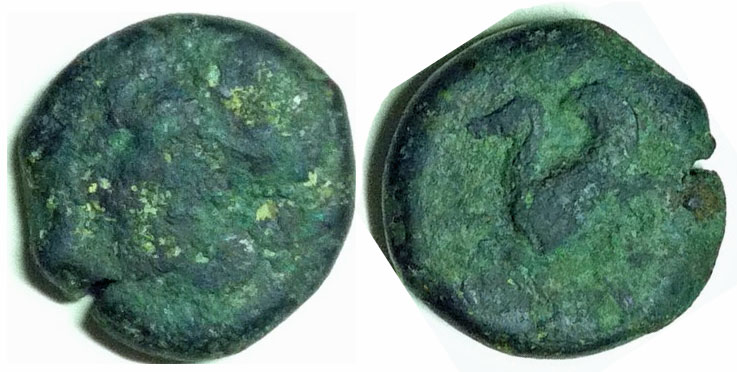 Some examples from CNG's archives: 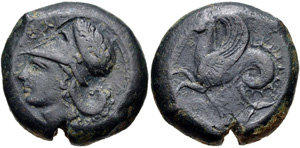 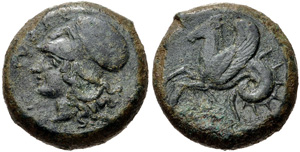 An example of attribution for the types shown above: SICILY, Syracuse. Dionysios I. 405-367 BC. Æ Litra (19mm, 9.19 g, 12h). Struck circa 400-390 BC. Helmeted head of Athena left / Hippocamp left, wearing bridle. CNS 45; SNG ANS 436- - "46; HGC 2, 1456 Obviously, we won't ever be certain of the precise attribution for your coin but I do think it is from Syracuse around that time. The denomination nomenclature varies. In some places I've seen this weight called a hemilitron and others a litra. I think it's a litra; the hemilitrons weigh less (duh). I would like to have checked Wildwinds but once again that site is not working for me. A check of isitdownrightnow.com says Wildwinds is working. I have this problem quite often and suspect my general IP address range and location is being blocked. I don't feel like hassling with a proxy server. Anyway, go to Wildwinds > Greek > Syracuse, Sicily and check through the extensive listings. Edited by ThisIsFun
10/02/2014 6:04 pm
|
|
Pillar of the Community
1121 Posts |
I admire your tenacity, TIF. I purchased this coin (and a couple of others) as coins attributed to 'Himera and Cyracuse' (if that helps).
In the first photo of (my) horse, I can clearly see what I believe is a straight line running North/South in front of the horse.
Could it be a post of some sort? Would that assist in attributing the coin?
(I am off to Wildwinds>Greek>Syracuse,Sicily)
|
|
Pillar of the Community
United States
2480 Posts |
Quote:
I can clearly see what I believe is a straight line running North/South in front of the horse. I don't see it. Quote:
I purchased this coin (and a couple of others) as coins attributed to 'Himera and Cyracuse' (if that helps). Unless you purchased it from David Sear or some other extremely experienced ancient numismatist, that doesn't help and probably only hinders by sending you in the wrong direction. I'm certainly no expert but have been a bit dismayed in recent months when I check the attribution of every Roman Alexandrian coin I see at auction (I have Emmett's book). I find mistakes in almost half of them, some minor, some major. Edited by ThisIsFun
10/02/2014 6:02 pm
|
| |
Replies: 20 / Views: 2,991 |












 Posted 10/01/2014 07:17 am


