| Author |
 Replies: 15 / Views: 3,303 Replies: 15 / Views: 3,303 |
|
|
Valued Member
United States
119 Posts |
HI all,,Well on week two of looking at coins and learning alot so far, many thanks goes out to all who responed to my post and showed me the way. Is this an example of a filled die?   |
|
|
|
Valued Member
United States
145 Posts |
Can't really tell by the picture but kinda looks like some type of gunk on the coin. Could be glue, solder or any of a host of other substances. Here is an example of a filled die error. 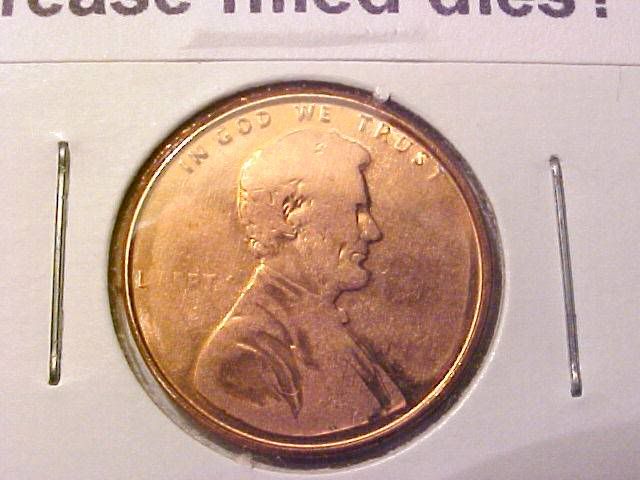 |
|
Pillar of the Community
United States
2254 Posts |
I could be way off base here in my assumption, so take it with a grain of salt and wait for our experts. But, I thought a Grease Filled Die would just limit or hide details, in essence plug/clog up the design, and not actually "add" substance to the coin. In your pictures, as Jorgy stated, it seems like something is on top of the coin. |
|
Pillar of the Community
United States
914 Posts |
You're right tights. Grease Filled Dies eliminate details such as the 'L' in liberty. The first coin looks like glue, the second coin looks sanded with a belt sander. |
|
Valued Member
 United States
119 Posts |
thanks for the info,i took a toothpick and was able the rub off the junk alittle. being new to coins just afraid todo anything, I got some much to learn
once again thanks
Eric
|
|
Pillar of the Community
United States
6406 Posts |
I believe this 1970-D dime is an actual filled die error, found in change and not belt-sanded (at least, not by me!). The blank area has a slightly bumpy texture which I believe is often seen when the filled die is caused by grease. 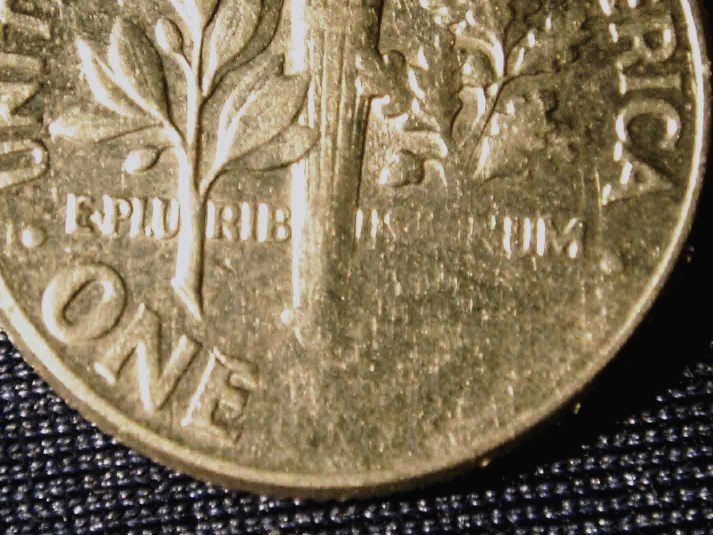 |
|
Bedrock of the Community
United States
62064 Posts |
I believe the proper term for grease filled is "Strike through error." Not Jorgy coin doesn't look sanded to me. The rim is full. If it had been sanded, the rim would have been taken off also. I would like to see an image of Jorgy reverse on his coin to see if it is a normal strike. That would tell more at this time. Often a filled die is refer to a letter/mint mark that the center has broken from the die. It makes the outside of the letter but not the center. Thus a die break not a filled die.
Edited by coop
12/14/2007 4:38 pm
|
|
Valued Member
United States
145 Posts |
<<The first coin looks like glue, the second coin looks sanded with a belt sander.>> Vaslin, The coin is not sanded it is " Struck Through Grease". I know for sure it isn't sanded due to the fact that I got it directly out of a mint sewn bag of 1995p that I opened searching for 1995 DDO's (of which I didn't find) :-( I did find 4 of the struck through cents but the one in my first post is the one with the most detail missing. Here are 3 of them with their respective reverses. Sorry for the cruddy pictures but I just took them free hand. Hope they aren't to big for the forum.    |
|
Pillar of the Community
United States
914 Posts |
First off, I know 0% about filled dies. So thanks for the additional pictures.
But, the second reverse realllly looks sanded. I think I can even see the direction that it was sanded in.
|
|
Valued Member
United States
145 Posts |
They do kinda have what in the photos look like sand marks but in hand it is very obvious that it's not . Also if they were sanded enough for the lettering/numbers to be gone there would be zinc showing as the plating is to thin on cents to sand them off without exposing the zinc core. Here is one I just sanded lightly to highlight the difference that a sanded cent has to the ones I posted. As you can see very little detail is removed before lots of zinc shows. Compare it to the other coins that have zero zinc showing. Hope this helps.  |
|
Pillar of the Community
United States
914 Posts |
That helps tremendously! Thanks for the education Jorgy!
|
|
Pillar of the Community
United States
2600 Posts |
Jorgy, sure not trying to be a contrarian, but I just don't know. I have dozens of examples of a strike through missing everything from one letter to almost complete devises and they are just gone. There is no change to the surface of the coin, just a missing devise. On your examples, the surfaces look rubbed or polished and I am trying to understand why. I would like to try rubbing with a piece of emery cloth, something barely abrasive and see what result I get. I could avoid hitting the rim this way and still work on the coin surface. Anyway, something just seems weird. Jim  |
|
Valued Member
United States
145 Posts |
Jim1953, Try the emery cloth and see what happens. You will find that the copper disappears and the zinc shows long before the letters/numbers do and no zinc shows on these coins. When a coin is struck through something it leaves an impression of what it was struck through. Most times on coins I have seen where just a letter/number or two are just gone it is from the devices getting plugged with junk so only those letters are affected. When a coin is Struck Through Grease or other substances on the face of the dies or planchet it leaves an impression on the coin where ever the contaminate is. And like I stated in a previous post, these came out of a mint sewn bag that I personally opened so if they were sanded it must be a new process at the mint ;-). Looking at the coins in hand it is obvious they are not sanded but I know the pictures make it look similar to sanding. Here is a couple of pictures taken with my QX3 at 60x. Top pic is of the reverse where it shows the area by "IBUS" and the "O" of "OF". The bottom picture is of the date area.  |
|
Pillar of the Community
United States
914 Posts |
Whew! Glad I'm not the only one Jim. I do wholeheartedly accept that Jaobler's dime is a Grease Filled Die. |
|
Bedrock of the Community
United States
62064 Posts |
You see the lines on current circulation coins that are not sand marks. I thought they were die scratches. But the flow into the deeper parts of the dies. If you open a roll of OBW coins you will find these lines in different directions, not just one like the die scratches on a die. I think this is on the planchet before striking and the lines don't disappear during striking. I've noticed it on Cents especially as that is what I search the most by rolls.
|
|
Pillar of the Community
United States
1571 Posts |
Coop, you just made my point. I have askd about these lines, particularily on very new, or AU coons that I thought were on the planchet prior to the strike. These lines won't dissapear during the strike. They are seen on top of the devices, now and then. But by the same tpken these "lines" can also be on the die, after it had been dressed after a clash, or other damage to the surface, but The lines on top of the devices, which are sub-surface, make a good argument for the scratches on the planchet.
Dick
|
| |
Replies: 15 / Views: 3,303 |
|








 Posted 12/14/2007 07:34 am


